News · Enterprise AI Governance · Workflow Automation
UK issues first cross-sector AI guidance for social care
The Department of Health and Social Care and the Department for Education published what they describe as the first cross-sector guidance on AI in children's and adult social care in England.
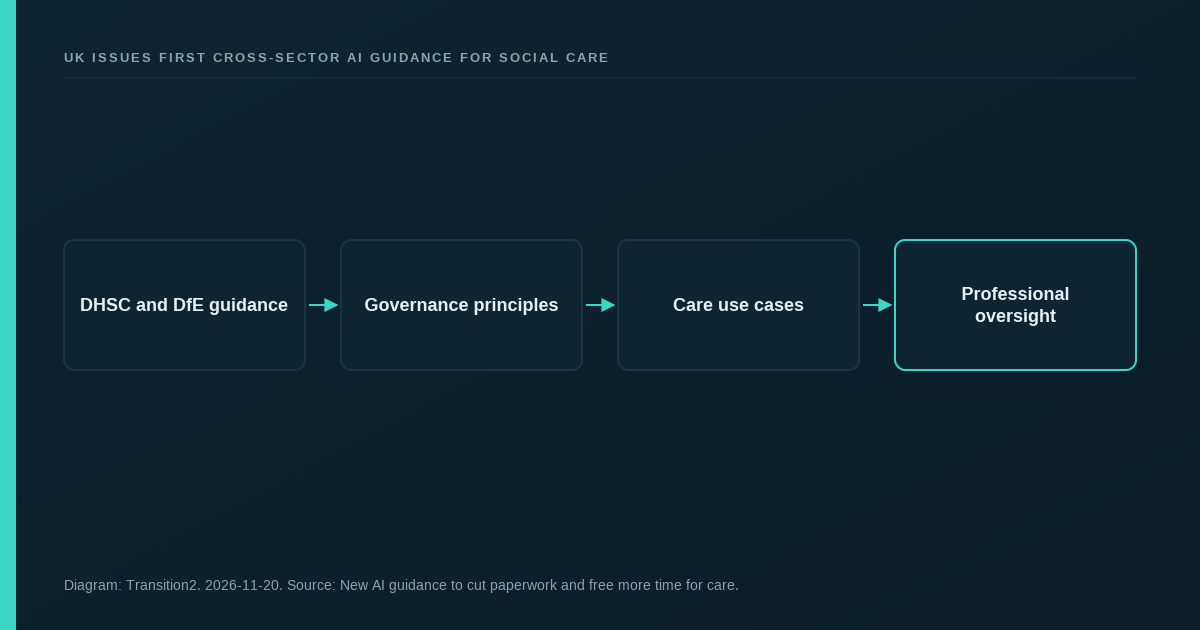
On November 20, 2026, the Department of Health and Social Care and the Department for Education published what they describe as the first cross-sector guidance on AI use in children's and adult social care in England (GOV.UK announcement, guidance). The non-statutory document is aimed primarily at local authorities and sets out principles on governance, accountability, data protection and professional oversight. The government points to council pilots that it says cut administrative time sharply, but it publishes no methodology for those figures.
What happened
The joint announcement from the two departments describes guidance that sets out principles on governance, accountability, data protection and professional oversight, plus practical advice for using AI in care settings (GOV.UK). Example uses include transcribing and summarising case notes, translating information, searching complex case histories, and identifying gaps in support.
The government backs the guidance with pilot figures. According to the announcement, a Swindon Borough Council adult social care pilot cut administrative time by 63%. Care Act assessment conversations fell from 1.5 hours to 30 minutes, and write-ups fell from 4 hours to 1.5 hours. The government also says Peterborough's "Hey Geraldine" assistant answered over 1,200 questions and saved about 15 minutes per interaction. Neither figure comes with a sample size or method.
The announcement also gives context on digital adoption. The government says 4 in 5 care providers now use digital social care records, covering almost 90% of people who draw on care (GOV.UK).
The announcement names Alison McGovern MP, Minister of State for Social Care and Mental Health, and Josh MacAlister OBE MP, Children and Families Minister. In that announcement, MacAlister said, "No technology can replace the knowledge and skill of a brilliant social worker." Isabelle Trowler, Chief Social Worker at the Department for Education, said the guidance recognises AI's potential "while keeping practitioners and their professional judgement central" and that organisations "must take responsibility for governing, implementing and supporting its use" (GOV.UK). DiarioBitcoin also reported the announcement.
Why it matters
The new guidance extends a single framing across adult and children's services, which share many of the same tasks: notes, assessments, translation and record searches (GOV.UK). With digital records in use at 4 in 5 providers, according to the government, many organisations already hold the kind of data these tools draw on.
The principles named (governance, accountability, data protection and professional oversight) put responsibility on the organisations deploying AI rather than on the tools. That matches Trowler's statement in the announcement that organisations must take responsibility for governing its use. The published guidance says AI-generated content should be treated as a first draft and reviewed, challenged and amended where necessary, and that AI should not make decisions that directly affect people, including decisions on risk, need, eligibility, safeguarding, care planning and intervention.
The savings figures need care. A 63% cut in administrative time is a large claim, and the government publishes no sample size or method for it (GOV.UK). They are best read as reported pilot outcomes rather than expected results elsewhere.
The Transition2 desk did not run an experiment for this story, because it concerns policy guidance with no schema or reproducible artifact.
What it means for businesses
Councils, care providers and the suppliers who sell them software now have a stated government position on how AI should be governed in this sector (GOV.UK). Suppliers of transcription, summarisation and translation tools will find their use cases named in the announcement. They should also expect buyers to ask how the products support professional oversight and data protection.
Buyers weighing the Swindon and Peterborough figures should measure locally. Record current time spent on assessments and write-ups before a pilot, then compare, rather than relying on unpublished methods. The Enterprise Governance hub covers how organisations can assign ownership for AI use, which is where the announcement places responsibility.
What it means for AI users
For practitioners, the published guidance says AI-generated content should be treated as a first draft and reviewed, challenged and amended where necessary, and that AI should not make decisions about risk, need, eligibility, safeguarding, care planning or intervention. Personal information should not be entered into publicly accessible AI tools, and AI should be used only with approved tools and in line with organisational and data protection policies (GOV.UK).
MacAlister's message in the announcement is that technology cannot replace a social worker's knowledge and skill. A summary or transcript produced by a tool remains the practitioner's responsibility once it enters a case record.
What it means for developers
Products for this sector need human review as a designed step, not an afterthought. The published guidance says AI-generated content should be treated as a first draft and reviewed, challenged and amended before use, so interfaces should make it easy to see what was generated, edit it and confirm it before it is saved. Accountability, one of the named principles in the announcement, is easier to meet when systems record who approved a generated note and when.
Data protection is the other design constraint. Tools that transcribe case conversations or search case histories handle highly sensitive personal data. The guidance says personal information should not be entered into publicly accessible AI tools, and that only approved tools should be used.
Copyright Eric MacDougall.
Sources
- New AI guidance to cut paperwork and free more time for care (accessed 2026-11-20)
- Reino Unido plantea una guia comun de IA para el cuidado social (accessed 2026-11-20)
- AI in social care (accessed 2026-11-20)