News · AI Reliability & Operations · Enterprise AI Governance
European Commission staff systems disrupted for over 10 days
Payslip, leave, medical reimbursement and translation services were hit, and reports citing unnamed sources say CERT-EU detected the AI pentest framework ARTEX.
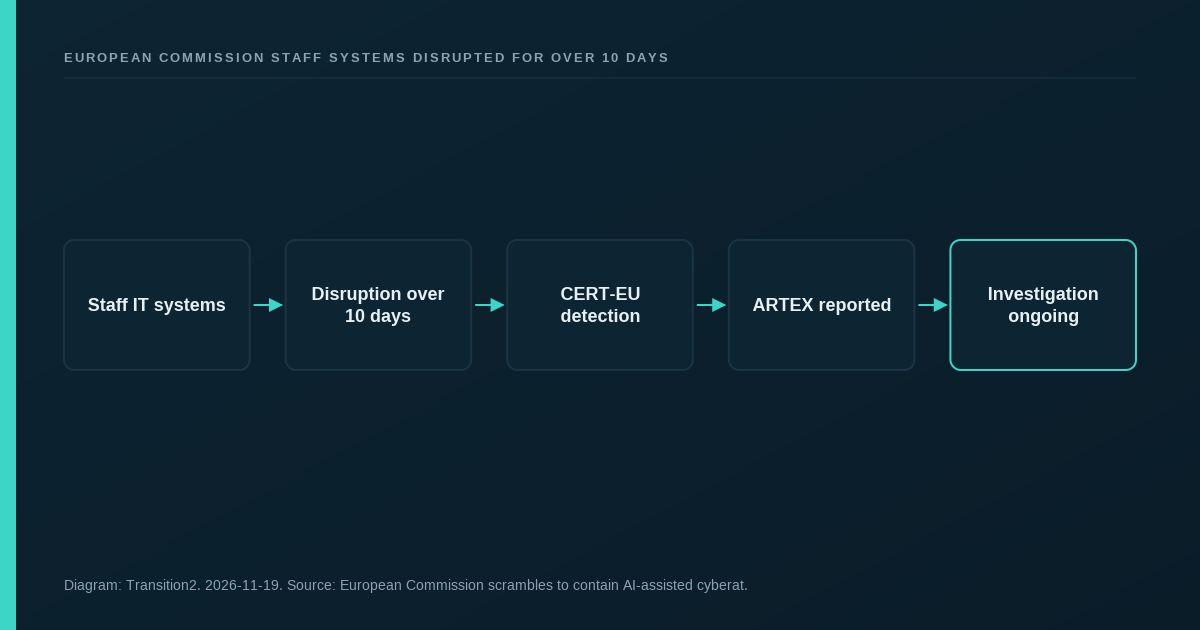
Attacks on the European Commission's internal IT systems have disrupted staff services for more than 10 days, according to reports published on November 19, 2026, by The Register, Security Affairs and Cyber Security News. Systems for payslips, timesheets, leave requests and medical reimbursements were affected, but salaries were paid on schedule. Politico broke the story, and citing its sources, the coverage says CERT-EU detected the use of ARTEX, a publicly available AI-driven penetration-testing framework. Whether any staff data was accessed or stolen is unconfirmed.
What happened
The disruption has run for more than 10 days and has hit administrative systems that Commission staff rely on every day, The Register reports. According to Security Affairs, the affected systems include Sysper, which handles payslips, timesheets and leave requests, and MyPMO, which handles medical reimbursements. Translation services went offline on November 17, according to Security Affairs and Cyber Security News. That date is when those services went down, not the length of the wider disruption, which the coverage describes as running for more than 10 days.
Recovery has been uneven. Sysper was restored earlier in the week and then went down again on Wednesday, November 18, Cyber Security News reports. Some staff could not submit timesheets or request leave, although salaries were paid on schedule, according to The Register. Security Affairs adds that the JSIS staff health-insurance portal was still down on November 19.
Commission spokesperson Thomas Regnier said that "individual systems were targeted" and that, in line with standard practice, the Commission had informed those concerned, as quoted by Security Affairs. The exact wording of the statement differs slightly between The Register and other coverage. Tech commissioner Henna Virkkunen briefed fellow commissioners on November 18, according to Cyber Security News. An unnamed EU official said the Commission believes it has contained most of the attack, but that the full extent of the damage is unclear, Security Affairs reports.
The AI element rests on sources that have not been made public. According to Politico's sources, cited across the coverage, CERT-EU detected the use of ARTEX (The Register, Security Affairs). The outlets state that detail with different degrees of confidence. Security Affairs calls ARTEX a "suspected" tool, while The Register describes the incident in its headline as an AI-assisted cyberattack. According to Cyber Security News, it is not established whether ARTEX was used to get in or only to look for weaknesses, and the attackers, the flaw and the access method have not been identified.
On data, the question is still open. Whether staff data was accessed or stolen is unconfirmed (Security Affairs, Cyber Security News). The Register says the attack potentially exposed staff data. This report treats exposure as unconfirmed because none of the coverage cited here reports a confirmation.
Two pieces of background matter for the tool. ARTEX's developer removed its repository in October, but copies and forks are still available, The Register reports. CERT-EU warned on November 5 that it had spotted what it believed to be ARTEX-assisted attacks, The Register reports. Security Affairs says the same 5 November note described ARTEX as a system that uses AI agents. The Transition2 desk covered the framework itself in its report on the FBI's ARTEX alert.
The Register also reports that researchers found more than 1,600 ARTEX consoles exposed to the internet. It cites an FBI finding that such attacks can go from picking a target to privileged access in under three hours. Horizon3.ai CEO Snehal Antani told The Register that frameworks of this kind let one actor run fleets of agents with little human input.
Why it matters
What is confirmed so far is operational. A large public administration has had staff systems for pay records, leave and medical claims unavailable or unstable for more than 10 days, and one restored system failed again within days (Cyber Security News). That is a service reliability problem in its own right, whatever the investigation eventually finds about data.
The timeline is also notable. CERT-EU's November 5 warning that it had spotted what it believed to be ARTEX-assisted attacks came two weeks before the Commission disruption was reported, The Register says. The developer's removal of the repository did not take the tool out of circulation, because copies and forks remain available (The Register). Taking down a public project is not the same as withdrawing a capability.
The speed figure matters for defenders. The FBI finding cited by The Register puts the gap between choosing a target and holding privileged access at under three hours. Response processes that assume a day or more to triage an alert leave little margin at that pace.
The central AI claim, however, is second-hand. ARTEX's involvement comes from Politico's unnamed sources, its role is not established, and outlets differ on how firmly to state it (Security Affairs). "AI-assisted" is best read as a reported detail of an active investigation rather than a finding.
The Transition2 desk did not run an experiment for this story, because it is an incident report with no public artifact (no indicators of compromise, CVE or code) and ARTEX is an offensive tool the desk will not run.
What it means for businesses
The systems hit here are internal self-service tools for pay, leave, medical claims and translation (Security Affairs). Because they do not face customers, they are easy to rank as low priority in an incident plan. The Commission's experience shows that losing them for more than 10 days still touches every member of staff. Payroll itself continued, since salaries were paid on schedule (The Register). Organisations can check whether the same holds for them: which back-office functions keep running when the self-service layer above them fails, and which stop.
Advisories need owners. CERT-EU warned on November 5 that it had spotted what it believed to be ARTEX-assisted attacks, The Register reports. Whatever link to this incident is eventually established, a warning that names a specific tool is only useful if it reaches someone who can check logs and exposure the same week. Related material sits in the AI Reliability & Operations and Enterprise Governance hubs.
Communications are part of the response. The Commission's public line so far is narrow: individual systems were targeted, and those concerned have been informed (Cyber Security News). A statement that commits only to what is known leaves room for later findings without forcing a retraction.
What it means for AI users
Most readers will meet a story like this as staff of an organisation rather than as defenders. When internal portals go down, the most reliable information comes from the organisation's own notices. In this case the Commission says it has informed those concerned (Security Affairs), and whether data was taken remains unconfirmed. Until the investigation reports, neither the worst case nor the all-clear should be assumed.
The story also shows how AI automation cuts both ways. Snehal Antani's account to The Register is that these frameworks let one actor run fleets of agents with little human input. The agent-driven approach that legitimate testers use to find weaknesses is the same one an attacker can use. That is useful context for any controls an organisation places on AI tools at work.
What it means for developers
A repository takedown is not a recall. ARTEX's developer removed the repository in October, yet copies and forks remain available (The Register). Anyone who publishes dual-use tooling should assume that public code stays reachable after removal.
Exposed management surfaces keep turning up. Researchers found more than 1,600 ARTEX consoles exposed to the internet, The Register reports. Teams running any authorized testing or automation framework can confirm that its consoles and control panels are not reachable from the public internet and that access to them is logged.
Detection speed is the binding constraint. The FBI finding cited by The Register, under three hours from target selection to privileged access, argues for near real-time alerting on privileged access changes and unusual administrative activity rather than periodic review. The desk's earlier ARTEX alert coverage has more on the framework itself.
Copyright Eric MacDougall.
Sources
- European Commission scrambles to contain AI-assisted cyberattack (accessed 2026-11-20)
- European Commission Cyberattack: ARTEX AI Tool Suspected in Prolonged Disruption (accessed 2026-11-20)
- Hackers Target European Commission with ARTEX AI Tool in Major Cyberattack (accessed 2026-11-20)
- Cyberattack hits the Commission (accessed 2026-11-20)