News · AI Reliability & Operations · Enterprise AI Governance
OpenAI reports gains against protected reasoning extraction
Internal tests found lower extraction success for prior and active requests in a comparison that changed both the model and its safeguards.
On November 20, 2026, OpenAI reported lower success rates for extracting protected model reasoning in an internal evaluation of newer safeguards. The evaluation covered reasoning from prior requests and from active requests, with lower reported success in both cases. OpenAI compared different model versions as well as different safeguards, so the results describe the tested configurations as a whole. OpenAI defense report
What happened
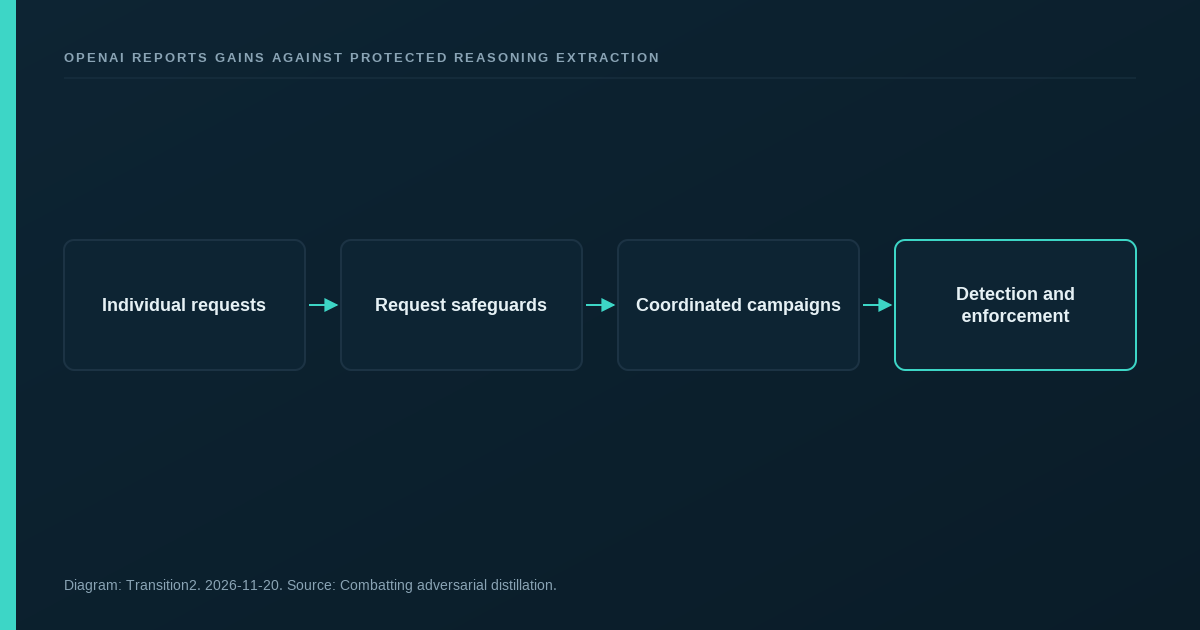
OpenAI described two levels of defense against unauthorized distillation. One applies safeguards to individual requests. The other uses detection and enforcement against coordinated campaigns. The report places those controls at different levels of the service, with one focused on the handling of a request and the other focused on activity across a campaign. OpenAI defense report
OpenAI reports that average success at extracting protected reasoning from a prior request fell from 54.0% on GPT-6 Astra with the original safeguards to 0.2% on GPT-6.2 Astra with the updated safeguards. For active requests, OpenAI reports 22.9% on the earlier configuration and 0.9% on the updated configuration. These percentages are the provider's internal results for the two evaluated extraction settings. OpenAI defense report | The Decoder coverage
Each comparison changes two things together. It replaces the original safeguards with updated safeguards and replaces GPT-6 Astra with GPT-6.2 Astra. The result supports a comparison of the configurations the provider tested. An estimate of any one safeguard's effect would require evidence that separates it from the model change and from the other controls in the evaluated setup. OpenAI defense report
Why it matters
The prior-request and active-request results answer distinct evaluation questions. A reader using the figures in a security assessment should keep those settings beside the corresponding rates. The lower figures apply to each setting under the newer configuration in the provider's test. Collapsing them into a single headline rate would lose the distinction the report preserves and obscure which outcome the number represents. OpenAI defense report
The two levels of defense also represent different kinds of service evidence. An evaluation of protected reasoning on individual requests can describe outcomes under the tested configuration. A description of campaign detection and enforcement addresses a broader pattern of activity. OpenAI's report describes both levels, while the quoted percentages refer to extraction success in the defined settings. They should be read as measures of those outcomes. OpenAI defense report
The desk did not run an experiment because a direct test requires the provider's hosted models, protected reasoning state and internal evaluation setup.
What it means for businesses
A business documenting provider safeguards can record the report as evidence for the stated models, outcome and configurations. The scope of the result belongs alongside the figures in that record. It concerns extraction of protected model reasoning in the provider's evaluation, which is a specific security outcome. Requirements for an application's own records, access decisions or data handling need evidence tied to those controls and to the application using them. OpenAI defense report
For Enterprise Governance, the practical distinction is between evidence about a service configuration and evidence about an individual control. Lower measured success in both settings supports the former. A decision that depends on how much a specific safeguard contributes would need a comparison designed to isolate it. Keeping that distinction in an assessment also makes the evidence easier to interpret if the application changes model versions later. OpenAI defense report
What it means for AI users
The report uses the term protected reasoning for the material its evaluation sought to extract. Its figures describe success at that evaluated outcome. A user can therefore read the numbers as evidence about the protection of that material under the test conditions. Judging the accuracy or usefulness of an answer requires looking at the answer and the evidence it provides, since those are different outcomes from the one reported here. OpenAI defense report
The report also makes clear why the model version belongs next to any number from the comparison. The earlier and updated results came from different model versions with different safeguards, and each number also corresponds to either a prior or active request. Preserving both details keeps a quoted rate connected to the circumstances that produced it. OpenAI defense report
What it means for developers
For an application team citing this report, the model identifier and safeguard configuration are part of the security evidence. An assessment can record the provider, the model versions compared, the measured outcome and which setting each result refers to. The record then makes clear that the percentages come from OpenAI's test and apply to the combined configurations, giving reviewers enough context to assess their relevance to the model the application uses. OpenAI defense report
The request and campaign distinction also helps define ownership. The report describes controls operated by OpenAI. A team building on the service can document where its own application decisions occur and which protections it relies on the provider to operate. Its evidence about user-visible application behavior can then be assessed separately from the provider's measurements of protected reasoning, with each claim tied to the component and outcome that were actually evaluated. OpenAI defense report
For an internal comparison across model updates, the same discipline applies to the conclusion. A run in which both a model and its safeguards change can establish an observed difference between the two setups. A test answering how much one change contributes needs a design that holds other relevant conditions fixed. OpenAI's reported comparison illustrates the distinction between those questions. OpenAI defense report
Copyright Eric MacDougall.
Sources
- Combatting adversarial distillation (accessed 2026-11-21)
- The Decoder coverage of OpenAI distillation defenses (accessed 2026-11-21)