News · AI Products & Copilots · Models, Tooling & Developer Practice · Enterprise AI Governance
Google opens Genie 4 world model to AI Ultra subscribers
Project Genie brings Genie 4's text-steerable worlds and native audio to eligible Ultra subscribers in the browser, with a waitlist for AI Pro members and SynthID on all output.
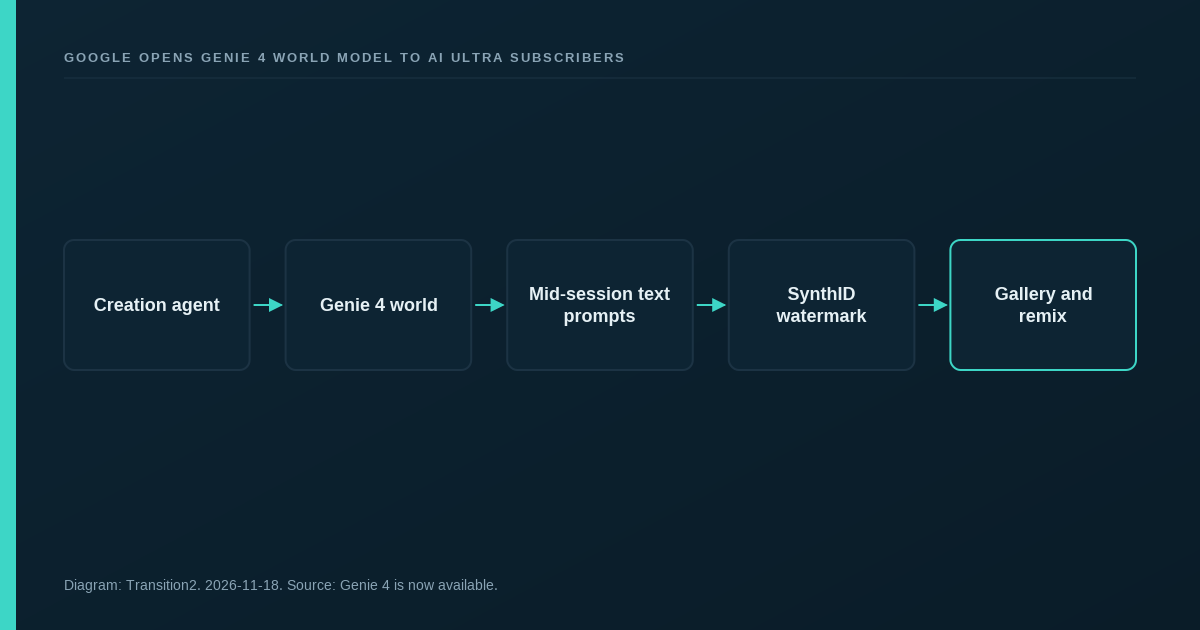
Google said on November 18, 2026 that its Genie 4 world model is rolling out to eligible Google AI Ultra subscribers through Project Genie, a browser-based experience, while Google AI Pro members can join a waitlist. Genie 4 lets users reshape a generated world mid-session with text prompts and adds real-time native audio. All Project Genie video and audio carries SynthID watermarking, and Google describes the system as frontier research with known limits.
What happened
The announcement came in a post on Google's Keyword blog by Diego Rivas and Pavan Kumar. Genie 4 is rolling out to eligible Google AI Ultra subscribers through Project Genie in the browser, and Google AI Pro members can join a waitlist (Google, TechTimes). Neither source states which regions are included.
The main new capability is control during a session. Users can change a world with text prompts while exploring it (Google, TechTimes). Google's post gives the examples of changing the weather, adding a character or redirecting the action. Genie 4 also adds real-time native audio, from ambient sound to character dialogue, Google says.
Project Genie includes a creation agent that builds worlds through conversation, and a gallery where users can explore, remix and publish worlds, Google says, with TechTimes reporting the same. Google's post also says Gemini can watch the on-screen session, suggest where to go next and trigger in-world events; that detail appears only in Google's post.
Genie 3 remains available, now with up to 3 minutes per generation, up from 60 seconds (Google, TechTimes).
On provenance and safety, all Project Genie video and audio carries SynthID watermarking (Google). Google says all model inputs and outputs go through safety screening.
Google describes Genie 3 and Genie 4 as frontier research systems with known limits, including long-term scene consistency and complex physical interactions. Google lists camera latency, intricate physical interactions, real-time audio precision and long-term scene permanence.
Why it matters
This is an availability story: a world model moving from research into a paid consumer product, with a waitlist path for a lower tier. The interesting change is interactivity. Genie 4 lets users rewrite the scene while inside it with ordinary text (Google). Adding native audio and a creation agent turns that into something closer to an authoring tool than a demo. Product patterns like this are tracked in AI Products.
The provenance choice matters as much as the features. Watermarking all video and audio with SynthID means content made in Project Genie carries a marker that Google's tools can detect, which matters once worlds can be published and remixed through the gallery. Google's own description of the limits, from scene permanence to physics, sets expectations plainly: these are research systems, not finished simulation engines.
Google's list of limits also names camera latency and real-time audio precision (Google), which matter for anyone judging the product as an interactive tool.
The Transition2 desk did not run an experiment for this article because access needs a paid Google AI Ultra subscription, and there are no public weights, API or reproducible artifact.
What it means for businesses
There is no API or weights in the sources, so Project Genie is not something a business can build on today; it is a subscriber product. For creative, marketing and training teams, it is a way to prototype interactive scenes and test ideas, with the limits Google lists in mind. Any material made with it carries SynthID (Google), which helps organisations that track AI-generated content in their own policies. Teams writing those policies can find related material in Enterprise Governance.
What it means for AI users
Eligible Ultra subscribers can try Genie 4 in the browser now, and Pro members can join a waitlist (Google, TechTimes). Expect to steer worlds with text, hear generated sound and dialogue, and browse or remix other users' published worlds. Expect the limits Google lists, including long-term scene permanence and intricate physical interactions. Genie 3 remains an option with generations of up to 3 minutes.
What it means for developers
Developers have nothing to integrate yet: the sources describe no public API, weights or reproducible artifact. What is useful is the interaction design. A conversational creation agent, mid-session text edits, and Gemini watching the session to suggest and trigger events (Google) show one way to wrap a generative model in an agent loop. Default provenance marking on every output is another pattern worth copying in any media-generating product. Broader model practice notes sit in Models & Practices.
Copyright Eric MacDougall.
Sources
- Genie 4 is now available (accessed 2026-11-19)
- Google Genie 4 Opens to Ultra Subscribers With Live Prompt Edits and No Published Session Length (accessed 2026-11-20)