News · Enterprise AI Governance · AI Reliability & Operations · Evaluation, Measurement & ROI
Perplexity Brain now creates and updates agent skills
The feature is on by default for US Max subscribers, edits the agent's instructions rather than model weights, and puts built-in skill changes behind replay tests and engineer approval.
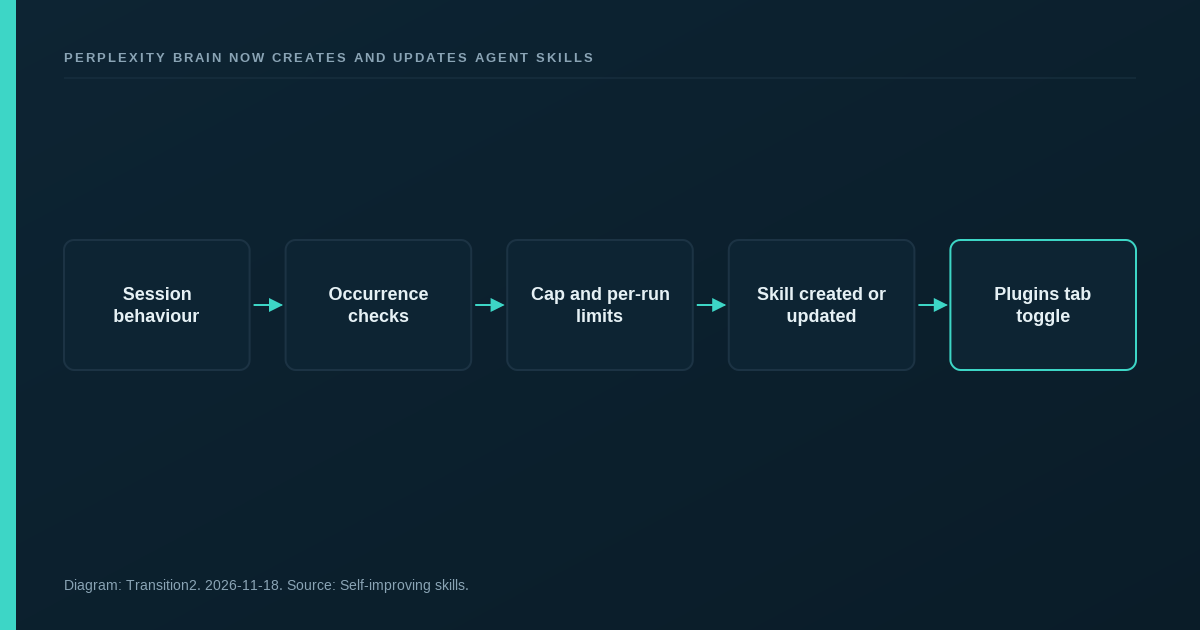
Perplexity said on November 18, 2026 that Brain, the personalisation system for its Computer agent, now creates and updates reusable agent skills automatically. Personal skill improvement is on by default for eligible US Max subscribers and can be turned off, and it changes the agent's instructions rather than the model's weights. Built-in skills face a stricter path of replay tests and engineer sign-off, and every performance figure comes from Perplexity's own randomized test.
What happened
In a post from Perplexity Engineering, the company said Brain now writes reusable skills from experience and updates existing ones. Personal skill improvement is available to all US Max subscribers, on by default for eligible users, and can be turned off. The Plugins tab marks Brain-authored skills and lets users enable or disable each one (Perplexity, Unite.AI).
The changes affect the agent's context and instructions, not the model's weights, as Unite.AI and OpenTools report. Automatically created skills are capped at 10 per user, and at the cap a new skill means retiring an existing one (Perplexity).
Perplexity's post sets rules for personal skills: a new skill needs two independent occurrences of a behaviour, an update needs one grounded occurrence, and each skill gets at most one change per run. Proposals are checked deterministically and by a sampled LLM judge. Apart from the one-change-per-run rule, these rules appear only in Perplexity's own post.
Built-in skills follow a stricter path. A candidate revision must pass every held-out scenario, fix at least one original failure and keep control scenarios passing in paired replay; an engineer then approves a pull request before the change merges (Perplexity, Unite.AI). Perplexity says built-in improvement uses sanitised evidence from consenting sessions, with secrets and attached files stripped; that detail appears only in Perplexity's post. OpenTools reports that the background improvement agent has no internet or connector access, a detail that appears only in its coverage.
On usage, Perplexity reports 80,000+ personal skills written for 20,000+ users between August 1 and November 14, 2026, and 100,000+ automatic updates to 30,000+ existing skills between September 4 and November 14. A figure caption in the same post gives 64,230 skills for August 1 to November 4, and the post does not reconcile the two figures.
Perplexity says its eight-week randomized test found that 72.9% of enabled users got a new skill against 6.5% of controls; tool-call failures fell 11% overall, or about 7% excluding background runs; threads with medium or high dissatisfaction fell 7.6%; and there was no measurable change in cost or latency. On SkillLearnBench, task success rose from 43.8% to 62.5% across only 16 paired instances, a narrow subset. Perplexity plans to extend improvement to user-authored, project-shared and organisation skills.
OpenTools says most of its figures came from Unite.AI's coverage, so the two are not fully independent; both match Perplexity's post.
Why it matters
This is an agent that edits its own instructions by default. For governance, the relevant questions are what can change, how fast, on what evidence, and who can see or undo it. Perplexity's answers are concrete: a cap of 10 auto skills, evidence thresholds for new skills and updates, one change per skill per run, per-skill toggles in the Plugins tab, and a separate gated path for built-in skills (Perplexity). Because the changes are to instructions rather than weights, users can see and switch off individual skills in the Plugins tab.
The data handling question is split. Perplexity says built-in improvement uses sanitised evidence from consenting sessions, while personal skills are built from a user's own sessions. The measured gains are vendor-reported, and the SkillLearnBench result rests on 16 paired instances. Wider governance patterns are covered in Enterprise Governance.
What the Transition2 desk tested
The desk wrote a small simulation of the gating rules as published in Perplexity's post. It is not Perplexity's code, and it does not call, test or benchmark any Perplexity system. A rule engine implements the five rules above (new skill, update, one change per run, the cap of 10, and the built-in revision gate), treating distinct sessions as independent occurrences. A seeded 200-event synthetic log (20 runs, 24 behaviours, 80% grounded, 25 injected same-session duplicates) went through a strict gate with the published rules and a naive gate, the negative control, with raw counts, no cap and no per-run limit.
Versions: Python 3.9.6, standard library only. The plan called for Python 3.12 and pytest 8.3.3, but pytest could not be installed in the sandbox, so the tests use stdlib unittest. Seed 20261118, PYTHONHASHSEED=0, network denied.
Results: 32 unit tests ran with 0 failures and 0 errors, and 11/11 checks passed. The strict gate never exceeded max_auto=10 or max_changes=1 per skill per run, with retirements=37 and dedup_rejections=12. Rejections by rule were a=61, b=9, c=42. The naive control reached max_auto=24 and max_changes=4, accepted 5 new skills from fewer than 2 independent occurrences, and accepted 176 proposals against 88 for the strict gate. A rerun was identical.
  kind:outcome                                   count
  new:a_new_needs_2_independent                     61
  new:accepted                                      47
  new:c_one_change_per_run                           5
  update:accepted                                   41
  update:b_update_needs_1_grounded                   9
  update:c_one_change_per_run                       37

metric                                     strict    naive
accepted                                       88      176
rejected                                      112       24
max_auto_skills_ever                           10       24
max_changes_per_skill_per_run                   1        4
cap_retirements                                37        0
same_session_dedup_rejections                  12        0
new_accepted_with_lt2_independent               0        5
What this does not show: anything about how well Perplexity's real system works or whether Perplexity enforces these rules in production. It does not test the vendor figures. It does not model the deterministic proposal checks or the sampled LLM judge, and "distinct sessions" is the simulation's own reading of "independent" and "grounded". The retirement policy is a simulation choice. It illustrates the controls; it is not a benchmark.
What it means for businesses
The feature is for individual US Max subscribers today, but Perplexity plans to extend it to project-shared and organisation skills. Organisations whose staff use Computer should know it is on by default and decide whether to keep it on. The gated built-in path, with held-out scenarios, controls and engineer approval, is a reference point for any internal agent that rewrites its own instructions. Measuring such changes is covered in Evaluation & ROI.
What it means for AI users
Eligible US Max subscribers can turn personal skill improvement off, and the Plugins tab shows which skills Brain wrote and lets each be disabled (Perplexity). Reviewing that list occasionally shows what the agent has learned. Built-in improvement draws only on consenting sessions, with secrets and attached files stripped, Perplexity says.
What it means for developers
The design separates personal and shared changes: thresholds, a cap and per-run limits for personal skills, and replay tests plus a human-approved pull request for built-in ones (Perplexity). Teams building self-editing agents can borrow that split. In the simulation above, the naive gate, with no cap, deduplication or per-run limit, accepted 176 proposals against 88 for the strict gate; that is an illustration, not a measurement of any vendor system. Operational practice for agents is covered in AI Reliability & Operations.
Copyright Eric MacDougall.
Sources
- Self-improving skills (accessed 2026-11-19)
- Perplexity Brain Creates and Updates Agent Skills From Experience (accessed 2026-11-19)
- Perplexity Brain Creates 80,000 Agent Skills for 20,000 Users From Experience (accessed 2026-11-19)