News · Models, Tooling & Developer Practice · Software Factories & AI-Assisted Engineering · Evaluation, Measurement & ROI
RadixArk releases DaisyRose-27B, an RL-only agent model
The Apache-2.0 post-train of Qwen3.8-27B targets long-horizon agent tasks, with self-reported gains that are small in absolute terms on the hardest benchmark.
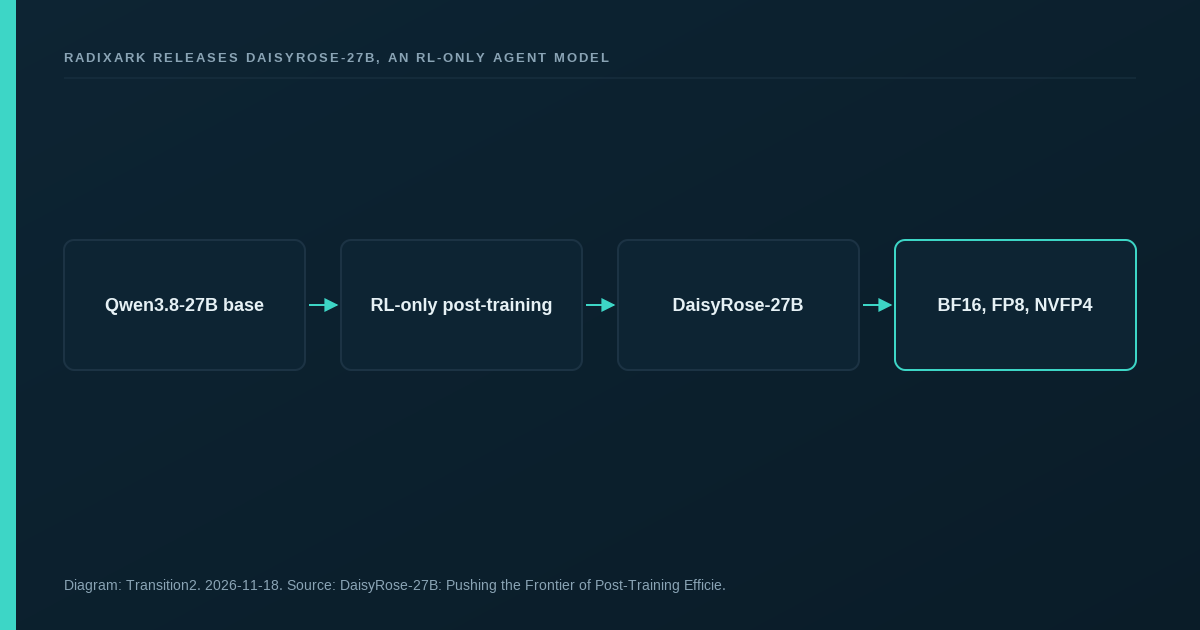
RadixArk released DaisyRose-27B, its first model, on November 18, 2026, as BF16, FP8 and NVFP4 checkpoints on Hugging Face. It is a reinforcement-learning-only post-train of Qwen3.8-27B aimed at long-horizon agent tasks, and its model card lists an Apache-2.0 license. Every score and efficiency figure is self-reported, and the headline Terminal-Bench 4.1 gain is small in absolute terms.
What happened
RadixArk announced the model in a post listing Jason Chen as author, published on both the Hugging Face blog and RadixArk's site. The weights are on Hugging Face as RadixArk/DaisyRose-27B in BF16, FP8 and NVFP4.
The model card states Apache-2.0. RadixArk's own blog post does not state a license.
RadixArk says DaisyRose is a post-train of Qwen/Qwen3.8-27B using reinforcement learning only, with no supervised fine-tuning or distillation. It keeps the base model's architecture, tokenizer, chat template, image understanding and 256K context. The base repo is published under Apache-2.0 with a native context of 262,144 tokens.
Training used about 1,200 curated tasks built with Eigent AI, run over 18 days on 144 H200 GPUs, with 128 running agent inference and 16 running the trainer, according to RadixArk. It used RadixArk's open-source Miles RL framework in fully asynchronous mode. The blog states about 63,000 GPU-hours; 18 days times 144 GPUs times 24 hours is 62,208, consistent as an approximation.
RadixArk's reported results, base to DaisyRose: Terminal-Bench 4.1 pass@1 from 5.6 to 12.0; Terminal-Bench 2.1 from 73.0 to 75.5; DeepSWE v1.1 from 42.2 to 46.2; IFBench from 79.5 to 82.4; GPQA Diamond from 89.2 to 90.7; and HLE text-only from 33.9 to 34.3. Each score is the better of the BF16 and FP8 runs.
RadixArk also claims 37% model FLOPs utilization on its internal backend against 16% for an open-source trainer, which it presents as 57% less GPU time. That backend is not open source, and no training tasks or data are released (RadixArk).
The size label varies. The blog and card text say 27B, the Hub metadata on the model page says 28B, and the card's own breakdown gives 27.8B, including a 0.46B vision encoder and a 0.42B MTP head.
Why it matters
DaisyRose is a test of how far reinforcement learning alone can move an open base model on agent work. The answer, on RadixArk's own numbers, is modest. Terminal-Bench 4.1 roughly doubles, but from 5.6 to 12.0, so the model still fails most of those tasks. The other gains are a few points or less, and HLE text-only moves from 33.9 to 34.3 (RadixArk). Reporting the better of two precision runs per benchmark can also flatter each figure compared with a single fixed configuration.
The efficiency story is harder to check. The 37% utilization figure comes from a closed backend, and neither the about 1,200 training tasks nor the data are released, so outsiders cannot inspect what the model was trained on or reproduce the run. What is open is the result: weights under a permissive license, in three precisions, on a base whose license and context length are publicly documented. Context on reading vendor benchmarks sits in Evaluation & ROI.
The Transition2 desk scoped a CPU-only check comparing DaisyRose's tokenizer, chat template and config files with the Qwen3.8-27B base, but did not run it for this article, so the claim that the tokenizer and chat template are unchanged rests on RadixArk's statements.
What it means for businesses
An Apache-2.0 license on the model card and an Apache-2.0 base make DaisyRose straightforward to review for commercial self-hosting. The open question is value: on RadixArk's own figures, gains over the base model are small on most benchmarks, so teams already running Qwen3.8-27B should test both on their own agent workloads before switching. Because training data is not released, organisations with provenance requirements will have less to review than with models that publish training sets. Guidance on choosing open models sits in Models & Practices.
What it means for AI users
DaisyRose is a developer release, not a consumer app. People using agent tools may encounter it inside products built on open models. The reported improvements on long-horizon agent benchmarks are self-reported, and the hardest of them still shows a low absolute pass rate, so expectations for complex multi-step tasks should stay grounded.
What it means for developers
RadixArk says the model keeps the base's architecture, tokenizer, chat template, image understanding and 256K context (RadixArk), which, if accurate, means existing Qwen3.8-27B prompt formats should carry over. That claim is untested here, so comparing tokenizer files and chat templates against the base repo before deployment is cheap insurance. The three precisions give options for memory budgets; plan sizing on the 27.8B breakdown in the card, which includes the vision encoder and MTP head. The Miles RL framework used for training is open source, per RadixArk, though the faster internal backend is not. Teams building coding and terminal agents can find related notes in Software Factories.
Copyright Eric MacDougall.
Sources
- DaisyRose-27B: Pushing the Frontier of Post-Training Efficiency (Hugging Face blog) (accessed 2026-11-19)
- RadixArk/DaisyRose-27B model card (accessed 2026-11-19)
- DaisyRose-27B: Pushing the Frontier of Post-Training Efficiency (accessed 2026-11-19)
- Qwen/Qwen3.8-27B model card (accessed 2026-11-19)