News · Software Factories & AI-Assisted Engineering · Models, Tooling & Developer Practice · Evaluation, Measurement & ROI
Claude Code trims background-subagent status overhead by about 99%
Anthropic says Haiku 5.5 now writes the 30-second background-subagent status line from short notes instead of re-reading the whole conversation.
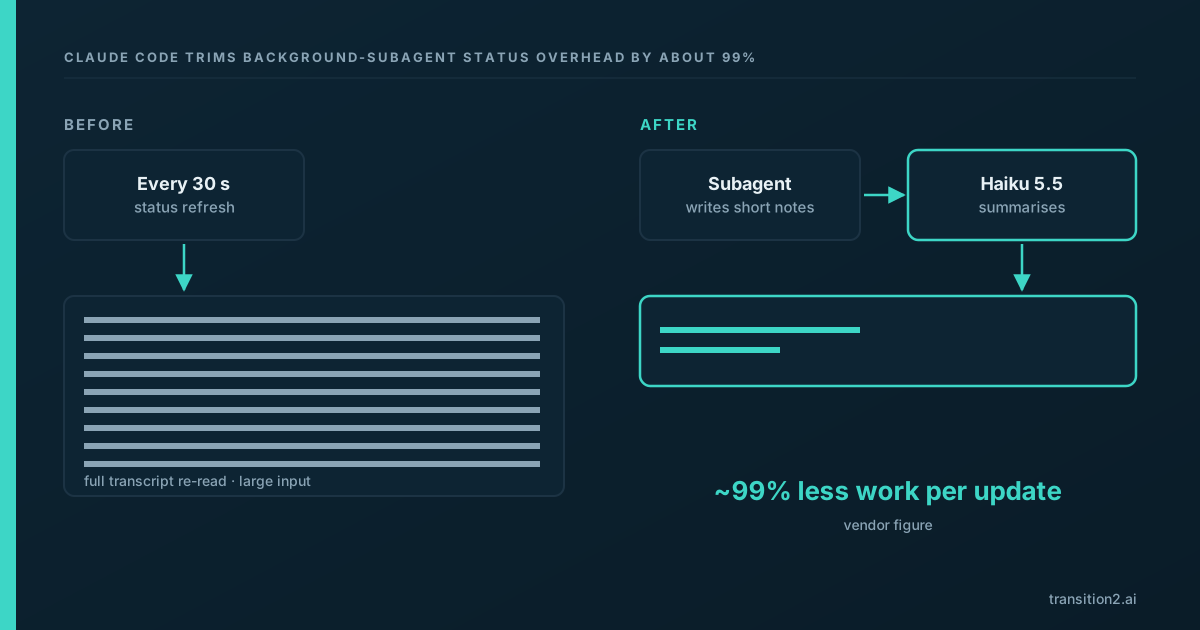
Anthropic said on November 4, 2026 that Claude Code no longer re-reads a subagent's whole conversation to produce the status line it shows for background subagents every 30 seconds. Instead, Claude Haiku 5.5 writes that line from short notes, and Anthropic says each update now costs about 99% less than before (Anthropic on X). The broader point is that monitoring an agent is itself a workload, and it is worth engineering on purpose.
What happened
According to Anthropic's posts from its Claude developer account (announcement, follow-up):
- A running subagent updates its status line every 30 seconds, and each update used to re-read its whole conversation.
- Haiku 5.5 now writes the line from short notes, which Anthropic says makes each update cost about 99% less. That figure is a vendor claim.
- The subagent itself keeps its own model; only the status line moved to Haiku 5.5.
- Sessions with background subagents used about 5% less of the usage limit, which Anthropic says works out to about 6% more prompts from the same limit.
- The change is live for most Pro, Max and Ultra users and for everyone on Team and Enterprise, on Claude Code v2.1.316 and later.
Whether the same reduction applies to Claude Code used through an API key, Amazon Bedrock, or Google Vertex is unverified. Anthropic's posts, as reviewed for this article, do not establish it.
Why it matters
A status line looks trivial: one sentence telling the user what a subagent is doing. But it runs every 30 seconds for every background subagent, for as long as the subagent runs. If each update re-reads a growing transcript, the work per update grows with the session, and the total grows with session length times the number of subagents. That is how monitoring glue quietly becomes a meaningful share of an agent session's usage.
The fix Anthropic describes has two parts. It changes the input, from the full conversation to short notes, and it changes the model for that one job, to Haiku 5.5, which Anthropic positions for high-volume work. Either change alone would help. Together they turn a workload that scales with transcript length into one that stays roughly flat per update.
The gap between the two numbers is also informative. A roughly 99% reduction per update produced about a 5% reduction in limit use for affected sessions. That suggests status updates were a real but minority share of those sessions, with the main agent work still dominant. Both figures come from Anthropic.
The Software Factories hub covers agent-assisted engineering setups where many background subagents run at once, which is where this kind of overhead adds up fastest.
What it means for businesses
Treat agent monitoring as a measured line item in usage reporting, separate from the agent's main work. Ask tool vendors how status, progress, and summary features are produced and whether they reuse full context. Where you build your own agents, route heartbeat and summary work to a small, fast model.
What it means for AI users
Background agents can look idle while still consuming usage. Status design matters. If you run background subagents on a Team or Enterprise plan, or on a Pro, Max or Ultra plan where the change has reached you, updating to v2.1.316 or later should stretch your limit by about 6% more prompts, according to Anthropic.
What it means for developers
Separate heartbeat summarisation from the main agent's context window. Have the agent append short structured notes as it works, and generate status from those notes with a small model rather than from the full transcript. Measure tokens per status update and total tokens per session before and after, so the change is verified in your own setup rather than assumed.
Sources
- Claude developer account on X: background subagent status update (accessed 2026-11-06)
- Claude developer account on X: follow-up (accessed 2026-11-06)