News · Software Factories & AI-Assisted Engineering · Evaluation, Measurement & ROI
Hugging Face releases adapters trained in 3 coding harnesses
The release combines separately trained adapters and reports a higher mean first-attempt pass rate under the tested configurations.
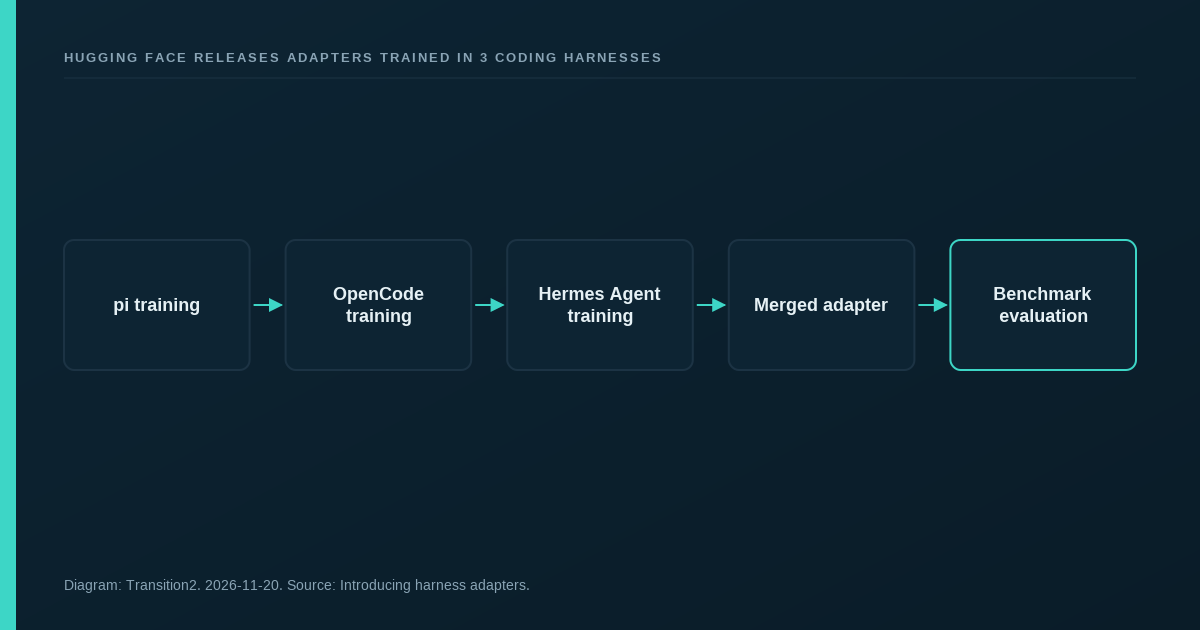
On November 20, 2026, Hugging Face published a release combining adapters trained inside pi, OpenCode and Hermes Agent. The release authors report that with thinking disabled, mean first-attempt success across six harness and benchmark pairs rose from 39.5% for the base model to 49.0% for the merged adapter. The comparison measures performance in the tested harnesses and settings, so the headline mean needs that context. Hugging Face release | Super-adapter model card
What happened
The team trained separate Qwen3.8-27B LoRA adapters inside the three harnesses. Each adapter represents an update for the same base model. The released rank-96 adapter concatenates the three rank-32 adapters, so the combined artifact brings together updates trained in different harnesses. Hugging Face release | Independent coverage of the adapter training and merge
The release team's reported comparison uses mean pass@1, or success on the first attempt, across six combinations of harness and benchmark. Thinking was disabled for the reported comparison. The 39.5% and 49.0% figures summarize the base-model and merged-adapter results over those pairs. The mean describes the set of measurements and cannot identify the outcome of a given pair on its own. Hugging Face release | Super-adapter model card
The authors also disclose how they chose the merge weight. They used Terminal-Bench 2.1 on earlier checkpoints, and they flag possible optimism in the results for that benchmark. They say SWE-bench Pro played no part in choosing the weight. The two benchmarks therefore have different relationships to the choice that produced the released adapter, even when their results are discussed in the same release. Hugging Face release | Super-adapter model card
Why it matters
A benchmark result for a coding agent can be tied to more than a base model name. Here, the training took place in named harnesses, and the performance summary averages pairs that include a harness as well as a benchmark. A claim based on this evaluation should identify the adapter, the harness and the thinking setting. Those details let readers tell which configuration produced the result and which parts they would need to match in a comparison. Hugging Face release | Super-adapter model card
The weight-selection disclosure also changes how the benchmark results can be read. Terminal-Bench 2.1 informed a choice about the adapter on earlier checkpoints, while SWE-bench Pro did not inform that choice. For Evaluation & ROI, recording where tuning decisions came from helps readers interpret a score alongside the way the artifact was selected. The disclosure leaves the numerical results as reported and clarifies what kind of evidence each benchmark supplies. Hugging Face release
What the Transition2 desk tested
The desk ran an exact-arithmetic simulation of the merge rule, with CPython 3.12.8 specified as the pin and no external packages. Three distinct rank-1 updates used fixed integer factors. The simulation scaled the columns by 1/2, concatenated them horizontally, stacked the rows vertically and multiplied. It compared the product against the weighted sum of separately computed updates. The negative control omitted the scaling and required a different result.
CHECK concatenated_shapes: PASS left row widths [3, 3], right row count 3
CHECK exact_weighted_sum: PASS compared the full 2 by 3 matrices
CHECK negative_unscaled_merge: PASS unscaled matrix must differ from the weighted reference
CHECKS 3/3
What this does not show. The desk checked the algebra with fixed inputs and exact fractions. It used no released adapter weights or vendor code and ran no coding benchmarks. The simulation supplies no evidence about the quality of the released adapter or the appropriate weight for merging trained updates.
What it means for businesses
A team assessing the release can treat the mean pass rate as a result from a named setup and define an acceptance check around its own coding tasks. The evaluation can compare the base model and merged adapter under the same harness and thinking setting, with success defined before scoring. That design uses the release team's comparison as a reference while testing the conditions relevant to the adoption decision. Hugging Face release | Super-adapter model card
For teams that use more than one harness, the reported mean is a reason to keep configuration-level results available. The mean answers how the tested combinations performed collectively. It leaves a narrower question open for a team interested in a particular harness and set of tasks. Hugging Face release
What it means for AI users
The reported comparison concerns success on a first attempt with thinking disabled. A user comparing it with a session that involved follow-up instructions, retries or a different thinking setting is looking at a different test condition. The release numbers can set the context for a first-attempt comparison, and direct inspection of the proposed changes can answer whether an individual output is acceptable. Hugging Face release | Super-adapter model card
What it means for developers
The adapter artifact, base model, harness, benchmark and thinking setting belong together in an evaluation record. If one component changes between runs, reporting that change helps readers interpret the resulting comparison. That practice follows directly from the release's use of harness and benchmark pairs and its explicit qualification about thinking. Hugging Face release
A reproducible assessment should also record how the merge weight was chosen and which tasks informed that decision. The authors' note about Terminal-Bench 2.1 and SWE-bench Pro makes that distinction available to anyone comparing the published results. An arithmetic check can confirm that an implementation applies the intended weighting. Performance still needs to be measured in the harness where the adapter will run. Hugging Face release | Super-adapter model card
Copyright Eric MacDougall.
Sources
- Introducing harness adapters (accessed 2026-11-21)
- Advanced Guide to harness adapters (accessed 2026-11-21)
- Qwen3.8-27B super-adapter model card (accessed 2026-11-21)