News · Models, Tooling & Developer Practice · Software Factories & AI-Assisted Engineering
Microsoft introduces MAI Code 2 and Code 2 Flash at Ignite
Both coding models are available in GitHub Copilot, and Microsoft's model card specifies Foundry API access for Code 2 Flash.
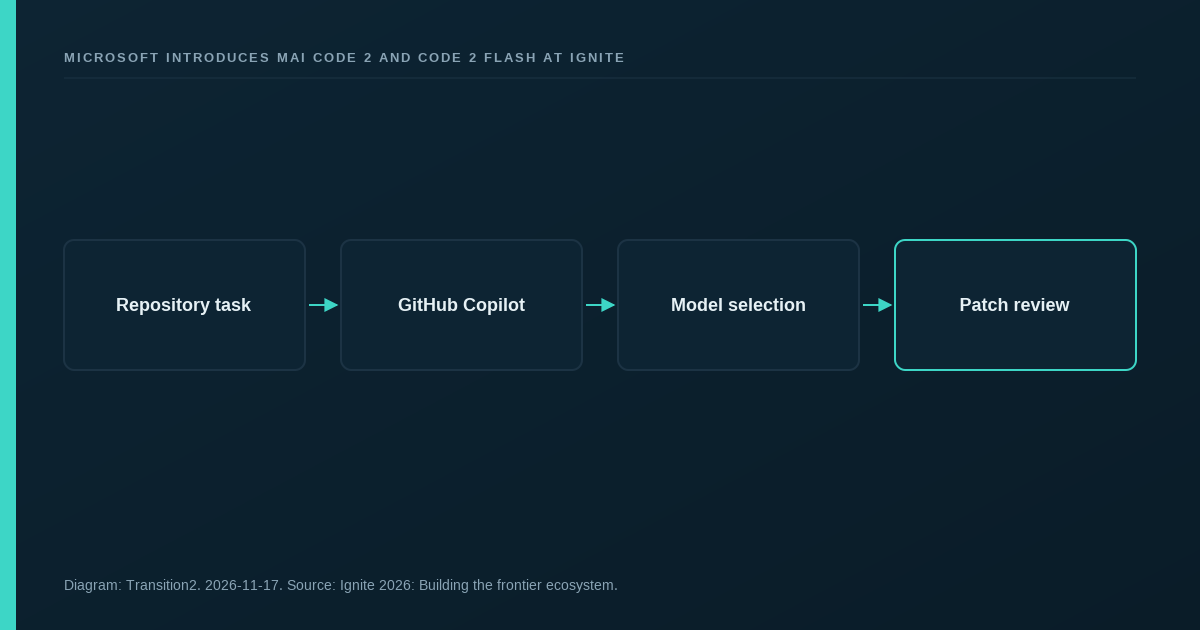
Microsoft introduced MAI Code 2 and MAI Code 2 Flash at Ignite on November 17, 2026, and says both coding models are available in GitHub Copilot. The company describes Code 2 as the option for complex repository work and the smaller Code 2 Flash as the option for faster, higher-volume work such as targeted edits and routine fixes. Microsoft Ignite announcement Microsoft AI model card
What happened
Microsoft introduced the coding pair as part of a wider set of specialized model announcements at Ignite. For a Copilot user, the concrete change is that both models are available in the same product. Microsoft's positioning gives the models different starting points within a coding workflow. Code 2 is intended for complex work across a repository, while the company's examples for Flash include more bounded changes and routine fixes. Microsoft Ignite announcement Microsoft AI model card
Microsoft's keynote recap describes Foundry availability broadly. The model card is more specific about the API and lists MAI Code 2 Flash for Foundry API access. A team evaluating both models in Copilot can rely on the common availability stated by the two Microsoft sources. For a team planning an API integration, the narrower model-card wording is the relevant published detail. Microsoft Ignite announcement Microsoft AI model card
Why it matters
The useful distinction in Microsoft's description is the scope of the work. A narrowly specified edit can have a clear expected result and a small review surface. A repository-wide change may require understanding dependencies between files, preserving conventions and checking that callers still behave as intended. Having both models available in Copilot lets a team frame an evaluation around those differences in the work it already does. Microsoft Ignite announcement Microsoft AI model card
Response time is also a different measure from the time it takes to finish a change. The latter can include clarifying the request, inspecting the patch, correcting errors and verifying behavior. Since Microsoft positions Flash for speed and volume, a relevant local comparison could measure the whole path to an acceptable patch as well as the time to the first response. That gives a team a result it can interpret against its own review process. Microsoft AI model card
The difference between Copilot and Foundry also affects what an evaluation can establish. A trial in Copilot can inform model choice within that product. An API trial concerns the specified model and the application that sends its requests. The availability statements matter because the route used for an evaluation should match the route on which the team intends to depend. Microsoft Ignite announcement Microsoft AI model card
The Transition2 desk did not run an experiment. Microsoft documents hosted distribution and provides no downloadable weights for either coding model. Comparing code quality or latency requires access to the hosted service.
What it means for businesses
A business evaluating these options in Copilot can give each model the same collection of representative work and group the results by task type. For routine changes, the share of patches that pass focused checks and the review time per patch may be relevant. For complex changes, acceptance might depend on whether the patch covers all affected components and preserves behavior at their boundaries. Microsoft's positioning provides a reason to distinguish these categories in the trial. Microsoft Ignite announcement Microsoft AI model card
A business case for high-volume use is sensitive to corrections that reviewers must make after generation. A quick initial edit has practical value when the reviewer can confirm it efficiently and move on. A broader change has value when reviewers can trace the result back to the original constraints. Those are concrete measures for teams applying Software Factories practices to the model choices Microsoft has announced. Microsoft AI model card
What it means for AI users
The Copilot launch gives users a choice before starting a coding request. A targeted edit with a clearly described expected result fits one of Microsoft's examples for Flash. A change that spans several parts of the repository fits the description for Code 2. The descriptions can help users choose a starting point and phrase the request with enough context for a fair evaluation. Microsoft Ignite announcement Microsoft AI model card
For a user comparing the two, recording the model, the request and the final accepted change can make the result easier to interpret. A longer response might explain a consequential choice or simply take more time to review. Comparing the resulting edits against the same acceptance criteria gives the user a clearer basis for deciding which option fits similar requests. Microsoft AI model card
What it means for developers
Developers deciding between the two models in Copilot can keep repository state, instructions and checks fixed during a comparison. The output can then be judged on the resulting patch, observed behavior and the amount of correction required. The approach is particularly useful when the work is described as routine, since a small patch is easier to inspect for both the requested change and unnecessary edits. Microsoft Ignite announcement Microsoft AI model card
For developers building a service integration, the Foundry detail sets the scope of the announced API option. Code 2 Flash is the model the card names for that route. An evaluation record that includes the model and the access route makes clear whether its results apply to a Copilot workflow or to a particular API integration. Microsoft AI model card
Copyright Eric MacDougall.
Sources
- Ignite 2026: Building the frontier ecosystem (accessed 2026-11-18)
- MAI Code 2 and MAI Code 2 Flash model card (accessed 2026-11-18)