News · Models, Tooling & Developer Practice · Evaluation, Measurement & ROI · Software Factories & AI-Assisted Engineering
Google releases Gemini 4 Neon at $3/$15 per million tokens
Google's new mid-tier Gemini 4 model has a context window of about 1M tokens and sits between Carbon and Hydrogen, and every performance figure so far comes from Google.
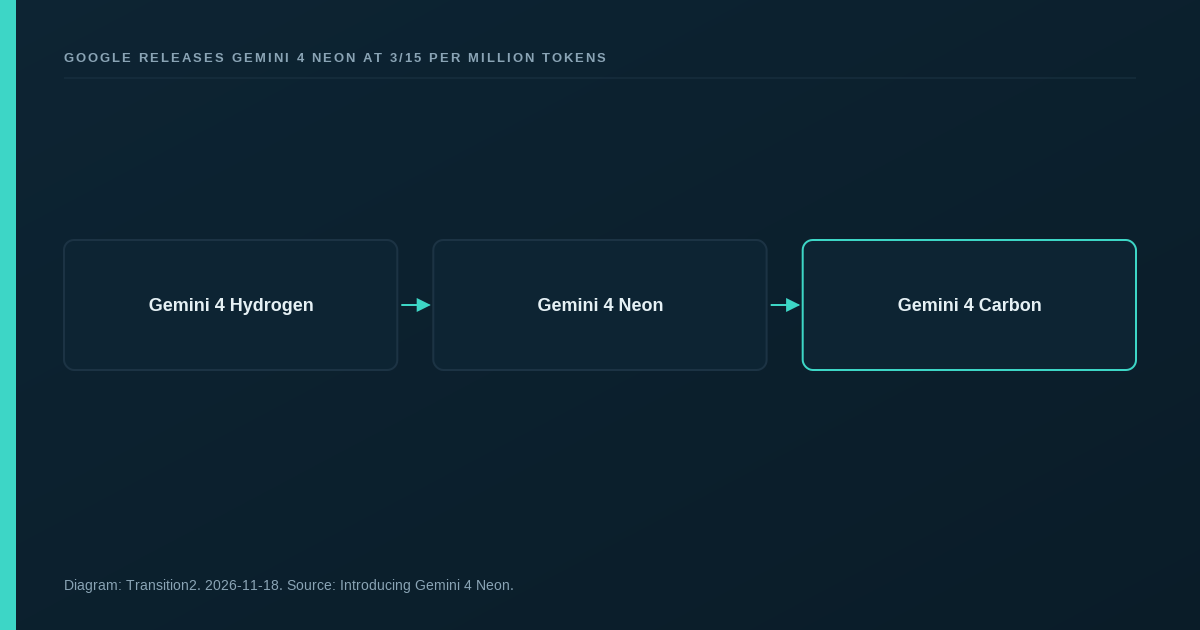
Google released Gemini 4 Neon on November 18, 2026, a mid-tier model priced at $3 per million input tokens and $15 per million output tokens, with a context window of about 1M tokens. Google positions it between Gemini 4 Carbon and Gemini 4 Hydrogen and aims it at fast agentic coding and knowledge work. Every benchmark, speed, cost-per-task and safety figure so far is a Google claim, and launch coverage from VentureBeat and Neowin does not agree on how much faster and cheaper Neon is than Carbon.
What happened
Google announced the model in a post on its Keyword blog written by Koray Kavukcuoglu, SVP at Google DeepMind. The API model ID is gemini-4-neon, according to Google's Gemini API docs.
Google lists API pricing per million tokens of $3 for input, $0.15 for cached input and $15 for output, with a context window of about 1M tokens; Neowin reports the same figures. Neon is available in the paid Gemini API through Google AI Studio and Android Studio, in Google Antigravity, in the Gemini app for Google AI Pro and Ultra subscribers, and in Google's business offerings, Google says.
Google describes Carbon as its model for the hardest long-horizon work and Hydrogen as its model for fast everyday execution, with Neon in between. Neon has four thinking levels: high is the default, and xhigh is meant for the hardest tasks. Third-party throughput figures reported by VentureBeat put Hydrogen ahead of Neon on speed, which fits that positioning.
The benchmark figures are Google's own, as published by Google and repeated by VentureBeat. Google says Neon scores 61 on the Artificial Analysis Intelligence Index at xhigh, 70.9% on the Vals Index, 46.2% on FrontierCode 2.0 at high, 70.5% on Terminal-Bench Science, 56.3% on Zapier AutomationBench and 39.0% on SWE-sweep in Antigravity. Google itself ranks Neon third on the Artificial Analysis index, not first overall.
Google says Neon's cost per task at the high thinking level is 32% lower than Carbon's. On safety, Google reports 0.0% attack success on Gray Swan's indirect prompt-injection benchmark at the highest thinking level and a 0.09% misaligned-action rate on an agentic safety suite; those figures appear only in Google's post. Google also says a variant called "Gemini 4 Neon for cyber" is rolling out to trusted defenders in its Fairwind Program, on request through a Google Cloud account team; that detail also appears only in Google's post.
On price, VentureBeat calculates that Neon costs 50% more than Claude Sonnet 5.5 and GPT-6.2 Sol, both at $2/$10, and 25% less than Claude Opus 5.5 at $4/$20. Carbon is on a $2/$10 introductory price until November 30, so per token Neon costs more than Carbon until then, according to VentureBeat and Neowin.
The published figures do not line up on several points. Thai Tran, AI product lead at Glean, is quoted in Google's post as saying that in Glean's early evaluations Neon "matched or exceeded Gemini 4 Carbon on overall quality at 3x the speed and 60% of the cost." VentureBeat reports third-party measurements of about 110 tokens per second for Neon at xhigh against 59 tokens per second for Carbon at high, roughly 1.9x on output speed. On cost, Google's 32% figure compares with an independent measurement of about 17% at xhigh reported by VentureBeat, and with Tran's "60% of the cost" figure. VentureBeat's table (Neon 61, Carbon 60 at high, Opus 59) reads as Neon first among the models it lists, but it sets Neon at xhigh against Carbon at high, so it is not like-for-like. Google says Neon is second on the Vals Index at 70.9%, while the same VentureBeat table puts it first, just ahead of Claude Sonnet at 70.85%.
Why it matters
Neon fills a price point that buyers can compare directly against competing tiers. Per token it sits above Claude Sonnet 5.5 and GPT-6.2 Sol and below Claude Opus 5.5, by VentureBeat's arithmetic. That makes it a model to judge on cost per finished task rather than list price, which is also how Google frames its case.
That framing is where the numbers diverge most. Google's 32% cost-per-task advantage over Carbon, the roughly 17% at xhigh in VentureBeat's coverage and Tran's "60% of the cost" figure cannot all describe the same measurement. Speed shows the same gap: Tran's "3x the speed" against a measured ratio of roughly 1.9x on output speed. Part of the spread comes from different thinking levels and different metrics, which is why a single headline figure is a weak basis for a routing or budget decision. More on that kind of comparison sits in Evaluation & ROI.
Timing matters too. While Carbon's introductory price lasts, Neon is the more expensive model per token (VentureBeat, Neowin), so any saving depends on Neon using fewer tokens or steps per task. That is a property of each workload, not of the price sheet.
The safety figures are notable but single-sourced. A 0.0% attack success rate on an indirect prompt-injection benchmark is a strong claim, and it is reported only by Google, at the highest thinking level, with no outside replication in the coverage cited here.
The Transition2 desk did not run an experiment for this article because every test of the model needs a paid Gemini API key or a Google subscription, and there is no open artifact to inspect.
What it means for businesses
Neon adds a middle option inside the Gemini 4 family rather than replacing Carbon or Hydrogen, per Google's positioning. Teams pricing candidate workloads should do it on completed tasks at the thinking level they will actually use, since Google's own cost claim is stated at high while the independent figure in VentureBeat's report is at xhigh. Procurement comparisons should also account for the Carbon introductory price, which runs only until November 30. Neon is listed for Google's business offerings, Google says, so organisations already buying Gemini through those channels can include it in vendor comparisons. For a wider view on choosing between model tiers, see Models & Practices.
What it means for AI users
For individuals, Neon is in the Gemini app for Google AI Pro and Ultra subscribers (Google, Neowin). Google pitches it at knowledge work and coding, but the published benchmarks are Google's and measure specific tasks, not everyday chat quality. Within the family, Google still positions Hydrogen as the fast everyday option and Carbon as the model for the hardest long-horizon work.
What it means for developers
The model ID is gemini-4-neon, per Google's Gemini API docs, and the model is available in the paid Gemini API through Google AI Studio and Android Studio and in Google Antigravity, Google says. The four thinking levels are the main lever: high is the default, and xhigh, meant for the hardest tasks, is the setting behind several of the headline comparisons. Cached input at $0.15 per million tokens matters for agent loops that resend long contexts, and the window of about 1M tokens allows large repositories or document sets in one request. The 39.0% SWE-sweep figure is stated for runs in Antigravity, so it does not describe results in other agent harnesses. Teams running coding agents can find related practice notes in Software Factories. Given the open disagreements on speed and cost, the launch numbers are best read as Google's claims until measured on a team's own tasks.
Copyright Eric MacDougall.
Sources
- Introducing Gemini 4 Neon (accessed 2026-11-19)
- Gemini 4 Neon (accessed 2026-11-20)
- Google launches Gemini 4 Neon with Opus 5.5-level coding performance at 25% lower API token prices (accessed 2026-11-19)
- Google launches Gemini 4 Neon, claims it's three times faster than Carbon (accessed 2026-11-19)