News · Models, Tooling & Developer Practice · AI Products & Copilots · Evaluation, Measurement & ROI
Alibaba launches Qwen4-Max flagship without open weights
Alibaba says the mixture-of-experts model has 2.4 trillion parameters and a 1M-token context, priced at $1.50 and $4.50 per million input and output tokens.
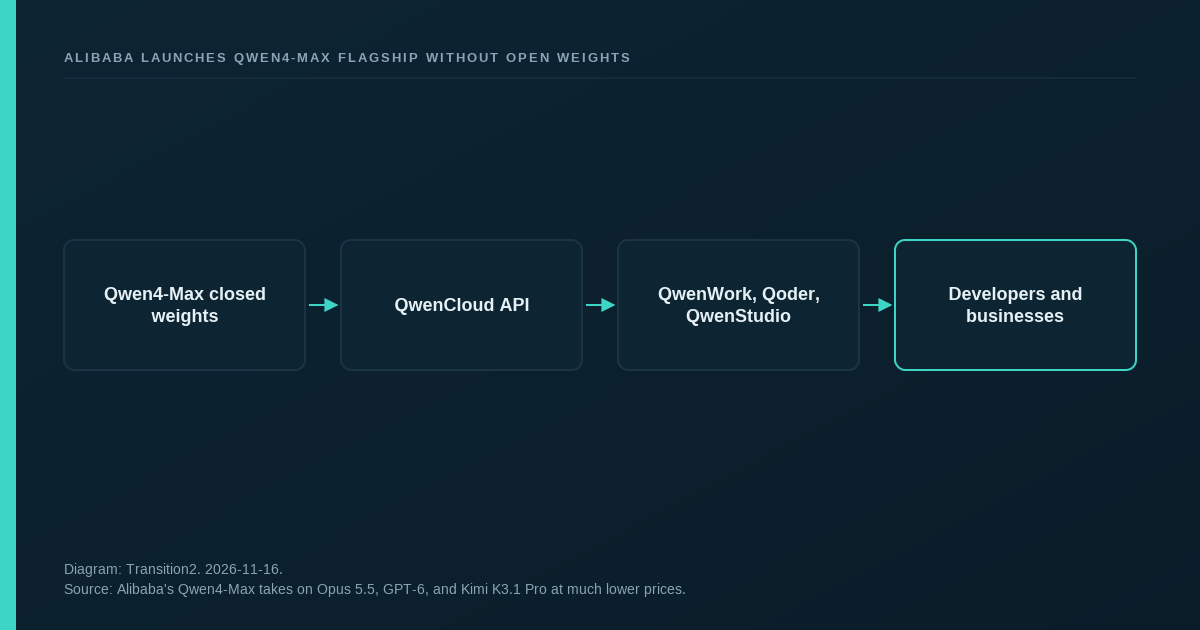
Alibaba launched Qwen4-Max on November 16, 2026, a mixture-of-experts model it says has 2.4 trillion total parameters, a 1M-token context window and API pricing of $1.50 per million input tokens and $4.50 per million output tokens (The Decoder). The weights are closed; Alibaba says smaller Qwen4 models will get open weights, with no date given. Most performance figures are Alibaba's own claims, and the one independent score in the sources places the model behind Kimi K3.1 Pro.
What happened
The launch followed a limited preview that opened on November 11, according to AlphaSignal.
Alibaba describes Qwen4-Max as a mixture-of-experts model with 2.4 trillion total parameters (The Decoder). The Decoder's Jonathan Kemper reports, citing Alibaba, that it activates 71B parameters per token (The Decoder). The context window is 1M tokens.
Pricing is $1.50 per million input tokens and $4.50 per million output tokens (The Decoder), with cache hits listed at $0.075 by the same outlet. The model is available through the QwenCloud API and in the QwenWork, Qoder and QwenStudio apps (The Decoder).
The Max tier stays closed. Alibaba says smaller Qwen4 models will be released with open weights but has not given a date (The Decoder).
On benchmarks, the figures are Alibaba's. Alibaba reports 48.5 on Terminal-Bench 4.0, behind Claude Opus 5.5 at 59.6 and Kimi K3.1 Pro at 67.2 (The Decoder). On Alibaba's own Work360 benchmark, the company says average cost per task fell from $4.43 with Qwen3.8-Max to $1.67 (The Decoder).
The only third-party number in the sources is the Artificial Analysis Intelligence Index, which scores Qwen4-Max at 43, against 34 for Qwen3.8-Max and 46 for Kimi K3.1 Pro, as reported by The Decoder.
Alibaba says it removed attack-focused cyber training data and added CBRN safety training (The Decoder). The Decoder reports that internal reviewers found no meaningful CBRN uplift. Alibaba also claims the model worked autonomously for 48 hours on designing a data-center chip coolant, which was then made and lab-tested (The Decoder).
The sources disagree on several details. AlphaSignal, writing during the preview, said no parameter count had been published and described 1M tokens as only a client default in Qwen Code; that page does not mention a 2.4T figure. The Decoder attributes 2.4T and a 1M context to Qwen4-Max, and says Qwen3.8-Max also has 2.4 trillion parameters. The Decoder names the comparator Kimi K3.1 Pro and describes native image processing. The desk could not read Alibaba's own launch post, which did not render.
Why it matters
The pricing and context window put Qwen4-Max into direct comparison with frontier models from other labs, and The Decoder's framing is that it competes "at much lower prices" (The Decoder). On Alibaba's own numbers the model trails Opus 5.5 and Kimi K3.1 Pro on Terminal-Bench 4.0, and it trails Kimi K3.1 Pro on the one independent index.
The weights decision matters as much as the price. With the Max tier closed, the flagship can only be used through Alibaba's API and apps (The Decoder), and open weights are promised only for smaller models without a date.
The cost-per-task claim on Work360, from $4.43 to $1.67, is the kind of figure buyers care about, but it comes from Alibaba's own benchmark, as reported by The Decoder, and has not been independently checked in the sources.
The Transition2 desk did not run an experiment for this story because the weights are closed and access requires a QwenCloud account or API key.
What it means for businesses
For buyers comparing frontier models, Qwen4-Max adds a lower list-price option, but every performance and cost figure except the Artificial Analysis score is Alibaba's own claim (The Decoder). A cost-per-task claim on a vendor benchmark is a starting point for an internal evaluation, not a substitute for one, which is the approach covered under Evaluation & ROI. Closed weights mean deployment depends on Alibaba's QwenCloud service and apps, so self-hosting the flagship is not an option (The Decoder). Teams that planned around open Qwen models will need the smaller Qwen4 releases, which have no date.
What it means for AI users
For people using Alibaba's apps, Qwen4-Max is available in QwenWork, Qoder and QwenStudio (The Decoder). The 1M-token context means long documents and large code bases can in principle fit in a single request, though preview-era reporting from AlphaSignal treated 1M as a client default rather than a model specification. Alibaba's claims about safety training and a 48-hour autonomous design run are vendor statements and have not been independently verified in the sources.
What it means for developers
Developers get API access through QwenCloud at $1.50 and $4.50 per million input and output tokens, with cache hits listed at $0.075 by The Decoder. For agentic coding work, the reported Terminal-Bench 4.0 score of 48.5 trails Opus 5.5 and Kimi K3.1 Pro on Alibaba's own chart. Running a team's own task suite against these models is the direct way to test that, and closed weights mean any such evaluation must go through the API. Model selection practice is covered under Models & Practices.
Copyright Eric MacDougall.
Sources
- Alibaba's Qwen4-Max takes on Opus 5.5, GPT-6, and Kimi K3.1 Pro at much lower prices (accessed 2026-11-17)
- Alibaba Launches Qwen4-Max With Agent-First Coding and 1M Token Support (accessed 2026-11-17)