News · AI Products & Copilots · Evaluation, Measurement & ROI
Genie 4 opens in the Gemini API at about $0.10 per second
Google's Genie 4 world model is now available to developers through the Gemini API and AI Studio, with token pricing that works out to about $0.10 per second of streamed video and 120-second sessions.
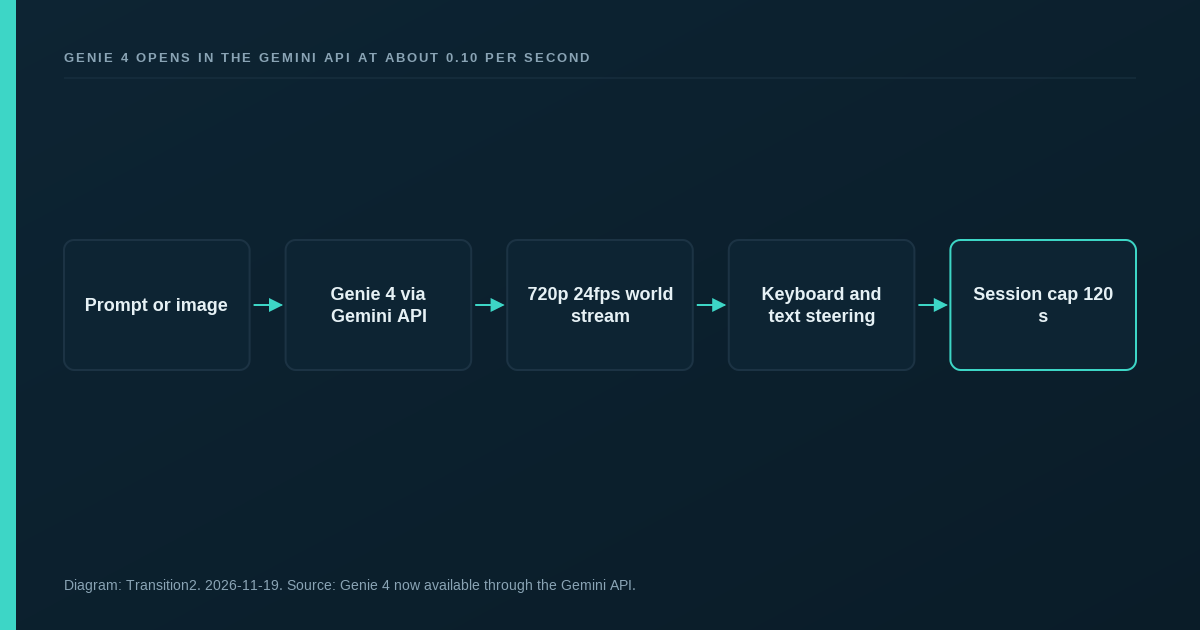
Google opened its Genie 4 world model to developers on November 19, 2026, through the Gemini API's Interactions API and Google AI Studio, a day after the consumer Project Genie rollout (Google). The launch post states no price. Google's Gemini API pricing page now lists rates that work out to about $0.10 per second of streamed video output, or about $6.05 per minute (Google AI Studio docs). Sessions are capped at 120 seconds.
What happened
According to Google's launch post, Genie 4 is available to developers through the Gemini API (Interactions API) and Google AI Studio from November 19. Developer access followed the consumer Project Genie rollout on November 18. The model generates continuous 720p, 24fps worlds with synchronized native audio from a text prompt, a reference image or both. Users steer with keyboard controls and with live text prompts that change weather, lighting, objects or events. Google says every output carries an imperceptible SynthID watermark.
The model ID is genie-4 (models/genie-4), per the Gemini API pricing page.
Pricing comes from that page, not the launch post. Google lists $1.50 per 1M input tokens, $9.00 per 1M text output tokens and $17.50 per 1M video output tokens (Google AI Studio docs). Video bills at 240 tokens per frame, or 5,760 tokens per second, which works out to about $0.10 per second or $6.05 per minute (TestingCatalog). There is no free tier, and the Batch API, Flex and Priority inference are not supported (Google AI Studio docs).
Sessions are capped at 120 seconds, PPC Land reports. Calling complete() ends a session and stops billing (Google AI Studio docs). Browser apps stream over WebRTC and server code uses WebSockets, according to TestingCatalog. PPC Land also reports that visual stability may degrade after 60 to 90 seconds.
Two discrepancies are worth noting. PPC Land reported that the pricing page had no Genie 4 entry when it published, while the pricing page now lists one, so the entry was added after launch. Coverage also disagrees on serving regions. TestingCatalog lists the US, Western Europe and Japan, while Unite.AI reports US data centers only.
Why it matters
Genie 4 turns a world model into something developers can call and meter. The billing unit is effectively streamed time. At the listed video rate, every second of a running world costs about the same, so the main cost lever is how long sessions stay open (Google AI Studio docs). That makes the complete() call, which stops billing, an operational control as well as an API detail.
The constraints shape what can be built. A 120-second cap (PPC Land) and a reported stability drop after 60 to 90 seconds point toward short, focused experiences rather than long sessions. The absence of a free tier and of Batch, Flex and Priority options (Google AI Studio docs) means every prototype session is billed at the standard rate from the first call.
Finally, the pricing record is new and still settling: it appeared after launch, and the launch post itself gives no price (PPC Land).
What the Transition2 desk tested
The desk ran an arithmetic check of the published pricing. It is not a test of the Genie 4 model. Nothing in the check called a Google API, ran a model or used a key, and the sandbox had network access denied.
The check took the rates on Google's pricing page as fetched on 2026-11-20: $17.50 per 1M video output tokens, and 240 tokens per frame at 24 fps. From those it computed tokens per second, cost per second, cost per minute, and the cost of a session that runs to the 120-second cap, rounding to cents with ROUND_HALF_UP. Three negative controls had to fail to match the published figures: a 10x-wrong price ($1.75 per 1M), a wrong frame rate (30 fps), and an excluded aggregator claim of a 180-second session.
Versions: Python 3.9+ standard library only (decimal, json), with no third-party packages. The rates are hard-coded constants copied from the pricing page.
Results, verbatim:
CHECK tokens_per_sec_consistent: PASS 240*24=5760
CHECK per_second_about_0_10: PASS exact=0.1008
CHECK per_minute_6_05: PASS exact=6.048
CHECK session_120s_12_10: PASS exact=12.096
CHECK neg_wrong_price_rejected: PASS got=0.60
CHECK neg_wrong_fps_rejected: PASS got=7.56
CHECK neg_180s_session_differs: PASS got=18.14
CHECKS 7/7
All 7 checks passed. The exact per-second figure of $0.1008 rounds to $0.10, the exact per-minute figure of $6.048 rounds to $6.05, and a full 120-second session at $12.096 rounds to $12.10. The negative controls produced values that did not match, which shows the comparison could fail.
What this does not show. It says nothing about model quality, latency, stability, regions or rate limits, and it does not verify that Google actually bills this way. It covers video output tokens only. Input tokens ($1.50/1M) and text output tokens ($9.00/1M) from prompts and live steering are excluded, so real sessions will cost somewhat more. If Google changes the pricing page, this check will not notice.
What it means for businesses
For budgeting, the desk's arithmetic puts the video output cost of a session that runs to the 120-second cap at $12.10, before input and text output tokens. Teams can multiply that by expected sessions to bound a pilot, then add a margin for steering prompts. With no free tier (Google AI Studio docs), evaluation itself carries a cost, so a short, scripted test plan is cheaper than open exploration.
Where data location matters, the regional discrepancy between TestingCatalog and Unite.AI should be resolved with Google before committing. The Evaluation & ROI hub covers how to frame pilots like this.
What it means for AI users
People who meet Genie 4 worlds in apps built on the API should know that, according to Google, every output carries an imperceptible SynthID watermark. The worlds run at 720p and 24fps with synchronized audio and respond to keyboard input and text prompts. Experiences built on the API will be short by design, given the 120-second cap (PPC Land), and quality may slip toward the end of longer sessions.
What it means for developers
The practical details are the model ID genie-4, WebRTC for browser clients and WebSockets for server code (TestingCatalog), and a hard 120-second session limit. Call complete() as soon as a session's purpose is met, since it ends the session and stops billing (Google AI Studio docs). Build idle timeouts and an explicit end-of-session path rather than relying on the cap.
Design for the reported stability window by keeping critical moments early in a session (PPC Land). Because the pricing entry appeared after launch, watch the pricing page and treat cost estimates as tied to the date they were made.
Copyright Eric MacDougall.
Sources
- Genie 4 now available through the Gemini API (accessed 2026-11-20)
- Gemini API pricing (Genie 4 entry) (accessed 2026-11-20)
- Google charges developers about 10 cents a second for Genie 4 worlds (accessed 2026-11-20)
- Google opens Genie 4 world model to developers in Gemini API (accessed 2026-11-20)
- Google Opens Genie 4 World Generation to Gemini API Developers (accessed 2026-11-20)