News · Models, Tooling & Developer Practice · Evaluation, Measurement & ROI
OpenAI releases GPT-6.2 Astra and Sol, cuts Astra API rates
OpenAI added both models to its API and lowered Astra's published rates for uncached input, cached input and output.
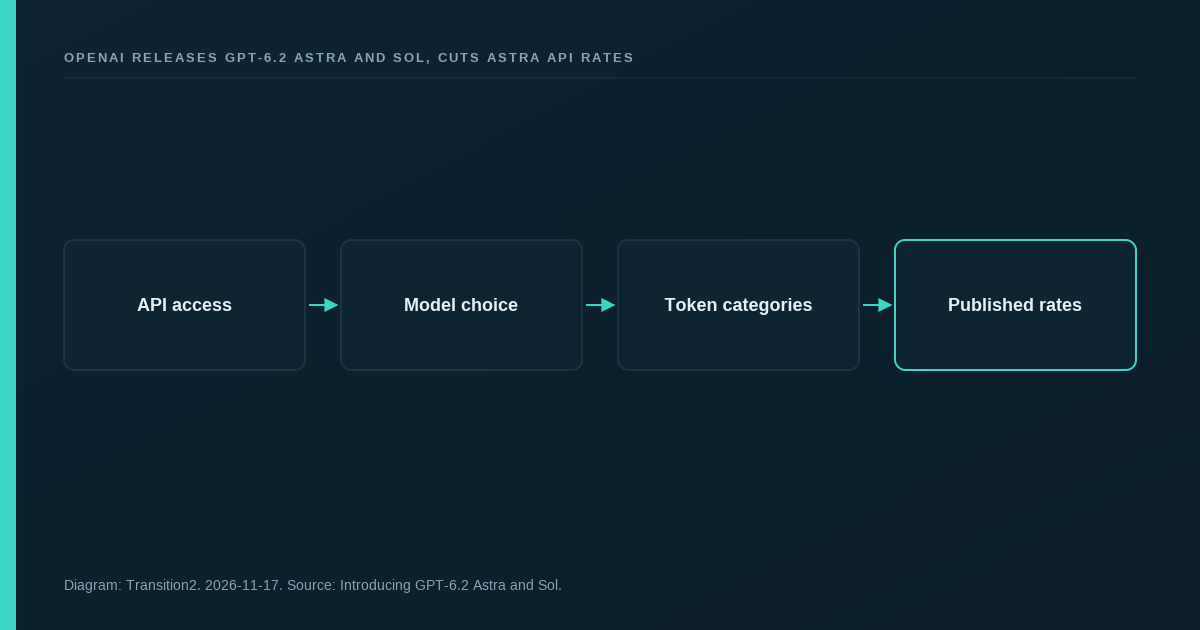
OpenAI released GPT-6.2 Astra and GPT-6.2 Sol on November 17, 2026, making both models available through its API. OpenAI's published rates for Astra are 20% below GPT-6 Astra for both uncached input and output, with a separate 60% reduction for cached input. OpenAI announcement
What happened
OpenAI positions Astra for demanding projects and Sol for everyday work. The API identifiers are gpt-6.2-astra and gpt-6.2-sol, so an API caller can select either model explicitly. In a separate account of the release, Simon Willison reported adding both identifiers to his LLM client. That gives developers a concrete example of how the new options appear in a client alongside OpenAI's announcement of API availability. OpenAI announcement Simon Willison's Weblog
Axios summarized Astra as 20% cheaper. OpenAI's published comparison is more specific. The company reports a 20% reduction for uncached input and output and a 60% reduction for cached input, each relative to GPT-6 Astra. The distinction matters when using the headline figure in a budget, since the published comparison has separate rates for usage that falls into different billing categories. Axios OpenAI announcement
Why it matters
The announcement gives teams a model choice and a rate comparison. OpenAI's description of demanding projects and everyday work offers a starting point for choosing what to evaluate. The Astra comparison answers a different question about what the provider charges for the same amount of usage in a given category. A team evaluating a switch can therefore ask separately whether the model meets its quality requirements and how applicable rates would affect its bill. OpenAI announcement
The category split matters even when comparing Astra with its predecessor at fixed usage. A workload with a larger share of its previous spend in cached input would show a larger rate-only reduction under the published comparison. An actual workload comparison has to account for how much input is billed in each category and how much output the model produces. The published percentages are fixed inputs to that calculation. The quantities have to come from the workload being assessed. OpenAI announcement
There is also a difference between a model being selectable and a team having evidence for a change in its default. The API identifiers establish which alternatives a team can call, and Willison's account shows that both identifiers can be represented in a client. A change to the default brings a separate set of questions about which requests should use it and how to judge the results. Those questions sit at the center of AI Reliability & Operations. OpenAI announcement Simon Willison's Weblog
The Transition2 desk did not run an experiment because testing model behavior or billed usage requires a hosted account, while an offline client stub could only check request formatting.
What it means for businesses
For a business already budgeting for GPT-6 Astra, the direct comparison is with the rates it uses for uncached input, cached input and output. Holding usage fixed can isolate the effect of the published rate changes. A second comparison can then incorporate measured usage from a representative run. Keeping those calculations separate helps explain whether a difference came from the rate schedule, a change in token usage or the mix of the two. OpenAI announcement
For a team considering both models, the descriptions of Astra and Sol can help define the evaluation. Everyday requests and demanding project work can have different acceptance criteria. An internal summary may mainly need to preserve the relevant facts, while a deliverable that another team will act on may need additional checks for omissions and unsupported conclusions. These are examples of criteria a business can set for itself when applying OpenAI's positioning to real work. OpenAI announcement
What it means for AI users
The immediate change applies to people using the API or a client that exposes the new model IDs. Someone comparing responses can keep the request and supporting material fixed and record which model produced each answer. That makes the comparison easier to interpret if the answers differ in length, detail or adherence to the request. The corresponding API identifiers also make the record more precise than a note that simply says GPT-6.2. OpenAI announcement Simon Willison's Weblog
OpenAI's everyday and demanding labels are most useful when the user can say what a successful answer would look like. A routine transformation might be judged by whether it follows a requested format and keeps the original meaning. A more demanding task might require reconciling several constraints or explaining where the supplied material leaves room for doubt. The release supplies the model options for that comparison. The user's task supplies the standard for judging the response. OpenAI announcement
What it means for developers
Explicit model selection makes it possible to compare the new models without changing which one handles every request. A developer can record the model identifier beside each evaluation result, preserve the same inputs for another run and compare outcomes by task type. Teams with a model registry or configuration layer have a practical distinction to preserve between adding an available model and assigning it to a workflow. OpenAI announcement Simon Willison's Weblog
Cost reporting should keep the billing categories visible for the same reason model reporting should keep the identifiers visible. An aggregate estimate may be sufficient for a budget summary, while the underlying breakdown lets a developer explain the result. In this release, cached input has a different percentage reduction from uncached input and output. A comparison that preserves those categories can reflect the published change and show which assumptions account for the estimated savings. OpenAI announcement
Copyright Eric MacDougall.
Sources
- Introducing GPT-6.2 Astra and Sol (accessed 2026-11-18)
- GPT-6.2 Astra and GPT-6.2 Sol (accessed 2026-11-18)
- Microsoft aims to challenge OpenAI, Anthropic with cheaper, specialized AI models (accessed 2026-11-18)