News · Evaluation, Measurement & ROI · Models, Tooling & Developer Practice
METR finds AI research task gains and weaker expert judgment
The evaluation found rapid gains on its combined task suites and stronger human performance when tasks required judgment without clear empirical feedback.
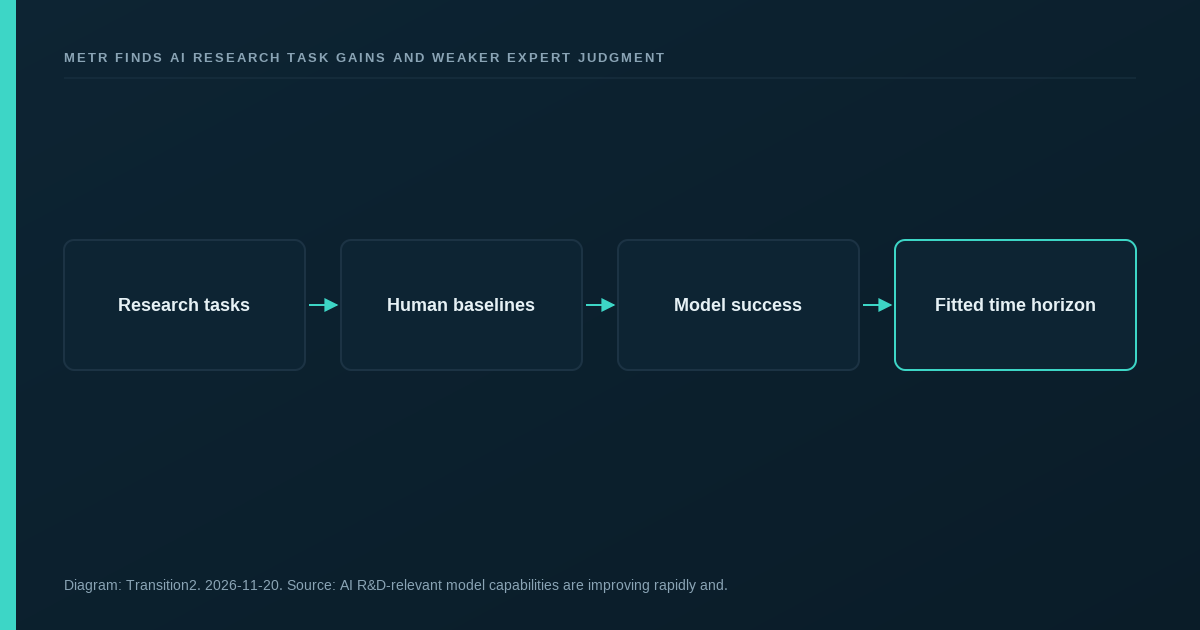
On November 20, 2026, METR released an evaluation combining its Time Horizon 1.1 and Time Horizon 2 task suites to track performance on work relevant to AI research. METR reports that its fitted 50% time horizon doubled roughly every 3.6 months across the combined suites. Frontier models often matched or exceeded recruited human baseliners on selected coding and optimization tasks, while human experts generally performed better on tasks requiring judgment without clear empirical feedback. METR capability update
What happened
METR combined two collections of tasks, Time Horizon 1.1 and Time Horizon 2, for its analysis of how task duration relates to model success. The 50% time horizon expresses that relationship in units of estimated human task duration. It is the duration at which the fit predicts 50% model success. The human duration describes the task on the benchmark's scale, and the success probability describes model performance on that scale. METR capability update
On the combined sets, METR estimated that the fitted horizon doubled roughly every 3.6 months. METR capability update METR also reported a shorter doubling estimate for the verifiable subset of Time Horizon 2. Frontier Now coverage Because those estimates come from different mixes of tasks, the combined estimate belongs with the combined suites and the shorter estimate belongs with the subset. Dropping the task mix from the description would obscure what each fit represents. METR capability update
The comparisons with people add a different kind of evidence. METR says frontier models often met or exceeded recruited human baseliners on selected coding and optimization tasks. On tasks that called for judgment without clear empirical feedback, METR says human experts generally did better. The update also reports a separate composite capability index, which showed no clear overall acceleration or deceleration among the public models tested. METR capability update
Why it matters
The time horizon is easy to read as a time allowance because its unit is duration. The underlying measurement, however, ties estimated human duration to predicted model success. For an evaluation reader, the relevant question is what a model can complete at the specified predicted success rate on tasks represented by the suite. The figure does not give the amount of time a model ran or the share of an arbitrary assignment it could carry through. METR capability update
The subset result makes task selection part of the interpretation. A fit for verifiable tasks emphasizes a different mix of work from the combined fit. Meanwhile, the composite index addresses how capabilities change across the public models it covers. A rapidly rising fitted horizon and an index showing no clear change in the overall rate can describe different aspects of the same evaluation update. A reader comparing them needs the metric and the tasks beside each conclusion. METR capability update
The desk did not run an experiment because testing the reported trend requires frontier model runs, the task environments and the corresponding human-duration baselines. A synthetic fit could illustrate how the metric works while leaving the empirical finding untested.
What it means for businesses
The report supports treating verifiable execution and expert judgment as distinct evaluation questions. For example, an internal trial could give a model an optimization task with a defined success measure and separately ask it to judge a case for which empirical feedback is absent. The observable outcome from the first exercise would answer a different question from expert assessment of the second. That distinction reflects the split METR found between selected tasks with measurable outcomes and tasks that relied on judgment. METR capability update
A business case based on the combined horizon should specify which parts of its proposed workflow resemble the tasks behind the estimate. It should also identify which parts require a different kind of evidence. This is the distinction covered by Evaluation & ROI. The benchmark can inform how a trial is designed, while the trial's own results carry the claim about a particular workflow. METR capability update
What it means for AI users
A user reading the update can distinguish between a model completing a task with criteria that can be checked and a model making a judgment that the available evidence cannot settle. When an answer has both elements, a working check on the first part gives a basis for assessing that part. The reasoning behind the judgment still needs to be examined on its own terms. METR's results give a concrete reason to keep the two assessments visible. METR capability update
The 50% figure matters when deciding what to infer from a benchmark headline. It marks the predicted success level used to define the horizon, rather than a guarantee for any individual task at a matching estimated human duration. Confidence in a particular answer depends on what can actually be verified about it. METR capability update
What it means for developers
The update provides a reason to retain task-level context when reporting an aggregate. An evaluation record can identify the task suite or subset, the basis for estimated human duration and the criterion for model success. That enables another reader to see whether a reported shift comes from comparing the same tasks or from changing the mix. METR's different fits for the combined suites and the verifiable subset illustrate why that context belongs with the number. METR capability update
A development team can also report measurable outcomes and expert assessments separately before combining them. Keeping both visible helps an evaluator determine whether a model improved at completing tasks with observable feedback, at handling ambiguous judgment, or at both. METR's report gives examples of those categories yielding different human and model comparisons. METR capability update
Copyright Eric MacDougall.
Sources
- AI R&D-relevant model capabilities are improving rapidly and are getting harder to measure (accessed 2026-11-21)
- Frontier Now coverage of the METR capability update (accessed 2026-11-21)