News · Models, Tooling & Developer Practice · Data & Knowledge Foundations · AI for SaaS & Software Companies
Three open-weight releases: Spark, Nemotron and ERNIE change the menu
Meta, NVIDIA and Baidu shipped large open-weight models between October 15 and November 5. License terms, modality and serving footprint set them apart.
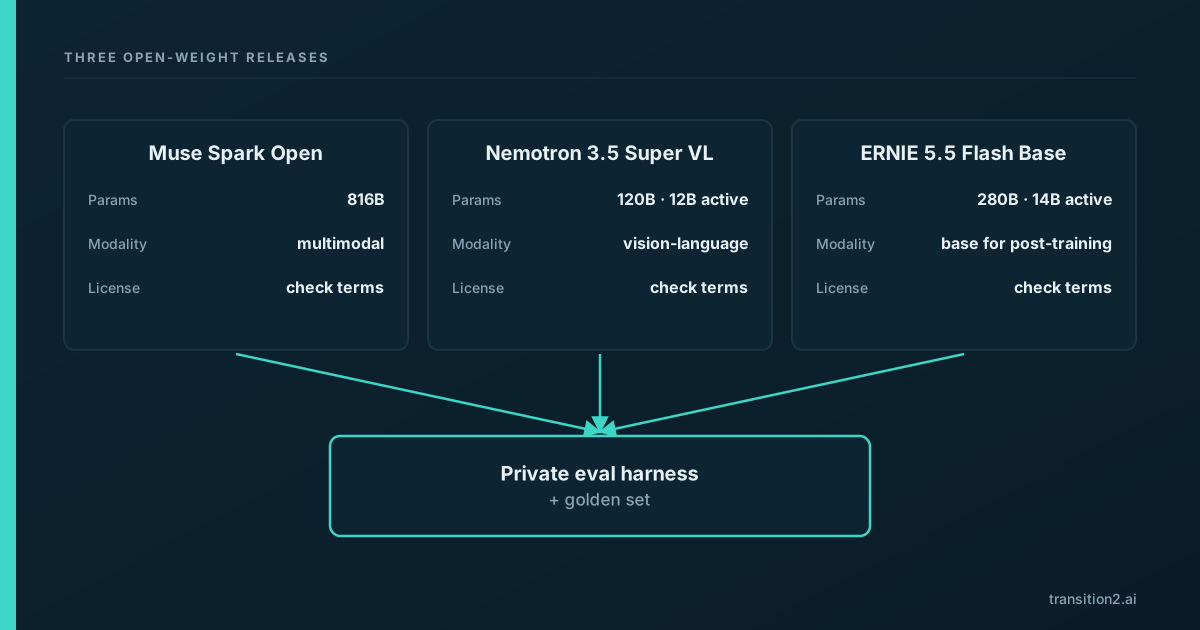
Between October 15 and November 5, 2026, three large open-weight models arrived: Meta's Muse Spark Open and NVIDIA's Nemotron 3.5 Super VL on October 15, and Baidu's ERNIE 5.5 Flash Base on November 5. Each is positioned as a base for teams that want to run or adapt their own models. The choice among them is less about any single benchmark and more about three practical questions: what the license allows, what the model can see and produce, and what it takes to serve and evaluate it.
What happened
Meta's Muse Spark Open is a multimodal model listed at 816B/42B parameters, the common notation for total and active parameters in a sparse model. It is released under the Muse Model License, Meta's own license rather than a standard open-source one. The license grants broad rights but requires a "Built with Muse Spark Open" notice on products that use the model or its derivatives. It also requires large model-as-a-service providers, with more than US$20 million in group revenue, to sign a separate agreement with Meta. The model card puts the self-hosting floor at 700GB of GPU memory for NVFP4 weights and 2TB for BF16.
NVIDIA's Nemotron 3.5 Super VL is a vision-language model listed at 120B/12B parameters. NVIDIA releases it under OpenMDW-1.1, a short permissive license that requires keeping notices when redistributing and places no restrictions on outputs. NVIDIA's model card lists 4x H100 or 2x GB200 GPUs for deployment.
Baidu's ERNIE 5.5 Flash Base is a 280B/14B mixture-of-experts model. Baidu presents it as a base model, intended for adaptation rather than as a finished assistant. It ships in FP8 and BF16 under the ERNIE 5.5 Flash Base Model License Agreement v1.0, Baidu's own license.
| Model | Organisation | Released | Parameters (as listed) | Modality | License | |---|---|---|---|---|---| | Muse Spark Open | Meta | 2026-10-15 | 816B/42B | Multimodal | Muse Model License (attribution; MaaS clause) | | Nemotron 3.5 Super VL | NVIDIA | 2026-10-15 | 120B/12B | Text, images, video | OpenMDW-1.1 (permissive) | | ERNIE 5.5 Flash Base | Baidu | 2026-11-05 | 280B/14B, MoE | Base model for adaptation | ERNIE 5.5 Flash Base Model License v1.0 |
The table uses only the figures each organisation publishes on the linked pages. The desk has not run these models, and the table makes no claim about relative quality.
Why it matters
With several strong releases in a matter of weeks, choosing an open model now looks like a portfolio choice. Each of these models suits a different shape of work.
License shapes what you can build. The three releases use three different license approaches. OpenMDW-1.1 is close to a permissive software license. The Muse Model License adds attribution and a separate-agreement trigger for large resellers of model access. ERNIE's license is Baidu's own agreement and needs its own read. For any commercial use, the license is the first filter, before quality. A model that performs well but whose terms do not fit the intended product is not a candidate, and legal review often takes longer than an eval run.
Modality shapes which workflows fit. A vision-language model such as Nemotron 3.5 Super VL is a natural candidate for document-heavy work where layout and images matter. A broad multimodal model such as Muse Spark Open covers more input types. A base model such as ERNIE 5.5 Flash Base is a starting point for teams that intend to fine-tune or otherwise post-train on their own data, and it should not be expected to behave like an instruction-tuned assistant out of the box.
Active parameters shape serving. In sparse models, the active parameter count drives much of the compute per token, while the total count drives memory. The three releases sit at very different points: 12B, 14B and 42B active, against 120B, 280B and 816B total. Those figures alone say a lot about the hardware footprint each needs, which in turn shapes latency and throughput for a given deployment.
A measurement angle
The only comparison that matters for a given organisation is on its own tasks. A fair evaluation keeps everything else constant:
- One golden set per workflow, built from representative internal examples with known good outcomes, run against every candidate.
- One serving stack where possible, so that differences reflect the model rather than the runtime.
- Matched settings: the same prompts, the same decoding parameters, the same context length.
- Operational measures alongside quality: latency, throughput and memory footprint at the expected load.
Record the results with the model version and license terms reviewed, so the decision can be revisited when the next release arrives.
What it means for businesses
Match the license to commercial plans before anything else, and plan for private evaluations before any migration. Open weights move the evaluation and serving work in-house; that is the point of choosing them, and it needs owners and time. If the intended use involves customer data, the ability to run the model inside your own environment may be the deciding factor, which ties model choice to the data foundations work that decides what the model can see.
Treat the three releases as a menu rather than a ranking. A document-heavy workflow might shortlist the vision-language option, a team with a strong post-training practice might shortlist the base model, and a team that needs broad input types might shortlist the multimodal one. Writing down which workflow each candidate is being considered for keeps the evaluation focused and makes the eventual decision easier to explain to risk and legal reviewers.
Avoid treating a release announcement as a migration plan. Run the candidates against current production behaviour on the same tasks, and move only the workflows where the evidence supports it.
What it means for AI users
Open does not mean unsupervised. A self-hosted model still needs the guardrails a hosted one has: access controls, logging, content filters suited to the use, and a way to report bad output. Base models in particular, such as ERNIE 5.5 Flash Base, are not finished assistants. If a tool built on one behaves oddly, that may reflect how it was adapted rather than the base model itself, and the team running it should hear about it.
What it means for developers
Standardise serving and evaluation across candidates. Pick one serving stack. vLLM and SGLang are documented for all three: Meta lists both for Muse Spark Open, NVIDIA's model card has instructions for both, and Baidu says both serve ERNIE 5.5 Flash Base through the completions API. Build the golden set once and reuse it for every model, so the comparison is fair and repeatable. The models and developer practice hub covers golden set design and model selection patterns.
Plan capacity from the listed parameter counts: total parameters for memory, active parameters for compute per token. For base models intended for adaptation, allow time for post-training and for evaluating the adapted model separately from the base, since the adapted model is what ships. Keep the license text, model version and eval results together in the repository, so the next review starts from evidence rather than memory.
Sources
- Muse Spark Open (accessed 2026-11-06)
- Nemotron 3.5 Super VL (accessed 2026-11-06)
- ERNIE 5.5 Flash Base (accessed 2026-11-06)
- Muse Spark Open model card (Hugging Face) (accessed 2026-11-06)
- Nemotron 3.5 Super VL model card (Hugging Face) (accessed 2026-11-06)
- OpenMDW License Agreement, version 1.1 (accessed 2026-11-06)