News · Models, Tooling & Developer Practice · AI for SaaS & Software Companies · Data & Knowledge Foundations
Baidu releases ERNIE 5.5 Flash Base open weights for post-training
Baidu released ERNIE 5.5 Flash Base, a 280B-total, 14B-active MoE checkpoint from the end of pre-training, as a starting point for fine-tuning.
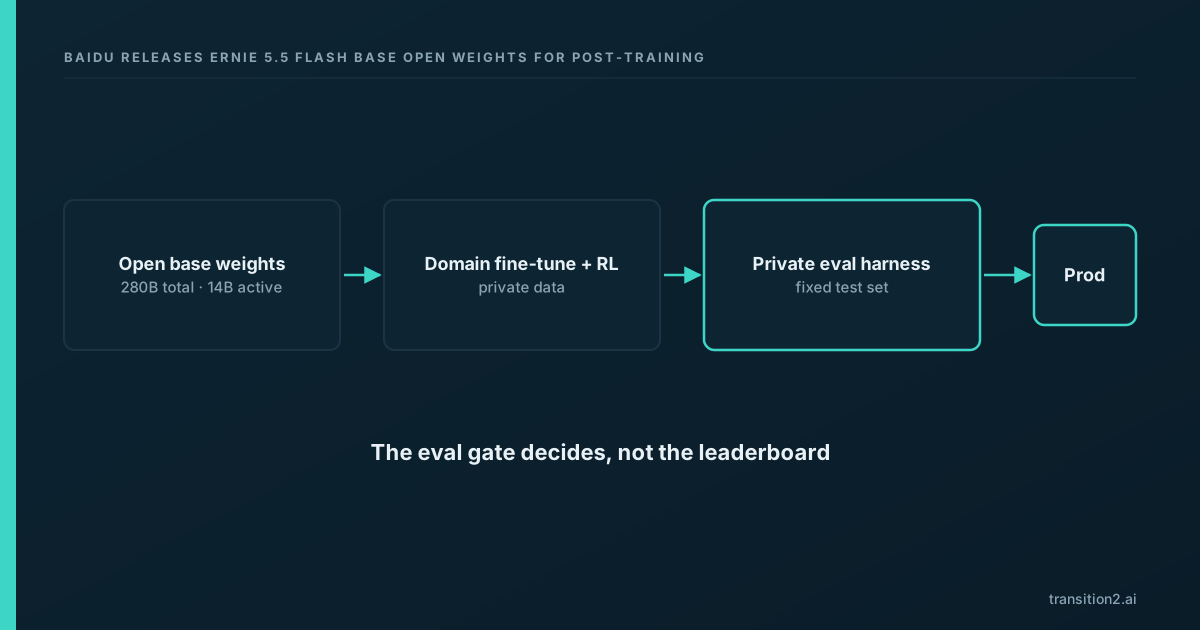
Baidu released ERNIE 5.5 Flash Base as open weights on November 5, 2026: a mixture-of-experts model with 280B total parameters and 14B active per token, trained on 33.5T tokens (Baidu). It is a base model taken at the end of pretraining, intended as a starting point for fine-tuning rather than as a finished assistant. For teams that adapt models to their own domain, it is another large open option. Its benchmark tables come from Baidu's own evaluation runs, and its license is Baidu's own.
What happened
According to Baidu's release page:
- Architecture. A sparse, hybrid-attention mixture-of-experts (MoE) model with 280B total parameters, of which 14B are active for any given token.
- Stage. The checkpoint at the end of pre-training, before any mid-training or post-training.
- Training. Pre-trained from scratch on 33.5T tokens with the Muon optimizer and FP8 mixed precision.
- Context. The training context was extended gradually to 128K tokens; Baidu says fine-tuning and inference support a 1M-token context.
- Benchmarks. Baidu compares the model with three open base models of similar size, DeepSeek-V4-Flash-Base (284B total, 13B active), Hy3-preview-Base (295B, 21B) and MiMo-V2.5-Base (310B, 15B), all run through the same harness, prompts and few-shot examples. It reports MMLU 93.3 (5-shot) against 89.4, 87.5 and 87.6 for those three, and HumanEval+ 82.3.
- Distribution and license. Weights are on Hugging Face in FP8 and BF16 safetensors under the ERNIE 5.5 Flash Base Model License Agreement v1.0.
The 1M context figure is a supported length for fine-tuning and inference, not the length the model was trained on. The benchmark scores come from Baidu's runs and have not been independently reproduced in the sources available to this desk.
Why it matters
An MoE model with 14B active parameters does far less compute per token than a dense model of 280B, while still drawing on a much larger set of learned parameters. That combination is why large MoE bases have become popular starting points for teams that want strong capability with manageable inference compute.
A base checkpoint, rather than a chat-tuned one, matters for post-training. Teams that run their own supervised fine-tuning or reinforcement learning on domain data often prefer to start before someone else's alignment choices are baked in. Open weights also mean the adapted model can run where the data lives, which is relevant for organisations with strict data residency rules. The Data & Knowledge Foundations hub covers preparing the domain data that this kind of adaptation depends on.
What it means for businesses
Open base models give more options for domain adaptation and reduce dependence on a single hosted provider. They do not remove the need for evaluation and governance. Read the ERNIE 5.5 Flash Base Model License Agreement before planning commercial use; it is Baidu's own license, not a standard open-source one. Plan for the full lifecycle: data preparation, post-training, evaluation, and ongoing review of model behaviour after deployment. Because this is a base checkpoint, safety and instruction-following behaviour will come from your own post-training, so the review step carries more weight than it would for a finished assistant model.
What it means for AI users
Vendor benchmark numbers are starting points. A score of 93.3 on MMLU from the publisher's own harness says the base is capable, not that a fine-tuned version will handle your tasks well. Judge any product built on it by how it performs on the work you actually do.
What it means for developers
Post-train on your own data with a fixed evaluation set held out before production. Baidu notes that the model expects a BOS token at the start of every input, so keep add_special_tokens=True when tokenizing. Re-run the published benchmarks in your own harness before relying on them, and test long-context behaviour directly at the lengths you need, since 1M is a claimed extension beyond the 128K training length. Measure throughput and latency on your serving hardware, because MoE efficiency depends heavily on how the experts are served.
Sources
- ERNIE 5.5 Flash Base release (accessed 2026-11-06)