News · Evaluation, Measurement & ROI · Models, Tooling & Developer Practice · AI for SaaS & Software Companies
Model routing after Haiku 5.5 and Argon: measure the successful task
Claude Haiku 5.5 and Gemini 4 Argon widen the small-to-frontier price gap. Routing and caching now decide cost per successful task more than any one model.
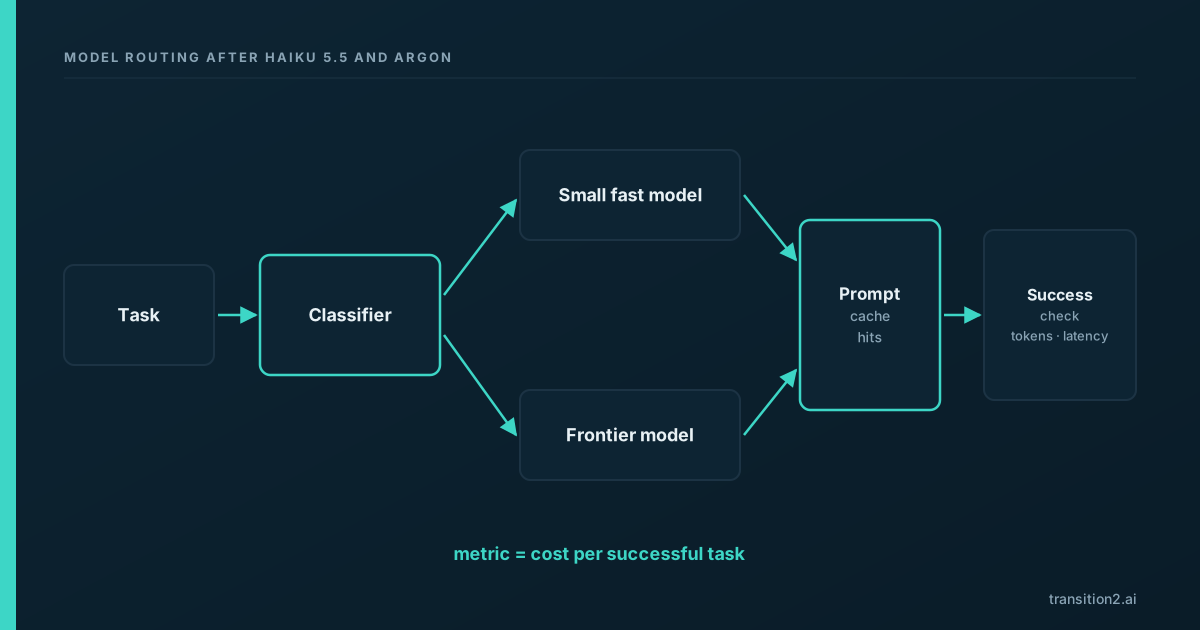
On October 13, 2026, Google made Gemini 4 Argon generally available, six days after Anthropic introduced Claude Haiku 5.5 on October 7. One is a small, fast model aimed at volume work; the other is a frontier model. Taken together, they make the case that the useful question is no longer which single model to standardise on, but how to route each task to the smallest model that completes it, and how to measure tokens, latency and usage per successful task rather than per call.
What happened
Anthropic's Haiku 5.5 announcement positions the model as the efficient tier of its lineup. It lists Haiku 5.5 at $0.10 per million input tokens and $0.50 per million output tokens for prompts up to 100K tokens ($0.50 and $2.50 above that), against $1 and $5 for Haiku 4.5, and says it costs around 75% less to run on average. The same announcement halves Sonnet 5.5 cache reads from $0.20 to $0.10 per million tokens, which Anthropic says makes Sonnet 5.5 around 20% cheaper on most agentic work. One caveat matters for per-task math: Anthropic's model documentation says Haiku 5.5 uses a newer tokenizer, so the same text counts as roughly 30% more tokens than on Haiku 4.5.
Google's Argon general availability post presents Argon as a frontier model. Google lists an introductory price of $2 per million input tokens and $10 per million output tokens until November 30, 2026, rising to $4 and $20 from December 1. Any team that adopted Argon during the introductory window should check that date against its own usage plans.
A third, smaller signal comes from Anthropic's Claude Code team. A developer update on subagent status lines says Haiku 5.5 now writes the status line for background subagents from short notes, so each update costs about 99% less than re-reading the whole conversation. It is a narrow example, but it is the routing idea in miniature: frequent, simple calls go to the small model, and the heavier reasoning stays where it is needed.
Why it matters
When the gap between a small model and a frontier model widens, picking one model for everything becomes a poor fit in both directions. Standardising on the frontier model means sending routine steps, such as classification, extraction, formatting and status updates, to a model that uses far more compute than the step requires. Standardising on the small model means hard steps fail more often, and each failure triggers retries, escalations or human rework.
Routing addresses both. A router looks at an incoming task, or a step within a task, and sends it to the lightest path in compute terms that is likely to succeed. Caching sits alongside it: if a long system prompt or a reference document is reused across many calls, cache reads mean the model does not reprocess the same tokens every time. Halving the Sonnet 5.5 cache-read price makes that design choice worth more.
The metric that ties this together is usage per successful task. Per-call figures hide failures. A small model that answers in a fraction of the latency but fails often on a given task type may use more total tokens, once retries and escalations are counted, than a larger model that succeeds first time. The only way to know is to measure success, not just calls.
A measurement angle
A minimum viable measurement setup has four parts:
- A golden set per task type: a fixed collection of representative inputs with known good outcomes, used offline to compare candidate models and routes before any change ships.
- A success definition that does not depend on the model grading itself: schema validation, an exact-match check, a downstream system accepting the output, or a human spot check on a sample.
- Per-route accounting: tokens in, tokens out, cache hits, latency and retries, logged by route so that the small and frontier paths can be compared on the same tasks.
- An online monitor: success rate per route in production, with an alert when it drops below the offline baseline.
With those in place, the headline number becomes tokens and latency per successful task, broken down by route. That number is what should move when a team adds a router, adjusts a threshold or changes models.
What it means for businesses
Adopt usage per successful task as the unit metric for AI workloads, alongside quality, and report it by workflow. The models and developer practice hub covers model selection patterns in more depth. Commercial terms change: Google says Argon's introductory price ends on November 30, 2026, and doubles from December 1. A workload that is efficient because of a temporary term is not efficient by design, so revisit routing decisions whenever a vendor's terms move.
For software companies building AI features, the same logic applies to the product itself. The AI for SaaS hub discusses how feature design interacts with model choice. A feature that routes well can serve more users within the same compute envelope.
What it means for AI users
Expect faster small models on routine steps and frontier models on hard ones, sometimes within the same conversation. If an assistant answers simple requests almost instantly and pauses on complex ones, that may be routing at work. If quality drops on a task that used to work, report it with an example; routed systems can send a task down the wrong path, and user reports are one of the signals that catch it.
What it means for developers
Implement routers with offline golden sets and online monitors, not intuition. Start with a simple rule, such as a task type label or an input length threshold, and measure it against the golden set before trying a learned classifier. Keep a fallback: when the small path's output fails validation, escalate to the frontier path and log the escalation, because the escalation rate is the clearest signal that the threshold needs tuning.
Structure prompts so that stable content comes first and can be cached, and track the cache hit rate per route. Log tokens, latency, retries and outcome for every call with the route attached, so that usage per successful task can be computed rather than estimated. When Anthropic or Google changes a model or its terms, rerun the golden set and compare before switching any production route.
Sources
- Introducing Claude Haiku 5.5 (accessed 2026-11-06)
- Claude Haiku 5.5 model documentation (accessed 2026-11-06)
- Gemini 4 Argon GA (accessed 2026-11-06)
- Claude Code developer update on subagent status lines (accessed 2026-11-06)