News · Models, Tooling & Developer Practice · AI Products & Copilots · AI for SaaS & Software Companies
Gemini 4 Argon goes GA for developers and enterprises
Google made Gemini 4 Argon generally available on Oct 13, 2026 with a 1M-token window shared by input, thinking and output. Intro pricing ends Nov 30.
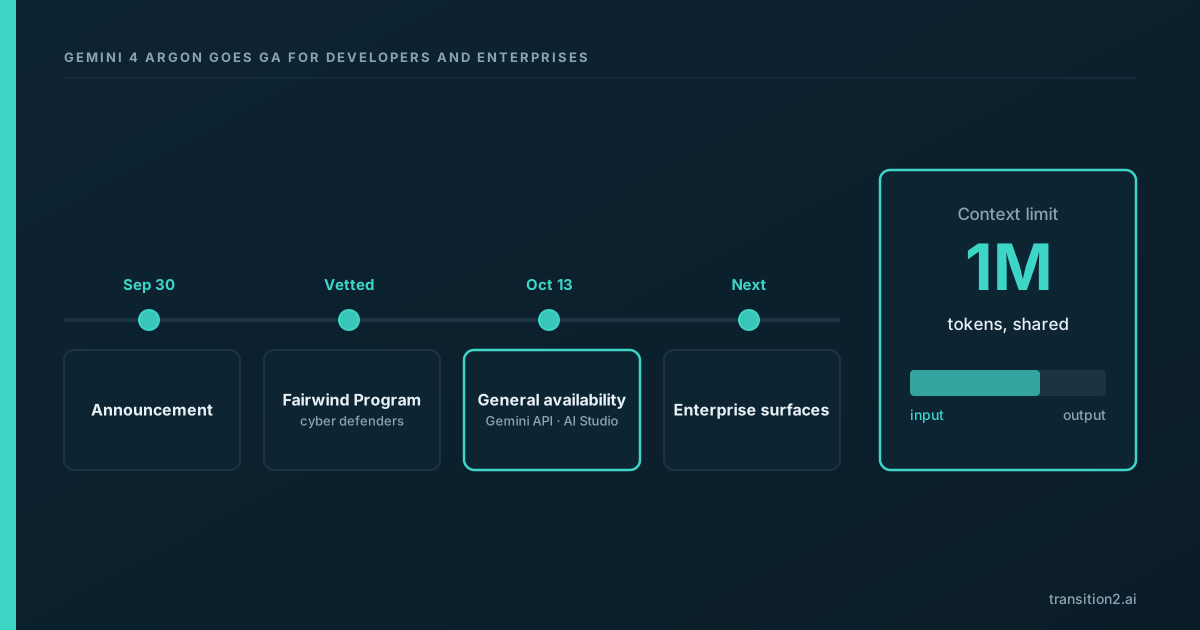
Google made Gemini 4 Argon generally available on October 13, 2026, through the Gemini API, Google AI Studio, and its enterprise surfaces, aiming the model at complex coding, knowledge work, and cyber defense (Google). Through the Gemini API, Argon has a 1M token window that input, thinking and output share, and it can generate far past the 64K-token output cap of earlier Gemini models. That unified limit, more than any single benchmark, is what changes how teams should structure long-running agent work. So does the calendar: Google's introductory price ends on November 30.
What happened
Google first announced Gemini 4 Argon on September 30, 2026. About two weeks later, its general availability post opened the model broadly. The key points from Google's announcements:
- Availability. Generally available from October 13, 2026, via the API in AI Studio and the Gemini platform, in Gemini for business, and in Google Antigravity for Google AI Ultra subscribers. Google AI Ultra and Pro subscribers also get it in the Gemini app and AI Mode in Search.
- Unified context. A 1M token window in the Gemini API that input, thinking and output share. Google's September post says the output limit rose to 1M tokens from 64K.
- Price. An introductory $2 per million input tokens and $10 per million output tokens, with cached input 95% off, through November 30, 2026. From December 1 the price is $4 and $20.
- Benchmarks. Google says Argon ranks first on the Vals Index, which weights finance, coding, legal and tax work by each sector's contribution to U.S. GDP, and first on Zapier's AutomationBench at 51.3%. These are Google's claims, and this desk has not reproduced them.
- Cyber defenders. Google's Fairwind Program, open by application, gives cyber defenders access to the model without the cyber guardrails applied to general users. Google says it is expanding the program to hundreds of additional partners.
Google's developer guide is the reference for how the limit behaves in practice. On the Interactions API, requests still default to a 65,536-token output limit; to generate more, a request sets background=True and a higher max_output_tokens, up to 1M tokens minus the input. Finer-grained client-side continuation is currently available only through the legacy GenerateContent API.
Why it matters
A shared limit changes planning for long runs. With separate input and output limits, a team can fill the context with documents and still count on a fixed amount of room for the answer. With a unified limit, every token of input reduces what is left for output, and vice versa. For long-horizon agent work, where a run accumulates tool results, intermediate notes, and generated artifacts over many turns, the question becomes how to divide one 1M token allowance across the whole run. Teams that assumed earlier Gemini behaviour, with a 64K output cap, should read the developer guide rather than carry those assumptions forward.
General availability is an operational threshold. A model in preview is something to experiment with. A generally available model is something teams can reasonably build products on, with the expectation of stable access through standard surfaces. For organisations that already work inside Google's enterprise tools, availability through those surfaces means Argon can be adopted under existing access controls rather than through a separate pilot channel.
Benchmark leadership is a starting point. A first-place result on the Vals Index across finance, coding, legal, and tax is useful context for teams in those domains, and it is reported by Google. Domain benchmarks rarely match a specific organisation's documents, terminology, and quality bar exactly. Treat the result as a reason to test, not as a reason to switch.
Phased access for cyber use is a policy choice worth noting. The Fairwind Program separates general access, with cyber guardrails, from vetted defender access without them. In that pattern, the most sensitive capability is gated by who the user is rather than only by what they ask. Google uses the same program for phased access to its next frontier model, Gemini 4 Carbon, announced on October 28 (desk coverage).
The Models, Tooling & Developer Practice hub covers model selection more broadly, and the AI Products & Copilots hub covers building user-facing features on top of models like this one.
What it means for businesses
Evaluate on your own work before committing a significant volume of it to Argon, and price the evaluation at the December 1 rates, not the introductory ones. General availability makes the model easy to reach, which is a reason to put a short evaluation step in front of adoption rather than a reason to skip one. If finance, legal, coding, or tax workflows are in scope, build a representative test set from your own documents and compare Argon against your current model on accuracy, completion rate, and latency.
Decide which surface each team will use. Developers may start in AI Studio or the Gemini API, while production workloads may belong on Google's enterprise surfaces where existing identity, logging, and data controls already apply. Write that choice down so experiments do not quietly become production dependencies.
If your security team does defensive work, the Fairwind Program is an option to consider through Google's application process. Any such access should run in isolated environments with logging and human review of outputs before they are acted on.
What it means for AI users
A long unified context helps with multi-step work: an assistant can keep more of a long document, conversation, or project in view at once. It does not guarantee the assistant uses all of it well. Answers drawn from long inputs still need grounding in the source material, and important outputs still need checking.
If a long session starts producing shorter or truncated answers, the shared limit may be the reason: a large amount of input leaves less room for output.
What it means for developers
Treat the 1M token limit as one allowance for input, thinking and output combined. Track tokens per turn, reserve room for the longest output you expect, and summarize or drop stale context before the run approaches the limit. Remember that the default output cap on the Interactions API is still 65,536 tokens unless you opt into a background long decode, and set max_output_tokens high enough that thinking does not crowd out the answer but low enough to bound spend.
Thinking level is tunable (low, medium or high, with medium the default); measure quality and tokens at each level for your tasks. Write tests that exercise the boundary: a long input with a long expected output, and a multi-turn agent run that accumulates context.
Log the token count of each request and response in long runs, so that when a run fails near the limit the cause is visible in the record rather than inferred afterwards.
Build evaluations around your tasks rather than published rankings. Measure task success, latency, and tokens per successful task, and rerun them when Google ships model updates.
Sources
- Gemini 4 Argon is now available for everyone (accessed 2026-11-06)
- Gemini 4 Argon developer guide (accessed 2026-11-06)
- Earlier Argon announcement (Sep 30) (accessed 2026-11-06)
- Introducing Gemini 4 Carbon (accessed 2026-11-06)