News · Enterprise AI Governance · Models, Tooling & Developer Practice
Report finds Blackwell fingerprints in six open-weight models
A checkpoint forensics report says initialization patterns in six recent open-weight models match NVIDIA Blackwell GPUs, and a CPU replay of its code passed all 14 of the Transition2 desk's own checks.
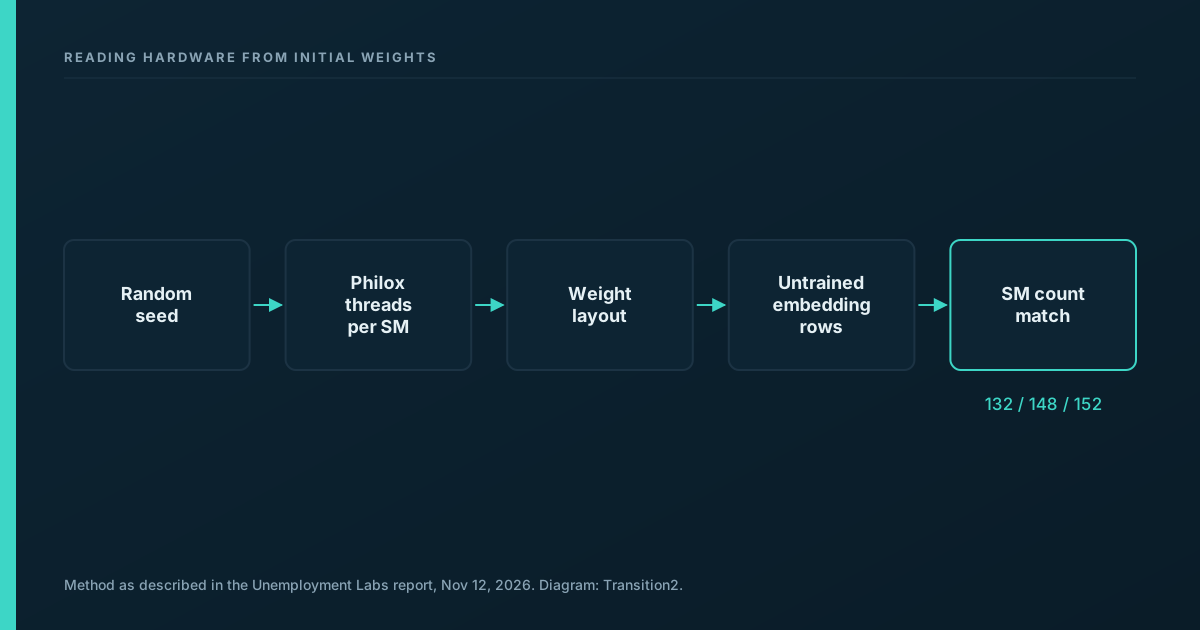
A report dated November 12, 2026 by Will DePue of Unemployment Labs says six open-weight models released since April 2026 by DeepSeek, Moonshot AI, MiniMax and Ant Group carry initialization patterns that match NVIDIA Blackwell hardware (Unemployment Labs). The Register and The Decoder covered it on November 13 (The Register; The Decoder). The report says the method identifies the hardware that generated a model's starting weights, not where any chip was, who owned it, or whether export controls were broken. The Transition2 desk re-ran the published code on a CPU-only machine, and all 14 of the desk's own checks passed.
What happened
According to the report, six recent models from the four labs match Blackwell, while earlier models from the same labs match Hopper. The Register and The Decoder reported the same finding.
The method relies on how PyTorch fills new weight tensors on a GPU. As the report and code describe it, PyTorch's CUDA normal_ function uses the Philox generator with 2,048 threads per streaming multiprocessor (SM). Element i is written by thread i mod G, where G = 2048 x the number of SMs, so the same seed puts values in different positions depending on how many SMs the GPU has. Embedding rows for tokens never seen in training keep their initial values, which preserves the layout in the released weights. The report lists Hopper H100, H800 and H200 at 132 SMs, B200 and B300 at 148, and GB200 and GB300 at 152.
By the report's reading, DeepSeek-V4-Flash and MiniMax-M3 match 148 SMs, and DeepSeek-V4-Pro, Kimi K3, Kimi K3.1-Pro and Ling-3.1-flash match 152 (Unemployment Labs). The newest readable models from Qwen, GLM, Tencent, Xiaomi and StepFun read as Hopper.
The report describes two kinds of validation. First, the method agreed with all 24 cases where developers had disclosed their hardware, which the report calls a consistency check rather than a measured accuracy rate. Second, it reports physical confirmation: on a B300, unmodified PyTorch reproduced 461 of 469 selected DeepSeek-V4-Flash rows; on an H100, all 57,344 preserved DeepSeek-V3 values matched bit for bit; on a rented GB200, all 13 Kimi K3 rows matched; and seed+1 reproduced none (Unemployment Labs; code).
The code and preserved rows are public, and the report says the replay "runs on a laptop in a few seconds" (Unemployment Labs). The author's thread on X drew about 6.3 million views by November 13, and one post on X argued that a fingerprint does not prove where chips were or that any rule was violated.
Why it matters
The report offers a public, reproducible way to infer one fact about a model's origin from artifacts left in its released weights (Unemployment Labs). For anyone doing provenance due diligence on open-weight models, that adds a new signal. The report is just as clear about what the signal cannot show:
- It identifies the hardware that generated the starting weights, which may not be the hardware used for training.
- It cannot say who owned the chips or where they were.
- It does not establish an export-control violation.
- A specially configured AMD MI300X can reproduce the 148 and 152 layouts. The report excludes this for V4-Flash on numerical grounds and judges it very unlikely for the other models.
- Models initialized with PaddlePaddle or on CPUs leave no GPU fingerprint, so a missing match says nothing.
- Its cluster-size estimates are low-confidence and were revised the same day.
Policy discussions should follow the report's own boundaries (Unemployment Labs). A match narrows down the class of hardware that initialized a model. It is not evidence about how the hardware was obtained.
What the Transition2 desk tested
On November 13, the desk ran its own ./run.sh wrapper against the checkpoint-forensics repository in a throwaway virtual environment, with dependencies pinned in the desk's requirements.txt and upstream pinned to commit b633870c4a8b0f85d70026b7f77f7d0858358f89. The machine was x86_64 Linux with Python 3.13.5, numpy 2.1.3 and scipy 1.14.1, and no GPU. The run had four steps:
replay.pyon the bundled rows (upstream's own check).REFETCH=1 replay.pyfor DeepSeek-V3-Base, Kimi-K3 and MiniMax-M3. This deletes the bundled rows, downloads them again from the pinned Hugging Face revisions with range requests, and asserts they match the sha256 in models.json.control_noise.py, a desk-written control that runs random Gaussian rows with no GPU origin, swept over 16..256 SMs.checks.py, which runs the desk's 14 pass/fail checks: 10 on the bundled replay against the upstream README table, 3 on the refetch and 1 on the noise control.
The upstream repository ships no run.sh, requirements.txt or checks.py; the desk wrote all three, so the 14 checks are the desk's own, not upstream's.
Results:
- 14/14 of the desk's checks passed (results/checks.json). The replay took about 3 seconds wall.
- The bundled replay reproduced the README table exactly: DeepSeek-V3-Base 132 SMs 8/8 rows; DeepSeek-V4-Flash 148 SMs 461/469; Kimi-K3 152 SMs 13/13; MiniMax-M3 148 SMs 17/17; Ling-3.1-flash-base 152 SMs 384/384 (median r 0.983, as the README says for the bf16 trunc_normal path). Seed+1 controls all
|r| < 0.005. - Rows re-downloaded from Hugging Face at the pinned revisions gave identical results for the three models tried.
- The desk's random-noise control: best layout median r 0.020 (no match), as expected.
This shows that the published code and data are internally consistent, that the rows really come from the public model weights at the pinned revisions, and that a control with no GPU origin produces no false match.
What this does not show: that the CPU model matches real GPU behavior, because the desk had no GPU and did not run upstream's gpu_check.py. It also does not show where any chip was, how it was obtained, or whether any export rule was broken. The report itself says the fingerprint identifies the initialization hardware, not the full training run. Not tested: the DeepSeek-V4-Flash and Ling refetch (larger downloads), the 24-model consistency check, and the cluster-size estimates the report calls low-confidence.
What it means for businesses
Treat the fingerprint as one input to model provenance review, not as a legal finding. The report itself does not establish where chips were or whether controls were violated (Unemployment Labs). Record the exact model revisions you deploy, so any later question about a model's origin can be tied to specific weights. The Enterprise Governance hub covers how to fold signals like this into vendor and model risk files.
What it means for AI users
The report is about how a model's starting weights were generated. It does not evaluate how the models behave or how safe they are (Unemployment Labs). Nothing in it changes how these models respond today. For background on comparing models, see Models & Practices.
What it means for developers
The code is small and public, so teams can check the claims themselves rather than rely on summaries. The desk's run shows that the CPU replay and the hash-checked refetch work as documented at the pinned commit. Two lessons carry over. Pin model revisions and verify file hashes, as the replay does with models.json. And by the report's own logic, the same mechanism applies to any model initialized with PyTorch's CUDA normal_ whose untrained embedding rows survive training. Teams publishing their own weights should know that released checkpoints can reveal the class of initialization hardware.
Copyright Eric MacDougall.
Sources
- Top Chinese Frontier AI Models Carry the Fingerprint of Export-Controlled NVIDIA Blackwell GPUs (accessed 2026-11-13)
- checkpoint-forensics code repository (commit b633870) (accessed 2026-11-13)
- The Register coverage of the checkpoint forensics report (accessed 2026-11-13)
- The Decoder coverage of the checkpoint forensics report (accessed 2026-11-13)
- Will DePue post on X (accessed 2026-11-13)
- A Fingerprint Is Not a Customs Manifest (accessed 2026-11-13)