News · AI Reliability & Operations · Enterprise AI Governance · Models, Tooling & Developer Practice
Gemini 4 Carbon: frontier cyber model with deliberate rollout
Google announced Gemini 4 Carbon on Oct 28, 2026 with top reported cyber-defense scores, and is releasing it first to a subset of cyber defenders.
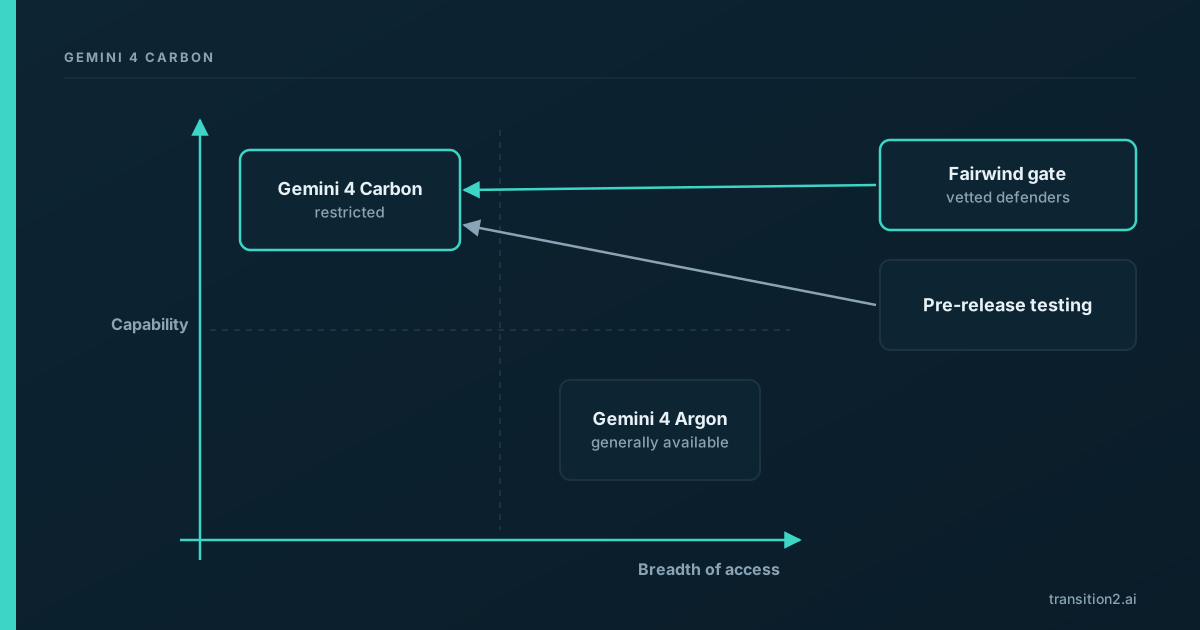
Google announced Gemini 4 Carbon on October 28, 2026, its next frontier model after Argon, with strong reported results on cyber-defense benchmarks, and did not make it generally available at announcement. Access starts with a subset of cyber defenders and expands in phases to trusted partners in Google's Fairwind Program, and Google says it is engaged in the U.S. government's voluntary process for pre-release model testing (Google). For security teams, the rollout design matters as much as the scores: a model this capable at finding and reasoning about vulnerabilities raises both defensive patch velocity and the risk of misuse.
What happened
According to Google's announcement, with additional reporting from The Verge:
- Announcement and access. Gemini 4 Carbon was announced on October 28, 2026. It was not generally available at announcement.
- Phased rollout. Google said that starting that week it would make Carbon available to a subset of cyber defenders, then gradually to more trusted partners through the Fairwind Program, and to developers, businesses and consumers later, after more work on guardrails.
- General ranking. Google cites Carbon as first on version 5.0 of the Artificial Analysis Intelligence Index, with a score of 59. The Verge reports that this puts it ahead of Claude Opus 5.5 and GPT-6 Astra on that index.
- Cyber benchmarks. Google reports 88.2% on SEC-bench Pro, which it uses for finding vulnerabilities; 54.8% on ExploitGym, for exploitation; and 71.0% on Collinear's CWE-bench, for patching at the root cause. These are vendor-reported figures and have not been independently reproduced in the sources for this article.
- Price. Google says Carbon will launch at the same introductory price as Argon, $2 per million input tokens and $10 per million output tokens.
The Fairwind Program is the same channel Google uses to give vetted cyber defenders access to Gemini 4 Argon without the cyber guardrails applied to general users. Argon is generally available; Carbon, at announcement, was not.
Why it matters
Capability and access are being managed separately. Carbon pairs top reported capability with deliberately narrow access. Argon pairs broad availability with guardrails for general users and a separate defender channel. Taken together, the two launches show Google treating "how capable is the model" and "who can use it, for what" as separate decisions. For organisations deciding whether and how to use cyber-capable models, that separation is a useful frame: the question is not only which model is strongest, but under what controls it runs.
The benchmarks point at both sides of security work. Google maps its three cyber benchmarks to three stages of the defender lifecycle: finding real vulnerabilities (SEC-bench Pro), checking which ones are exploitable so they can be prioritised (ExploitGym), and turning validated findings into fixes (CWE-bench). The same capability that helps a defender confirm a bug is real and prioritise a fix could help someone with the opposite intent. That dual-use nature is why phased access is the appropriate posture, and why scores alone are the wrong basis for a decision.
Pre-release testing adds an external check. Google says it is actively engaged in the U.S. government's voluntary process for pre-release model testing. The announcement describes participation; it does not publish results. It is still a meaningful process signal, since it puts an outside party in the review loop before broad release.
Isolation matters more than raw scores. A model that is strong at vulnerability work is most useful, and least risky, when it runs inside environments built for that work: isolated from production systems, with full logging, and with human review before any finding or patch is acted on. A defender team with a less capable model in a well-controlled pipeline may be better placed than one with a more capable model and weak controls.
The AI Reliability & Operations hub covers operational controls for models in sensitive pipelines, and the Enterprise AI Governance hub covers access policy and documentation.
What it means for businesses
If your security team obtains Fairwind access, run Carbon only in isolated defender workflows. That means dedicated environments separated from production, logging of every prompt and output, and human merge gates on any patch or configuration change it proposes.
Decide in advance which use cases are in scope, such as code review for known weakness classes, triage of reported vulnerabilities, or drafting fixes, and which are not. Record that scope in your AI governance documentation and review it when access terms or the model change.
When comparing vendor claims, keep the distinction between general rankings and task-specific results. A first place on a general intelligence index says little about how the model handles your languages, frameworks, and code base.
If you do not have access, the practical step is the same as for any wave of improved discovery tools: shorten the time from an available fix to a deployed fix.
What it means for AI users
Most people will not have access to Carbon for some time, by design. The phased rollout is a deliberate safety measure for a model with security-relevant capability, not a sign that the model is unfinished.
The visible effect for most users will be indirect: software vendors that use tools like this may ship security fixes more often. Installing updates promptly is the way to benefit.
What it means for developers
Do not publish exploit detail produced by cyber-capable models, in code, issues, chat, or blog posts. Focus outputs on the patch, the detection, and the class of weakness, which is what maintainers and defenders need.
If you build tooling around Carbon or similar models, keep the model's environment isolated, log inputs and outputs to a store with restricted access, and route every proposed change through normal code review. Never wire such a model directly to production systems or deployment credentials.
Treat vendor benchmark scores as context. If you get access, evaluate on your own code and your own past vulnerabilities: measure how often the model identifies the correct weakness class, how often its proposed fixes pass your tests and review, and how often it produces false positives that take up reviewer time.
Sources
- Introducing Gemini 4 Carbon (accessed 2026-11-06)
- The Verge coverage (accessed 2026-11-06)
- Gemini 4 Argon is now available for everyone (accessed 2026-11-06)