News · Enterprise AI Governance · AI Reliability & Operations · Models, Tooling & Developer Practice
MCP 2026-07-28: stateless core pushes auth to the edges
MCP 2026-07-28 swaps stateful sessions for a request/response core. Identity, token scope and sandboxing now carry the security load.
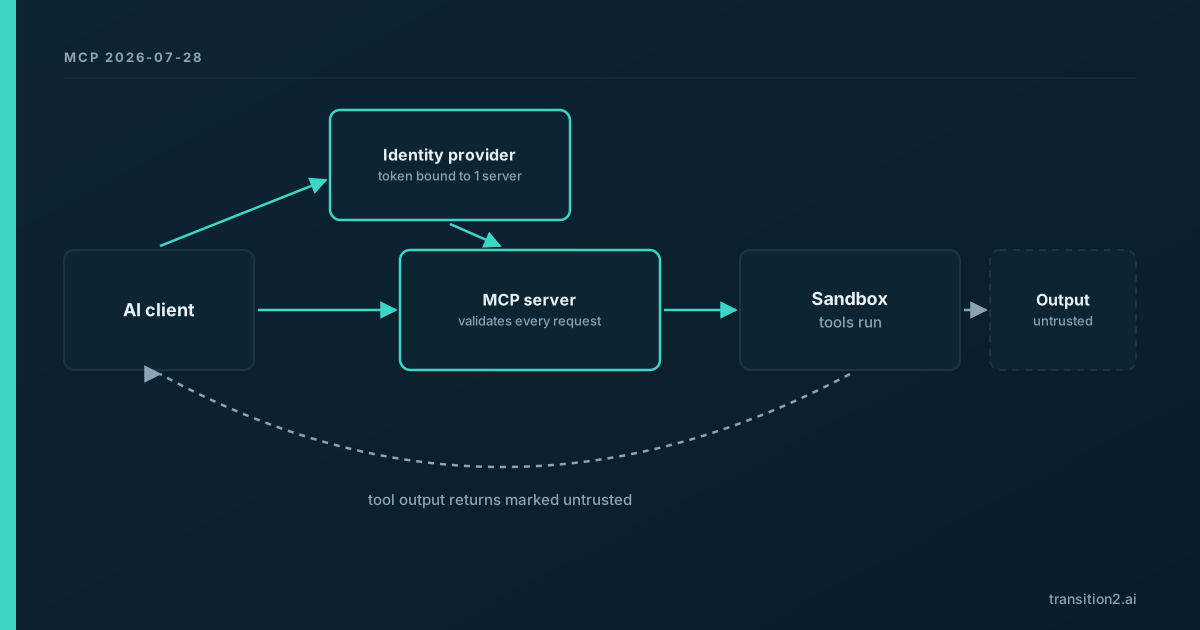
The Model Context Protocol revision dated 2026-07-28 moves MCP from a bidirectional stateful protocol to a stateless request/response core, so servers can run on serverless and edge infrastructure, according to Anthropic's article on bringing the release to Claude. Anthropic separately documents enterprise-managed authorization for MCP connectors, which lets organisations control connector access centrally. The practical consequence for enterprises is that a long-lived protocol session can no longer be treated as the safety boundary. Identity, least privilege and sandboxing become the controls that matter.
What happened
MCP is the open protocol that lets AI applications connect to external tools and data sources through MCP servers. The 2026-07-28 revision changes how that connection is structured.
- A stateless core. Per Anthropic's write-up, this fifth release of the specification moves MCP from a bidirectional stateful protocol to a request/response model, so servers can deploy on serverless and edge infrastructure. In a stateless design, any server instance can handle any request, which makes horizontal scaling simpler.
- Standardised extensions. MCP Apps and Tasks now ship under a versioned extensions framework, a formal path for interactive UIs and long-running work that does not change the core protocol.
- Auth hardening. Anthropic says authorization now aligns with production OAuth 2.0 and OpenID Connect deployments, so MCP servers can connect to enterprise identity systems such as Entra or Okta without workarounds. The same article says MCP recently passed 400 million monthly SDK downloads.
- Centrally managed authorization. Anthropic's enterprise-managed auth article describes how administrators can manage authorization for MCP connectors centrally rather than leaving each user to connect tools individually.
- Security guidance. OWASP publishes an MCP Security Cheat Sheet. Among other controls, it says to "prefer ephemeral, short-lived tokens over long-lived PATs", to validate that each access token was issued for the MCP server receiving it, and to "require explicit user confirmation for destructive, financial, or data-sharing operations". It also says to run local MCP servers in a sandbox with minimal privileges. The sheet is maintained over time, so check the current version before shipping.
The specification and Anthropic's article are dated July 28, 2026. This article reviews what the change means for enterprise deployments several months into adoption.
Why it matters
In a stateful protocol, a session established at the start of a connection carries context forward. Teams sometimes lean on that session as an implicit trust boundary: once a client is connected and authenticated, later requests inherit that trust. A stateless core removes that crutch. Every request has to stand on its own.
That shifts responsibility to three places.
The identity provider. If each request must carry proof of who is calling and what they may do, the token becomes the control. Central management of connector authorization, as Anthropic describes, puts that control in the hands of administrators and the organisation's identity provider rather than individual users.
The MCP server. A server that cannot rely on session state has to validate every request: check the token, confirm it was issued for this server, and confirm the requested action is within scope.
The tool execution environment. Tools reached through MCP can read files, call APIs and change records. Running them in a sandbox with narrow permissions limits the damage if something goes wrong.
Central management also changes who decides. When each user connects tools individually, an organisation's view of which connectors are active is partial at best. Moving authorization to administrators, as Anthropic's enterprise-managed auth article describes, gives security teams one place to grant, scope and revoke access, and one record of what has been granted. In a design where every request is checked against its token, scope changes and revocations made at the identity provider can apply without waiting for a long-lived session to end, provided servers validate each request.
There is also a class of risk that a stateless design does not remove: tool output is untrusted input. An MCP tool may return content from a web page, a document or a ticket that contains planted instructions. If an agent treats that text as a command and holds a broadly scoped or long-lived token, the planted instruction can lead the agent to misuse that credential. In effect, a planted prompt can become a stolen credential. The mitigations are architectural: short-lived, narrowly scoped tokens bound to a single server; treating all tool output as data rather than instructions; and human approval for sensitive actions. The OWASP cheat sheet is the reference to check for the current recommended controls.
For more on governance patterns, see the Transition2 Enterprise AI Governance hub and the AI Reliability and Operations hub.
Measuring readiness
A stateless protocol makes some controls easy to measure. Useful indicators for an MCP deployment:
- Token lifetime and scope. The share of MCP tokens that are short-lived and bound to a single server, versus long-lived or shared tokens.
- Request validation coverage. The share of server endpoints that validate the token audience and scope on every request.
- Sandboxed tools. The share of tools that run in an isolated environment with least-privilege access.
- Approval gates. The list of actions that require a human to confirm, and how often those gates fire.
- Connector inventory. A current list of which MCP connectors are enabled, who approved them and what each can reach.
These numbers are simple to collect and give security and platform teams a shared view of exposure.
What it means for businesses
Centralize MCP connector authorization in the identity provider and remove long-lived shared tokens. A stateless protocol means every request is only as safe as the token it carries, so token issuance, scope and lifetime belong under the same governance as any other enterprise access. Keep an inventory of approved connectors, assign an owner to each, and review them on a schedule. Require that vendors offering MCP servers explain how they validate requests and isolate tool execution.
What it means for AI users
Approve MCP tools the way you approve a third-party app asking for access to your account. Look at what each connector can read and change, and grant only what a task needs. Be cautious when an assistant proposes an action based on content it just read from a web page or document, because that content may contain instructions that did not come from you. If your organisation manages connectors centrally, use the approved ones rather than connecting tools on your own.
What it means for developers
Validate every request on the server: check the token, confirm it was issued for this specific server, and enforce scope per action. Do not depend on session state for authorization. Bind OAuth tokens to the intended server and keep them short-lived. Run tool execution in a sandbox with the minimum access each tool needs. Treat every tool output as untrusted data, never as instructions, and keep it separate from system prompts. Require explicit human approval for sensitive or irreversible actions. Check your implementation against the current OWASP MCP Security Cheat Sheet before shipping.
Sources
- Bringing MCP 2026-07-28 to Claude (accessed 2026-11-06)
- Centrally manage authorization for MCP connectors (accessed 2026-11-06)
- OWASP MCP Security Cheat Sheet (accessed 2026-11-06)