News · Enterprise AI Governance · AI for SaaS & Software Companies · Models, Tooling & Developer Practice
Private watermarks aim to measure model use without tracking people
An arXiv paper proposes locally differentially private watermarks that estimate how often text comes from a model without singling out any one text or user.
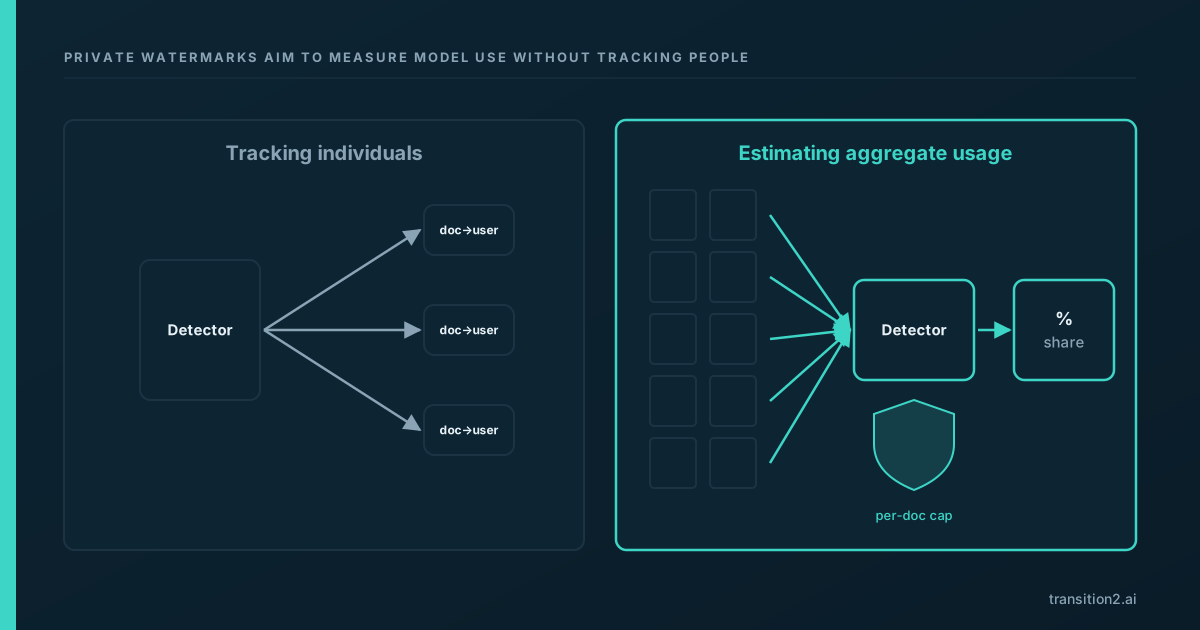
Language model watermarks can support provenance without tracking individual users, if their goal shifts from identifying who produced a given text to estimating how much text in a population came from a model. That is the argument of a paper by Elise L. Han and Tatsunori Hashimoto first posted to arXiv on November 4, 2026, which introduces a private watermark called Red-Green Sequence (RGS). The authors report low estimation error at strong privacy settings. The results are the authors' own and have not been independently replicated.
What the paper reports
The abstract opens with a tension. Watermarking has potential for regulating how language models are used, but many users argue that fine-grained tracking of their usage violates their privacy. The authors say that tension weakens watermarks in practice, because users turn to evasion such as paraphrasing, which can remove much of the watermark signal.
Their proposal is to change what a watermark is for. Instead of tracking individuals, a watermark can be designed to estimate aggregate usage. To do that, the authors develop locally differentially private watermarks. Local differential privacy is a formal guarantee that limits how much any single contribution can reveal. Here it provably limits how much evidence any one text can add to detection, while still allowing accurate estimates of how often watermarked text appears across a population.
RGS is their concrete scheme, which they describe as private and computationally efficient. The authors report that it achieves accurate frequency estimation at high privacy levels across various models, sample sizes and generation entropies, in settings they describe as reflecting realistic deployment.
The abstract gives two sets of figures. In differential privacy, a smaller privacy parameter, called epsilon, means a stronger privacy guarantee.
- On C4 language modeling tasks, at an epsilon of 1, the authors report a mean squared error of 0.0019 and a mean absolute bias of 0.0038.
- In a harder setting, an essay writing task with only 100 text samples, at an epsilon of 2, they report errors on the order of 0.0113 mean squared error with 0.004 mean absolute bias.
Because each text's contribution to detection is deliberately limited, the scheme is not built for confident attribution of single documents. The abstract does not report how RGS holds up against paraphrasing or other deliberate removal, or how it compares with existing watermarks on detection of individual texts.
Why it matters
Watermark debates often stall on a binary: strong provenance or user privacy. This paper offers a middle path for one class of question. Some governance questions are about how much model-written text is circulating in a setting, not who wrote a particular paragraph. A watermark built for that question can, on the authors' account, answer it while limiting what it reveals about any one person.
It also reframes evasion. The authors tie the loss of watermark effectiveness to users who feel tracked and paraphrase to strip the signal. A scheme that is built not to single people out addresses that objection directly, though whether it changes user behavior is not something the abstract measures. The Enterprise AI Governance hub covers bringing a decision like watermark policy under one owner.
What it means for businesses
Decide which question a watermark policy is meant to answer. Measuring how much model output appears in a channel is a different goal from attributing a specific document, and the paper suggests the two call for different designs with different privacy consequences. When a provider or platform offers watermarking, ask what it encodes, who can run detection, and whether results are individual or aggregate. Route the answers through privacy review as well as legal review, and keep that review proportionate.
What it means for AI users
A watermark built for aggregate estimation is designed not to prove that a particular text, or a particular person, used a model. Readers should not treat any single watermark result as a verdict on one document. Writers using AI tools at work should ask whether output is watermarked and whether detection is aimed at individuals or totals.
What it means for developers
Match the detector to the decision. A frequency estimator is the wrong tool for a moderation or enforcement workflow that acts on single documents. If aggregate estimation fits the use case, report both error and bias at the privacy setting in use, as the authors do, and test small sample sizes, since the abstract reports higher error in its harder 100-sample essay setting. Log scheme versions and privacy parameters with each estimate. The paper is the reference for the RGS construction.
Sources
- Reconciling Privacy with Provenance for Language Model Watermarks (arXiv) (accessed 2026-11-06)