News · Models, Tooling & Developer Practice · AI Products & Copilots · Software Factories & AI-Assisted Engineering
Nemotron 3.5 Super VL: open multimodal agents from data center to desktop
NVIDIA's Nemotron 3.5 Super VL is an open 120B-total, 12B-active vision-language model for agents, with Bolt models for local and edge hardware.
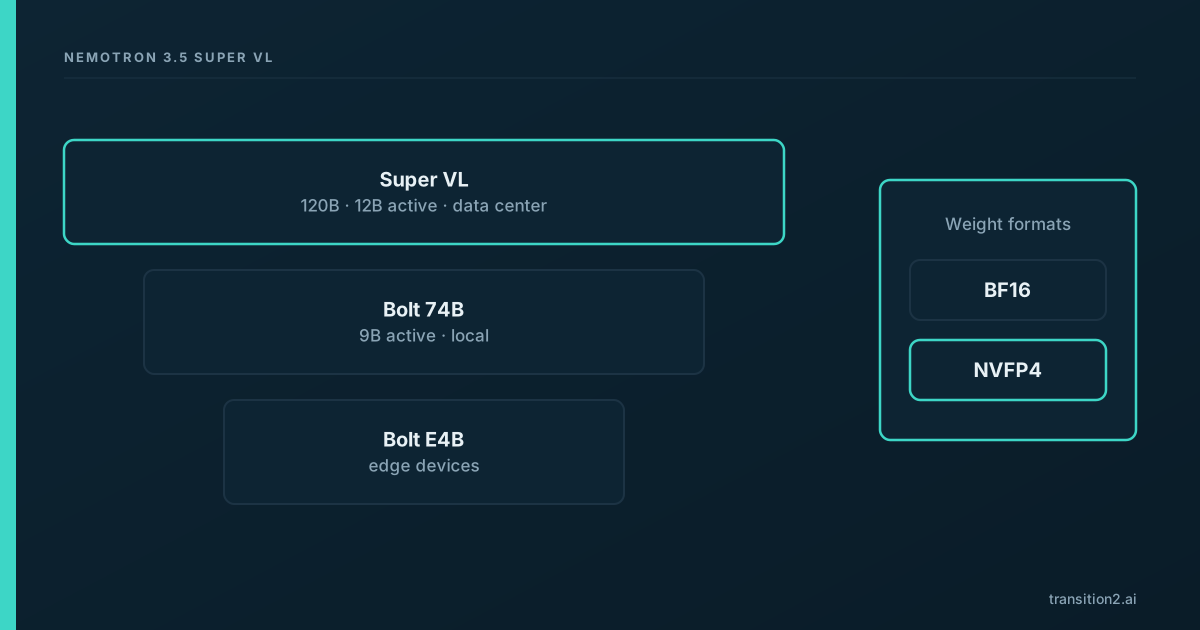
NVIDIA released Nemotron 3.5 Super VL on October 15, 2026, an open vision-language model built for agents that reads text, images and video. It is a mixture-of-experts model with 120B total parameters and 12B active, a context window of up to 1M tokens, and native multi-token prediction for speculative decoding, according to NVIDIA's announcement. Weights ship in BF16 and NVFP4 formats under the OpenMDW-1.1 license, and two smaller Bolt models extend the family to local and edge hardware. For teams that can run their own models, it is a new option for multimodal agents that stay running for long periods.
What happened
On October 15, 2026, NVIDIA published its Nemotron 3.5 Super VL announcement, with weights on Hugging Face and a technical page from NVIDIA Research. The main points:
- Architecture: 120B total parameters, 12B active per token, in a mixture-of-experts design.
- Inputs: text, images and video.
- Context: up to 1M tokens.
- Decoding: native multi-token prediction (MTP) for speculative decoding, a technique in which the model drafts several tokens ahead and then verifies them, which can reduce generation latency.
- Formats: BF16 weights and NVFP4 weights. NVFP4 is NVIDIA's 4-bit floating point format.
- Deployment: the Hugging Face model card lists 4x H100 or 2x GB200 GPUs.
- Training: NVIDIA's technical page says Super is distilled from Nemotron 3 Ultra Base. It says the NVFP4 checkpoint keeps a median 99.62% of BF16 accuracy across 36 benchmarks.
- License: OpenMDW-1.1.
- Smaller models: Bolt 74B-A9B, with 74B total and 9B active parameters, uses native 2-bit quantization to fit in 24GB of memory on RTX and DGX Spark systems, with support in llama.cpp, Ollama, LM Studio, Unsloth and vLLM. Bolt E4B, a 4GB model for voice and conversational agents on GeForce RTX, Jetson and DGX Spark, was announced as "coming Oct. 23".
The family also includes Lightning, a high-throughput model NVIDIA released in August, and Ultra for the hardest reasoning tasks.
NVIDIA also calls Super VL the fastest open agentic model in its class, "5x faster than the next best", citing throughput on the Artificial Analysis Intelligence Index leaderboard. That is the company's reading of a third-party ranking. The desk did not check it independently, and "in its class" depends on how the comparison group is defined.
Why it matters
The release lines up three things that matter for agents that run continuously rather than answering a single question.
Small active size with large total capacity. With 12B parameters active per token, the compute needed for each generated token is closer to a mid-sized model than to a 120B dense model. For an agent that runs all day, per-token compute is what drives throughput and hardware use.
Speculative decoding built in. Multi-token prediction is part of the model rather than an add-on. When it works well, it lowers latency for each step of an agent's loop, which compounds across the many steps a long task takes.
One family across hardware tiers. Super VL targets data center deployment, while Bolt 74B-A9B and Bolt E4B target local and edge deployment. A team can, in principle, keep a consistent model family from a central service down to a local device. Whether quality holds across that range for a specific task needs to be measured, not assumed.
Multimodal input for real workflows. Many agent tasks involve screenshots, scanned documents or short video. A single open model that reads all three reduces the need to chain separate vision and language systems.
The open license matters too. OpenMDW-1.1 is short and permissive. It grants the right to deal in the model materials without restriction, including under copyright and patent rights. If you redistribute them, you must keep the agreement and the notices of origin. Your rights end if you sue anyone claiming the materials infringe a patent or copyright, unless you are responding to a suit brought against you first. It places no restrictions on outputs. It also leaves clearing any third-party rights to the user.
For broader context, see the Transition2 Models, Tooling and Developer Practice hub and the AI Products and Copilots hub.
How to measure it on your own workload
The speed claim refers to a public leaderboard. What matters for a deployment is behavior on the actual task mix. A practical evaluation:
- Fix the task set. Use real agent tasks that include images or video where the workflow does, plus long-context cases if those are expected.
- Measure quality per format. Run the set against BF16 and NVFP4 weights separately. Lower precision can change outputs, so check that task success holds at the format that will be served.
- Measure latency with and without speculative decoding. Record time to first token, tokens per second and end-to-end step latency. This shows how much MTP helps on the real prompts.
- Measure across tiers. If Bolt models are candidates for local use, run the same set on them and record where quality drops.
- Track compute per completed task. Agents that loop many times can use far more tokens than a single exchange. Tokens and GPU time per successful task is a more honest metric than tokens per second alone.
What it means for businesses
Self-hosting an open model like Nemotron 3.5 Super VL can make sense when data residency requirements or sustained, high-volume usage favor running models in-house. It does not remove the need to invest in evaluation and operations. Someone still has to own capacity, monitoring, upgrades and incident response. OpenMDW-1.1 is permissive, but have legal review confirm the redistribution notices and the patent-suit termination clause fit your plans. Treat the 5x speed figure as NVIDIA's claim and confirm throughput and latency on the business's own tasks before committing hardware.
What it means for AI users
An agent that is always running needs clear service expectations and an off switch, no matter which model powers it. Users should know what the agent is allowed to do on its own, how to stop it, and where to see what it has done. Faster models make agents more responsive, but speed does not make an agent more trustworthy. If an agent acts on screenshots or video, ask how its reading of that input is checked before it takes an action.
What it means for developers
Use the NVFP4 weights as the serving candidate and the BF16 weights as the reference baseline for fine-tuning and quality comparison. Before switching production traffic to NVFP4, run the evaluation set on both and confirm task success is acceptable at the lower precision. Turn on multi-token prediction and measure its effect on the real prompts rather than relying on headline figures. If the stack spans data center and edge, test each Bolt model separately and route tasks by measured quality, not by model name. Set service level objectives for long-running agents, including step latency and error rate, and build a kill switch that stops an agent cleanly without leaving half-finished actions.
Sources
- NVIDIA Nemotron 3.5 Super VL blog (accessed 2026-11-06)
- HF Nemotron 3.5 Super VL BF16 (accessed 2026-11-06)
- Nemotron 3.5 tech page (accessed 2026-11-06)
- OpenMDW License Agreement, version 1.1 (accessed 2026-11-06)