News · Models, Tooling & Developer Practice · Customer Experience Agents · Software Factories & AI-Assisted Engineering
Claude Haiku 5.5: a fast model for subagents and high-volume work
Anthropic released Claude Haiku 5.5 on Oct 7, 2026 for high-volume work such as classification, extraction, routing and subagents.
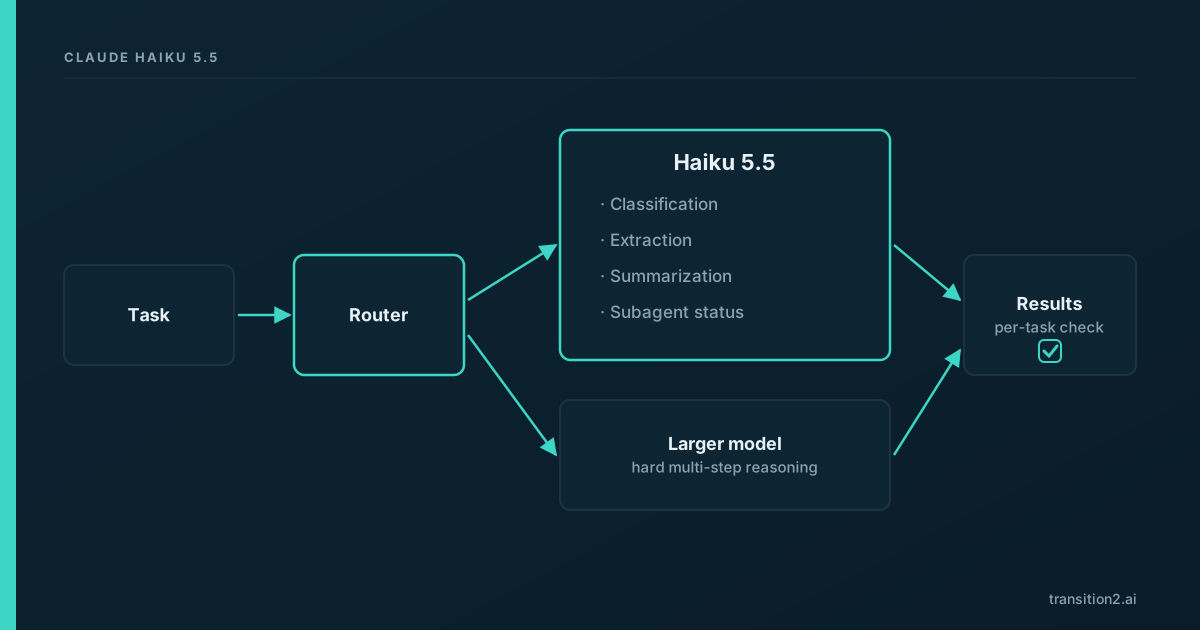
Anthropic released Claude Haiku 5.5 on October 7, 2026, under the model id claude-haiku-5-5, positioning it for high-volume work such as summaries, classification, subagents and browser use (Anthropic). Anthropic calls it the cheapest, fastest and most capable small model it has released. The platform documentation lists a 1M token context window and up to 128K output tokens (Claude platform docs). The release reinforces a pattern many teams already follow: send the many small, repetitive steps of a workflow to a fast model, and reserve larger models for the steps that need them.
What happened
According to Anthropic's launch page and platform documentation:
- Release and id. Claude Haiku 5.5 was released on October 7, 2026, with the API model id
claude-haiku-5-5. - Intended use. The docs describe it as built for high-volume, latency-sensitive work such as classification, routing, extraction and subagent tasks; the launch page adds summaries, compactions, database queries, live customer support and browser use.
- Context and output. A 1M token context window and up to 128K output tokens, with adaptive thinking controlled by the effort parameter.
- Price. $0.10 per million input tokens and $0.50 per million output tokens for prompts up to 100,000 tokens, rising to $0.50 and $2.50 for longer prompts. Haiku 4.5 is listed at $1 and $5. Anthropic says Haiku 5.5 costs around 75% less to run on average, and that prompts up to 100,000 tokens made up about 90% of requests to its previous Haiku model.
- Availability. The Claude API, Amazon Bedrock (as
anthropic.claude-haiku-5-5), Claude models on Google Cloud, Microsoft Foundry and the Claude Platform on AWS. AWS published its own launch post for Bedrock.
At the same launch Anthropic halved the price of Sonnet 5.5 cache reads, from $0.20 to $0.10 per million tokens, which it says makes Sonnet 5.5 about 20% cheaper on most agentic work. Benchmark comparisons on the launch page are Anthropic's own and are not repeated here.
A month after launch, Anthropic gave a concrete example of the model in this role inside its own tooling. On November 4, Claude Code began using Haiku 5.5 to write the status line for background subagents from short notes instead of re-reading the whole conversation, and Anthropic says each update now costs about 99% less (Anthropic on X; desk coverage). That figure is also a vendor claim.
Why it matters
Most production AI workflows are not one large reasoning task. They are many small steps: deciding which queue a message belongs in, pulling fields out of a document, summarizing a thread, checking whether a subagent is still making progress. Those steps run constantly and are usually simple, and the main requirements for them are speed, consistency, and low compute per call.
Routing by step, not by product. A common mistake is to choose one model for an entire application. A support assistant, for example, might classify the incoming request, extract the account details, look up relevant articles, draft a reply, and decide whether to escalate. Only some of those steps need a larger model's reasoning. Haiku 5.5 is explicitly positioned for the others. The Customer Experience Agents hub covers how these stages typically fit together in support flows.
Subagents multiply small calls. Agent systems that fan work out to subagents generate a large number of short calls: status checks, summaries of intermediate results, and simple tool decisions. Anthropic's own Claude Code change is a clear example of moving that layer to a smaller model and trimming its input at the same time. For teams running agent-assisted engineering setups, discussed in the Software Factories hub, this layer is often where usage grows without anyone noticing.
Long context in a small model, at a price step. A 1M token context window in a model aimed at high-volume work means extraction and summarization over long documents do not automatically require stepping up to a larger model. Two caveats apply. Input and output prices are five times higher for prompts over 100,000 tokens, and whether quality holds at those lengths for a given task is something to test, not assume.
Multi-cloud availability simplifies adoption. Availability on the Claude API, Bedrock, Google Cloud, and Microsoft Foundry means teams can usually reach the model inside the cloud environment they already use, under existing access and data controls.
What it means for businesses
Split workloads by difficulty. Use frontier models for the hard, high-consequence steps and a Haiku-class model for volume work such as triage, extraction, and summarization. Decide the split from measured results on your own tasks, not from model names.
Track usage per workflow step, not just per application. The Claude Code example shows that supporting work such as status updates can be a meaningful share of total usage, and that it is often the easiest share to reduce without affecting the quality of the main task.
Confirm which cloud surface your teams will use, and review its data handling terms, before rolling out across departments. Using the surface where your other workloads already run keeps identity, logging, and data residency controls in one place.
What it means for AI users
When teams route correctly, support chats, document tools, and browser-agent loops should feel more responsive, because the frequent small steps run on a model built for speed.
If an assistant built on a small model gets a hard question wrong, that may be a routing problem rather than a model limit. Good products escalate difficult requests to a larger model; it is reasonable to expect that behaviour.
What it means for developers
Use model routing deliberately. Classify each step in a workflow by difficulty and consequence, send simple high-volume steps to claude-haiku-5-5, and escalate the rest. Keep the routing rule in configuration so it can change as models change.
Use prompt caching for long, stable instructions and reference material shared across many calls. Cache reads are listed at $0.01 per million tokens for prompts up to 100,000 tokens, and the minimum cacheable prompt is 512 tokens.
Re-measure token counts when migrating. The docs say Haiku 5.5 uses the newer tokenizer from Claude 4.7 onward, so the same text counts as roughly 30% more tokens than on Haiku 4.5. Budget and rate-limit math built on Haiku 4.5 counts will be off.
Measure tokens and latency per successful task, not per call. A fast call that fails and has to be retried on a larger model is not an improvement. Build a small evaluation set for each routed step, compare Haiku 5.5 against your current model on it, and test long-context steps at the document lengths you actually handle before relying on the 1M window.
For subagent status and progress reporting, follow the pattern Anthropic describes for Claude Code: have the agent write short notes as it works, and summarize those notes with a small model instead of re-reading the full transcript.
Sources
- Introducing Claude Haiku 5.5 (accessed 2026-11-06)
- Haiku 5.5 platform docs (accessed 2026-11-06)
- Haiku 5.5 on AWS (accessed 2026-11-06)
- Claude developer account on X: background subagent status update (accessed 2026-11-06)