News · Models, Tooling & Developer Practice · Software Factories & AI-Assisted Engineering
Gemini 4 Hydrogen arrives with Orchestrator handoffs in Antigravity
Google released a fast coding model and a mode that passes work between a planning model and Hydrogen inside one session, backed by Google-reported benchmark claims.
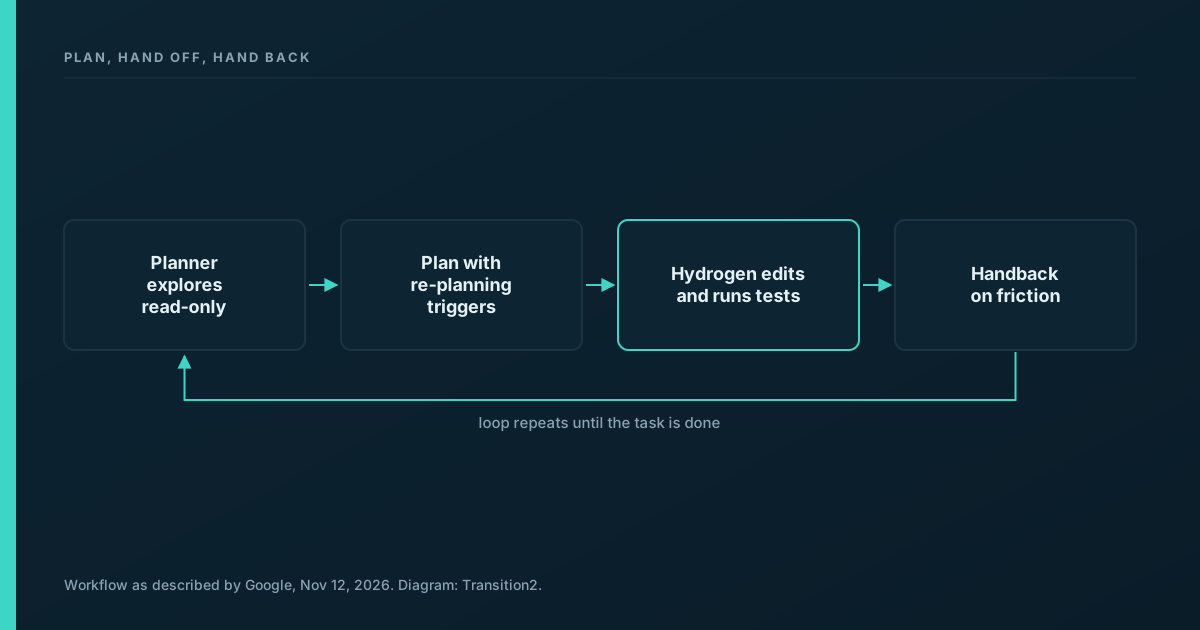
Google introduced Gemini 4 Hydrogen on November 12, 2026, describing it as a fast model for everyday coding and agentic workflows (Google). The same day, Google's Antigravity coding environment added Orchestrator, a mode that switches between a planning model and Hydrogen within one session (Antigravity blog). Google reports that Orchestrator came close to Carbon's task success while using 24% less quota and finishing 19% faster on average, but its two launch posts name different benchmark versions for that result.
What happened
Google says Hydrogen is available across AI Studio, the Gemini API, Gemini for business, the Gemini app, Google Search, and Antigravity for Pro and Ultra subscribers (Google; Google developers post).
The model has four thinking levels: low, medium, high (the default) and xhigh. Google says Hydrogen scores 51 on the Artificial Analysis Intelligence Index at the default high setting, against 50 for Argon, and 54 at xhigh (Google).
Hydrogen accepts a native 1 million-token input and can produce up to 1 million output tokens. Google published flat per-token rates across the full window (Google; InfoWorld).
Against Gemini 3.8 Flash, Google reports 2.5x faster task completion at the default setting, a Terminal-Bench 4.1 score of 57% against 18.2%, and more than 5x fewer fabricated claims (Google).
Orchestrator is the larger workflow change. Inside a single Antigravity session, a planning model (Carbon or Argon) explores the codebase read-only and builds a plan that includes re-planning triggers. Hydrogen then edits code, updates packages and runs tests, and it hands control back to the planner when it "hits friction" (Antigravity blog; InfoWorld; WinBuzzer). Citing Google's documentation, WinBuzzer reports that Hydrogen returns control to Carbon when verification fails twice, when an interface behaves unexpectedly, or when a design decision is unsettled, and that Orchestrator users cannot choose reasoning effort. InfoWorld notes that this differs from conventional routing, which assigns one model to a whole task.
Google reports that Orchestrator reached near-Carbon task success while using 24% less quota and finishing 19% faster on average (Google; Antigravity blog). The posts disagree on the benchmark: the Google model post cites Terminal-Bench 4.0, and the Antigravity post cites Terminal-Bench 4.1.
On access, Orchestrator (Carbon) is for AI Ultra subscribers, Orchestrator (Argon) is for Ultra and Pro subscribers, and enterprises get access through Gemini for business (Antigravity blog; InfoWorld). Google's documentation and the launch post disagree on that last point: WinBuzzer reports that the enterprise model table supports standalone Hydrogen and excludes Orchestrator, while the launch post says enterprises can access both (WinBuzzer).
Google also makes safety claims. It says Hydrogen reduced overreach in agentic tasks by up to 81%, is up to 2x less likely to bypass permission boundaries on blocked tasks, and is "more than 2.3x more resilient on the Gray Swan IPI benchmark" (Google).
Why it matters
The main change is the unit of routing. Conventional routing picks one model per task. Orchestrator routes by phase inside a task, so exploration and judgment calls go to a planning model and execution goes to a faster model (InfoWorld). If Google's quota and speed figures hold up on real repositories, a team could keep most of the heavier model's task success while using less of its quota.
The handoff conditions, as reported from the documentation, are specific: two failed verifications, an unexpected interface, or an unsettled design decision (WinBuzzer). Specific triggers can be observed and counted, which makes the behavior testable. The tradeoff is control: users of the mode cannot set reasoning effort.
Every performance number in this launch is reported by Google. The benchmark mismatch on the headline Orchestrator result, Terminal-Bench 4.0 in one post and 4.1 in the other, means readers cannot tell from the launch materials which suite produced the 24% and 19% figures (Google; Antigravity blog). The safety claims, including the Gray Swan IPI result, are also vendor-reported and should be treated as claims until tested independently.
Google says per-token rates are flat across the full 1 million-token window (Google; InfoWorld).
The Transition2 desk did not run an experiment for this story, because testing Hydrogen and Orchestrator requires a Gemini API key and an Antigravity subscription that the desk's test machine does not have.
What it means for businesses
Access depends on tier. Orchestrator with Carbon as planner is limited to AI Ultra, the Argon variant covers Ultra and Pro, and the launch post says enterprises go through Gemini for business (Antigravity blog), although Google's enterprise model table reportedly excludes Orchestrator (WinBuzzer). Before standardizing on the mode, confirm which variant your teams can actually reach.
Teams running engineering pipelines on quota should treat the 24% quota figure as a hypothesis to test on their own code. The Software Factories hub covers how to measure agent throughput on real repositories rather than on public suites. Governance teams should note Google's permission-boundary claims (Google) and check agent behavior in a sandbox with blocked actions before granting broader repository access.
What it means for AI users
Hydrogen appears across the Gemini app and Google Search as well as developer tools (Google), so many users will meet it without choosing it. Where thinking levels are exposed, high is the default and xhigh is the top setting. Inside Orchestrator, users cannot pick reasoning effort, and the planner may take back control partway through a task (WinBuzzer). A session that pauses to re-plan is the mode working as designed. More guidance on choosing models is in Models & Practices.
What it means for developers
Because the desk could not test the mode, here is an evaluation recipe teams can run themselves. It is advice, not a result.
- Fix a task set. Pick representative tasks from your own repositories, each with a deterministic pass check such as a test suite. Keep the set unchanged across runs.
- Compare configurations. Run the planner model alone, Hydrogen alone at each thinking level you care about, and Orchestrator. Pin model identifiers and record the date of each run.
- Measure per-phase success. For Orchestrator, score the planning phase (did the plan identify the right files and set sensible re-planning triggers) separately from the execution phase (did the edits pass the checks).
- Count handoffs. Log each return to the planner and tag it with the reported trigger: repeated verification failure, unexpected interface, or unsettled design decision. A high handoff count on simple tasks is a signal worth investigating.
- Track tokens per successful task. Add up tokens across both models for every attempt, then divide by successful tasks only, so failed runs count against the configuration that produced them. Record wall-clock latency next to it.
- Check claims and boundaries. Sample outputs for fabricated claims, and include sandboxed tasks that should be blocked, to see whether the agent respects permission limits.
- Name the benchmark version. If you compare against Google's figures, state whether you used Terminal-Bench 4.0 or 4.1, given the mismatch in the launch posts.
Copyright Eric MacDougall.
Sources
- Introducing Gemini 4 Hydrogen (accessed 2026-11-13)
- Gemini 4 Hydrogen in Google Antigravity (accessed 2026-11-13)
- Google adds multi-model Orchestrator, Gemini 4 Hydrogen to Antigravity (accessed 2026-11-13)
- Build with Gemini 4 Hydrogen (accessed 2026-11-13)
- Google Antigravity pairs Gemini 4 models for coding (accessed 2026-11-13)