News · Workflow Automation · Software Factories & AI-Assisted Engineering · Models, Tooling & Developer Practice
Mistral Studio Managed Agents: durable harness with approval gates
Mistral's public-preview Managed Agents run one Python agent in-process, self-hosted or Mistral-managed, with crash-resume and approval gates.
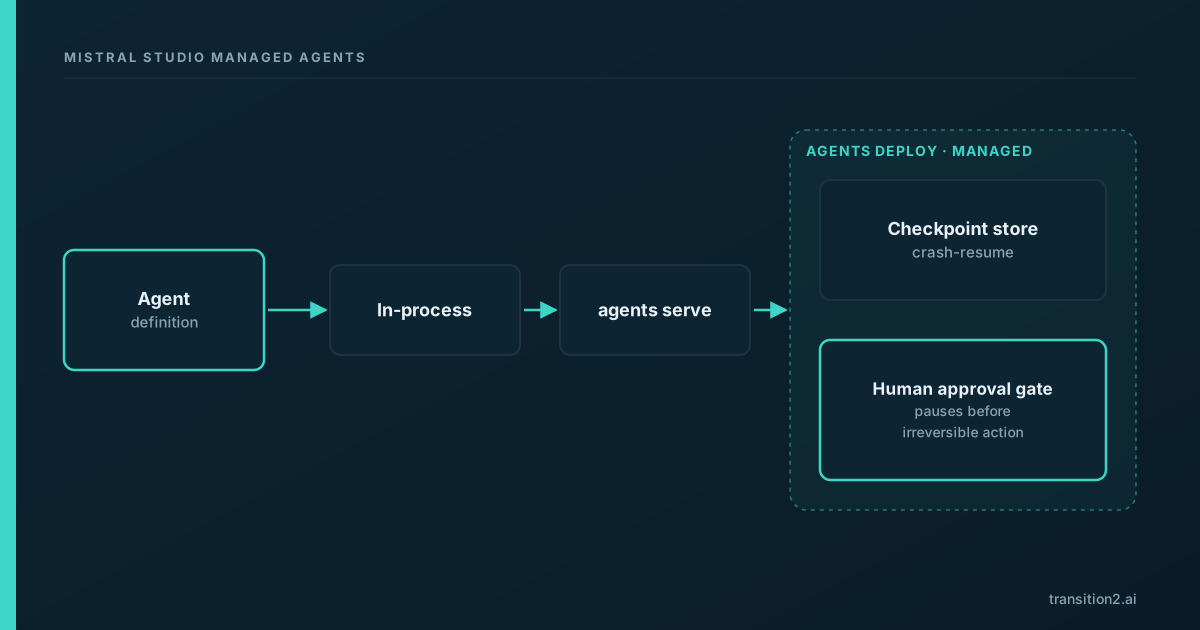
Mistral announced Managed Agents in Studio on November 5, 2026, as a public preview. According to its release notes, you build an agent in Python with the Agents SDK (mistralai-agents), define its model, instructions, tools and environment once, then run the same code in your own process, self-hosted with agents serve, or Mistral-managed with agents deploy. Once deployed, the release notes say, execution is durable and runs in the background: a task can run for hours or days, resumes from its last finished step after a crash, and can finish after your app exits. Mistral stores the session, so you host no database. For teams building long-running workflows, the notable part is not a new model but the shape of the runtime: durability and approval are described as properties of the deployment rather than something each team assembles.
What happened
The release notes describe a single agent definition, written with Mistral's Python Agents SDK, that runs in three ways:
- In your process. The agent runs inside the calling application.
- agents serve. The agent is self-hosted: you run it on your own infrastructure.
- agents deploy. The agent is Mistral-managed, with durable background execution.
agents init scaffolds a working project. The release notes list the other parts of the harness:
- Approvals and live control. You choose which tool calls need approval, from your code or from a person. You can steer or interrupt a turn while it runs, and reopen a session after your app restarts.
- Composable pieces. Typed Python tools, per-session sandboxes hosted by Mistral, connectors and MCP servers, skills, secrets, guardrails and custom hooks.
- Tracing by default. Each turn is a trace in Studio with one span per model call and tool call. Spans are redacted on the worker before they leave it.
Mistral's Build with Studio announcement places Managed Agents inside a broader Studio update. It says Studio is adding managed agents and apps alongside workflows, enterprise context, agent observability and evaluations, and that agents connect to enterprise data and systems through connectors and MCP servers. It presents Studio as the place to build with Mistral Large 4 (nicknamed "Le Chonk"), and says agents, workflows and apps can be deployed in the cloud, in a customer's own VPC, on-premises, or across a mix of these. It says OpenTelemetry traces show each step of a run, including model calls, tool use and approvals. Its example of an agent that investigates production incidents follows a team's runbook and asks for approval before taking sensitive actions. The release notes are the place to track version-level changes to the platform.
The announcement also includes usage figures. Those are vendor claims, and this article does not repeat them as measured results. Teams that care about throughput or latency under their own workloads should measure them in their own load tests.
Why it matters
Most agent prototypes are written as a loop inside a script. That works until the run lasts longer than a single process stays alive, touches a system where a mistake cannot be undone, or needs to move from a laptop to shared infrastructure. At that point teams typically add three things by hand: a way to record progress so a crash does not restart the work from zero, a way to stop and ask a person before a risky step, and a way to run the same logic in a different environment. Studio Managed Agents puts all three in the product description.
Durability changes what an agent can be asked to do. A run that lasts hours or days will meet restarts, network failures, and deploys of unrelated services. Without crash-resume, every one of those events either restarts the work or leaves it half done. Half-done is the worse outcome for workflows such as reconciling records or processing a queue of documents, because partial writes are hard to detect later. A harness that resumes from stored state makes long runs practical, provided the steps it replays are safe to repeat. That last condition is on the agent author, not the platform: a step that sends a message or posts a record needs an idempotency key or a check before it runs again.
Approval gates move a control point into the runtime. Many organisations already require a person to sign off on irreversible actions such as sending external communications, changing access, or committing records to a system of record. When that requirement lives only in policy documents, agents can bypass it by accident. When the harness itself pauses and waits, the control is enforced where the action happens. The value depends on placement: a gate at the start of a run is a formality, while a gate immediately before the irreversible call is a real check.
Portability reduces the gap between demo and production. If promotion from local to managed is a configuration change rather than a rewrite, the version that was tested is closer to the version that runs. That narrows a common source of failures where an agent behaves well in development and differently once wrapped in new infrastructure code.
Connectors and MCP keep integration options open. Mistral says agents reach enterprise systems through connectors and MCP servers, so teams that have standardised on MCP can reuse that work.
None of this is unique as an idea. What is notable is that a model provider is packaging these properties as the default harness shape, which raises the baseline for what teams should expect from any agent platform they evaluate. The Workflow Automation hub covers where long-running agents fit relative to deterministic automation, and the Models, Tooling & Developer Practice hub covers harness choices more broadly.
What it means for businesses
Prefer agent platforms that make human approval explicit for irreversible actions and that resume long runs after failure. Managed Agents is a public preview, so treat it as something to pilot rather than a production commitment. Because Mistral stores the session state in managed mode, ask where that state lives and how long it is kept before you send regulated data through it. When evaluating Studio or any comparable harness, ask three concrete questions: where exactly can an approval gate sit, what state is preserved across a crash, and what record exists of who approved what and when.
Do not treat the presence of approval gates as a finished control. Map each workflow's irreversible steps first, then confirm the gate sits directly in front of each one. For processes with audit requirements, confirm the approval record can be exported into the systems your reviewers already use.
Treat vendor usage figures as a starting point. Run a representative workload, measure completion rate, time to completion, and how often runs need a human to intervene, and decide from those numbers.
What it means for AI users
An agent that runs for hours or days is not something to start and forget. Long-running agents need visible status and an interrupt path. If you are the approver, expect to see what the agent is about to do and why, with enough context to say no.
If an approval request arrives without that context, treat it as a reason to pause rather than a formality. An approval gate only protects you if the person approving can tell what is being approved.
What it means for developers
Design agents to be portable across run modes so that promotion from local to served to managed is configuration, not a rewrite. Keep environment-specific details such as endpoints, credentials, and tool registrations out of agent logic.
Make every step that can be replayed after a crash safe to replay. Use idempotency keys for external writes, check for completed work before redoing it, and record step boundaries so a resumed run knows where it stopped.
Place approval gates immediately before irreversible tool calls and include the exact pending action in the approval request. Then test the unhappy paths: a crash just before the gate, a crash just after approval, an approval that times out, and a rejection. Each should leave the external system in a known state.
Finally, measure the harness under your own load. Record latency per step, total run duration, resume success rate, and token usage per completed task, and compare those against your current approach before migrating production workflows.
Sources
- Build with Studio (Mistral) (accessed 2026-11-06)
- Mistral release notes (accessed 2026-11-06)