News · Workflow Automation · AI Reliability & Operations · Models, Tooling & Developer Practice
Do agents need to sleep? A paper argues memory needs consolidation
An arXiv paper maps a theory of sleep onto agent memory and predicts that selectionist consolidation will win as memory stores grow.
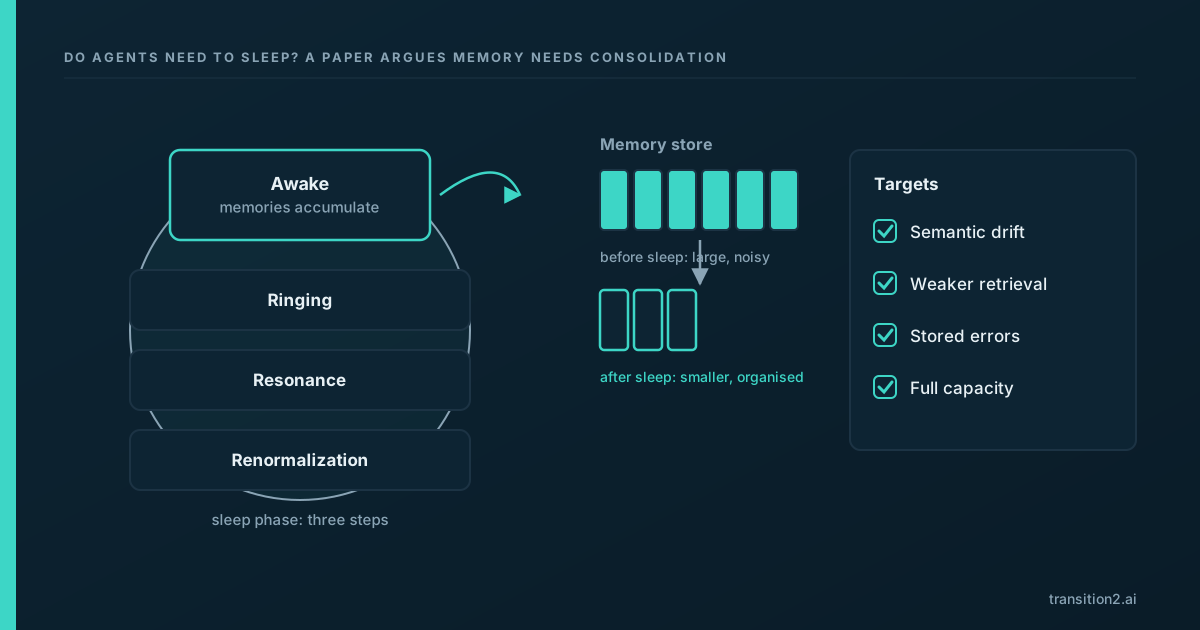
Agents that keep memory across sessions may need something like sleep: a regular phase that decides what to keep and what to forget. That is the argument of "Do agents need to sleep?", a paper by Ido Haber and Giulio Tononi first posted to arXiv on November 1, 2026 and revised on November 3. The authors map a biological theory of sleep onto operations that digital memory systems can perform, and they make a testable prediction about which kind of memory consolidation should work better as stores grow. The paper, as its abstract describes it, sets out a theory and a prediction rather than experimental results.
What the paper reports
The abstract starts from an observation about LLM-based agents that run persistently and build up memory through use. The authors say such agents already show the symptoms of unchecked plasticity, meaning memory that keeps changing without a mechanism to manage it. They list four:
- semantic drift, where stored meaning shifts over time;
- degraded retrieval precision;
- propagation of errors that were stored and then reused;
- saturation of memory capacity.
To address these, the authors draw on the selectionist "ringing, resonance and renormalization" (RRR) account of sleep. They propose that each of its three phases maps onto an operation that is feasible in digital memory architectures. The abstract sets this selectionist view against instructionist alternatives, and that contrast is the basis of the paper's prediction.
The authors also note that engineers building stateful agents are independently rediscovering the problems sleep evolved to solve: "what to forget, and when to do the forgetting."
From this they derive a falsifiable prediction: selectionist consolidation will outperform instructionist alternatives as memory stores grow large. Their broader claim is about continuous learning itself. In their account, plasticity always comes with a trade-off, and for any system that learns continuously with finite capacity while staying coupled to its environment, that trade-off is sleep.
The abstract does not report experiments, benchmarks or a reference implementation. The prediction is offered for others to test.
Why it matters
Agent products are moving toward long runs and persistent memory. In its release notes for Managed Agents, Mistral says its agents can run for hours or days and resume after a crash. That is the company's own description, not an independent measurement, but it shows why the paper's question is practical. The longer an agent runs and the more it remembers, the more the four symptoms above have room to build.
The paper's useful move is to separate two things that often get blurred: keeping an agent running and keeping its memory healthy. Crash and resume features make interruptions survivable. A consolidation phase, in the authors' framing, is what keeps accumulated memory from drifting or filling up. A record of what a long-running process did is the raw material any consolidation step would work from; the Workflow Automation hub collects the desk's coverage of evidence trails.
What it means for businesses
Before approving agents that keep memory across sessions or run for long stretches, ask how that memory is maintained. Who decides what is forgotten, how often, and how are stored errors corrected? Set a review cadence for long runs and treat the length of an unattended run as a setting earned with evidence.
What it means for AI users
An assistant that remembers more is not automatically more accurate. If a tool keeps long-term memory, check periodically what it has stored, correct or delete wrong entries, and watch for answers that lean on outdated facts. Scheduled pauses or reviews in long tasks are a natural moment to do that.
What it means for developers
Treat memory maintenance as a first-class part of the agent harness, not a side effect of crash handling. Track the paper's four symptoms directly: measure retrieval precision over time, watch for drift in stored summaries, trace reused errors back to their source, and alert before capacity is reached. If you build a consolidation step, the authors' prediction suggests a test: compare selectionist and instructionist consolidation, as the paper defines them, on the same agent as its memory store grows. Checkpoints should still capture resumable state, a readable summary and a record of side effects. The AI Reliability & Operations hub covers the operational side, and the paper is the reference for the theory.
Sources
- Do agents need to sleep? (arXiv) (accessed 2026-11-06)
- Mistral release notes: Managed Agents (Nov 5, 2026) (accessed 2026-11-06)