News · Models, Tooling & Developer Practice · Software Factories & AI-Assisted Engineering
ggml and llama.cpp tag v1.0.0 and adopt semantic versioning
The local-inference stack moved to semantic versioning at v1.0.0, pruning deprecated APIs and advancing the RPC protocol to v9.
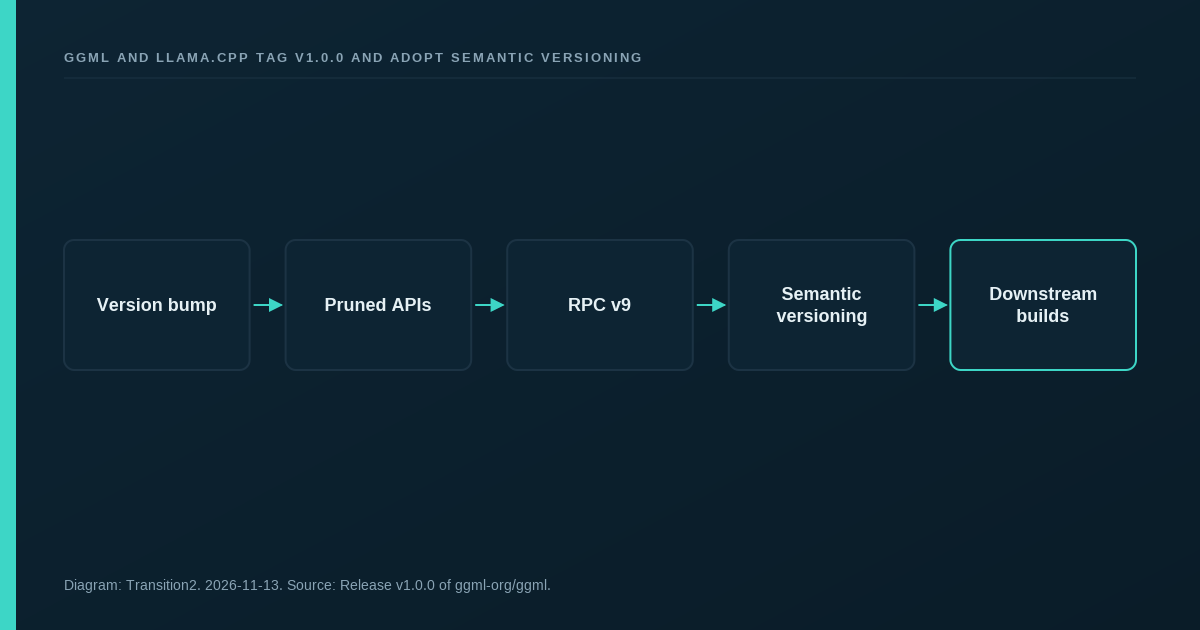
The ggml and llama.cpp projects both tagged v1.0.0 on November 13, 2026 (ggml; llama.cpp), moving the local-inference stack onto semantic versioning and pruning deprecated APIs. The release advances the RPC protocol to v9 and rejects incompatible peers, which makes this a coordinated upgrade rather than a drop-in bump. Downstream maintainers should pin versions and read the removal lists before upgrading.
What happened
According to the GitHub release pages, ggml v1.0.0 was tagged on November 13 at commit 417a024b4fb6bc3116d41af7c067166a039bdf12, a version-bump commit authored by ggerganov, with llama.cpp v1.0.0 shipping the same day and updating ggml to v1.0.0 (ggml; llama.cpp). The commit sets GGML_VERSION_MAJOR from 0 to 1 and MINOR from 29 to 0, so the previous release was 0.29.0 (ggml commit; DEV Community). Project lead Georgi Gerganov authored the version-bump commit.
The breaking changes are the headline. ggml prunes its deprecated public API and removes the legacy DIAG_MASK_INF and DIAG_MASK_ZERO ops, and the RPC protocol moves to v9 with incompatible peers rejected (ggml). Additions include ggml_rope_set_truncate and ggml_rope_get_truncate for configurable YaRN truncation, FP8 support including OCP FP8 on CUDA, and a TRI backward pass (ggml). On the llama.cpp side, v1.0.0 removes llama_set_warmup, 35 deprecated functions and defrag_thold, renames llama_set_embd_state_src to llama_set_ctx_state_src, and folds clip.h into mtmd (llama.cpp).
Both projects now use formal semantic versioning, with API and ABI breaking changes tied to major releases, which is consistent with the major-version bump and the pruning in this release (RuntimeWire). The release pages themselves link only a "Releases and versioning of ggml-org projects" discussion and do not publish an explicit stable-API guarantee, so headlines framing this as a "stable API promise" go beyond what the pages state; the accurate term is semantic versioning.
An independent tester counts 13 removed GGML_API declarations, including ggml_diag_mask_inf and its in-place variant, ggml_diag_mask_zero and its in-place variant, ggml_add1 and its in-place variant, ggml_rope_custom and its in-place variant, and ggml_mul_mat_set_prec (DEV Community). The DIAG_MASK removals are corroborated by the ggml release notes.
On performance, the same tester reports that on a 4-vCPU AMD EPYC virtual machine running Qwen2.5-0.5B at Q4_K_M, token generation was essentially unchanged, at 19.84 versus 19.78 tokens per second comparing 0.29.0 and 1.0.0, and concludes that the 1.0 gains are mostly on GPU backends (DEV Community). That is one independent blogger's single-VM result and should be read as such.
Why it matters
A 1.0 tag on a stack this widely embedded is less about new features than about a contract. Semantic versioning tells downstream maintainers that breaking changes will now be signaled by a major-version bump (RuntimeWire), which makes dependency management more predictable, but the immediate cost is that this particular release breaks things on purpose. The RPC move to v9 rejecting incompatible peers means mixed-version deployments will not interoperate, so distributed setups have to upgrade in lockstep. The pruned APIs and the folded headers should surface at build time where code depends on them, which still requires migration work. For teams tracking Models and Practices, the signal is to pin to known-good commits and schedule the migration deliberately.
The desk did not run its planned CPU-only API-break probe in this session, so this report carries no experiment results and relies on the release notes and the one independent tester's figures cited above.
What it means for businesses
The upgrade is not free, and that is the point to budget for. Organizations that embed ggml or llama.cpp in products should treat v1.0.0 as a migration with removed APIs and a protocol break, not a routine patch. Pin to specific commits or tags, test builds against the removal lists, and sequence distributed deployments so RPC peers move together. The payoff is a more predictable versioning contract going forward, which reduces the surprise factor in future upgrades.
What it means for AI users
For users running local models, the practical takeaway is that this release is aimed at maintainers rather than at a visible feature change, and one independent CPU benchmark shows token generation essentially flat at 19.84 versus 19.78 tokens per second on the tested hardware. Anyone expecting a speed jump on CPU from the 1.0 tag should temper that expectation, since the tester attributes the gains to GPU backends. Wait for your toolchain or distribution to adopt v1.0.0 cleanly rather than upgrading mid-stack.
What it means for developers
Read both removal lists before upgrading. On the ggml side, the DIAG_MASK ops are gone and an independent count puts 13 GGML_API declarations removed, including add1, rope_custom and mul_mat_set_prec variants. On the llama.cpp side, llama_set_warmup, 35 deprecated functions and defrag_thold are removed, llama_set_embd_state_src is renamed to llama_set_ctx_state_src, and clip.h is folded into mtmd. Expect compile-time breakage where you used any of these, and plan for the RPC v9 change if you run distributed inference. The additions, including configurable YaRN truncation and broader FP8 support, are the upside once the migration is done.
Copyright Eric MacDougall.
Sources
- Release v1.0.0 of ggml-org/ggml (accessed 2026-11-15)
- ggml : bump version to 1.0.0 (accessed 2026-11-15)
- Release v1.0.0 of ggml-org/llama.cpp (accessed 2026-11-15)
- ggml 1.0.0: 13 APIs gone, CPU speed unchanged (accessed 2026-11-15)
- After 3.5 years, llama.cpp finally calls itself 1.0 (accessed 2026-11-15)