News · Models, Tooling & Developer Practice · AI Reliability & Operations
Thinking Machines releases looped Inkling 2 Mini weights
The main checkpoint runs its middle decoder block three times per token, and a separate research checkpoint supports a variable loop count.
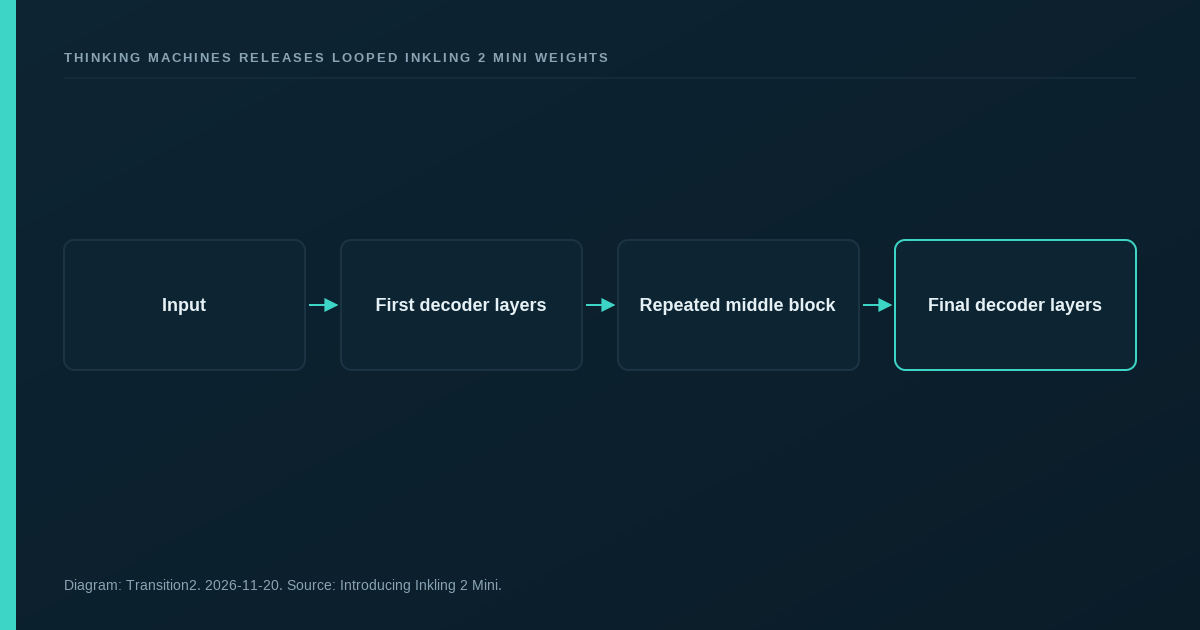
Thinking Machines Lab released downloadable weights for Inkling 2 Mini on November 20, 2026, alongside a separate variable-loop research checkpoint. Thinking Machines Lab announcement The main checkpoint runs the middle 12 of its 24 decoder layers three times with shared weights, for 48 layer applications per token. The model accepts text and images and generates text, and the model card lists the Apache 2.0 license. Inkling 2 Mini model card
What happened
The model card describes a 24-layer decoder-only transformer. The first six layers run once, the middle 12 run three times with shared weights, and the final six run once. In the main checkpoint, that schedule gives 48 layer applications per token. Inkling 2 Mini model card | vLLM architecture notes
The 24 and 48 figures count different things. The first counts the decoder layers that make up the model. The second counts layer applications under the main checkpoint's loop schedule. vLLM's notes describe a prelude, a three-pass loop core and a coda, and treat the 48 figure as layer visits rather than a second set of layer weights. Inkling 2 Mini model card | vLLM architecture notes
The announcement also identifies a separate checkpoint for research with a variable loop count. The published three-pass schedule describes the main checkpoint. For anyone comparing the two downloads, the checkpoint name and the loop setting belong beside the result, since the main release's execution count describes a specific configuration. Thinking Machines Lab announcement | vLLM architecture notes
Why it matters
A layer count tells a reader how many distinct decoder layers the model has. A visit count tells a reader how many times the decoder runs layers for each token. With this release, both figures are needed to explain how reuse works. The architecture gives the model additional passes through its middle layers while using the same middle-layer parameters on each pass. Inkling 2 Mini model card | vLLM architecture notes
The distinction also affects how a comparison is framed. Counting physical layers describes the model's structure, while counting visits describes the execution path. Neither count on its own supplies the latency of a real deployment. A comparison grounded in AI Reliability & Operations can keep the architecture in the configuration record and reserve performance conclusions for runs on the intended serving stack. The release gives those runs a concrete schedule to identify. Inkling 2 Mini model card | vLLM architecture notes
What the Transition2 desk tested
The desk ran a schedule simulation with numbered stubs in place of the decoder layers. The specified pin was CPython 3.12.8, and the simulation used the standard library with no external packages. It recorded the layer call order with one pass and with three passes through the middle 12 layers. A negative control repeated each middle layer individually, preserving the counts while changing the order. The reference was the published 24-layer schedule with three middle-layer passes. Inkling 2 Mini model card | vLLM architecture notes
CHECK one_pass_order: PASS 24 visits
CHECK three_pass_order: PASS full trace compared
CHECK three_pass_counts: PASS 48 visits, 24 unique
CHECK negative_individual_repeats: PASS same counts and distinct order required
CHECKS 4/4
What this does not show. The desk tested call order and counts using stubs. The simulation used no model weights or vendor code and measured no output quality, memory use or speed. Its negative control shows why a count-only check would miss a different execution order.
What it means for businesses
The downloadable main checkpoint gives an evaluation team a specific artifact to identify in a trial. Thinking Machines Lab announcement Its model card gives the team a place to verify the listed license and input and output types. A trial brief can then keep the license, the selection of representative text and images, and any serving measurements separate. The evidence for one of those decisions does not answer the others. Inkling 2 Mini model card
If a trial includes the research checkpoint, results should say which checkpoint and loop setting produced each observation. Otherwise, readers comparing runs can mistake a configuration difference for a measurement disagreement. That reporting distinction follows from the lab distributing a fixed-schedule main checkpoint and a separate checkpoint for variable-loop research. Thinking Machines Lab announcement
What it means for AI users
The model card's input and output distinction matters when choosing examples for an evaluation. A user can include a prompt that supplies an image and asks for a written answer, since images are supported as input and text is the output. The layer and visit counts describe what runs inside the model, so they should be kept separate from judgments about whether that written answer is correct or useful. Inkling 2 Mini model card
When comparing outputs from the main and research checkpoints, a user can keep the prompt and inputs fixed and identify the checkpoint next to each answer. That makes it possible to discuss what each answer did with the same material while keeping the loop setting visible as part of the comparison. Thinking Machines Lab announcement
What it means for developers
The published schedule makes the ordered trace a useful integration check. A total of 48 calls across 24 layers can agree with the documentation while the middle calls occur in the wrong order, as the desk's negative control illustrates. The reference trace checks that the middle 12 layers are visited three times before execution advances to the final six. vLLM's implementation notes describe the same distinction between layers and visits. vLLM architecture notes
Configuration and execution evidence can be recorded together. The checkpoint identifies which release artifact was loaded, the loop setting identifies the intended execution schedule, and the trace checks the schedule actually followed. Quality and serving measurements can then be attached to that specific configuration. Thinking Machines Lab announcement | vLLM architecture notes
Copyright Eric MacDougall.
Sources
- Introducing Inkling 2 Mini (accessed 2026-11-21)
- Inkling 2 Mini model card (accessed 2026-11-21)
- Inkling 2 Mini on vLLM (accessed 2026-11-21)