News · Invoice Reconciliation · Data & Knowledge Foundations · Models, Tooling & Developer Practice
Cloudflare releases open-weight Clairic extraction models
Clairic (27B) and Clairic-flash (9B) are now on Hugging Face under Apache-2.0, with typed output heads for pulling fields from receipts, PDFs and tables.
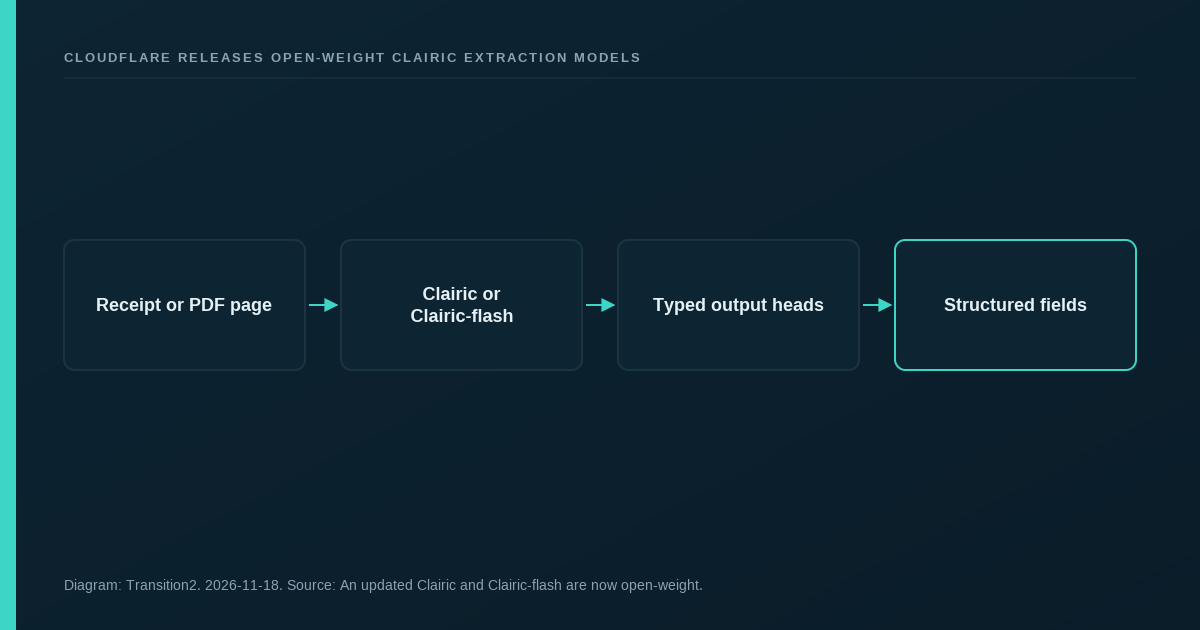
On November 18, 2026, Cloudflare released updated versions of Clairic (27B) and Clairic-flash (9B), its typed data-extraction models, as open weights on Hugging Face. The model cards license both under Apache-2.0, and both can run locally without Cloudflare's Workers AI. Cloudflare's accuracy and latency figures come from its own internal evals.
What happened
Cloudflare's announcement, written by Alex Reneau and Michelle Chen, says updated Clairic and Clairic-flash models are now open-weight. The weights are published on Hugging Face as Cloudflare/clairic and Cloudflare/clairic-flash.
Both model cards state an Apache-2.0 license (Clairic, Clairic-flash). Cloudflare's blog post does not state a license; the repos do. According to the cards, Clairic is built on Qwen/Qwen3.8-27B and Clairic-flash on Qwen3.5-9B (Clairic card, Clairic-flash card).
The repos contain safetensors weights, typed-output head files (clair_head.safetensors and clair_head_config.json), tokenizer and processor files, and Python helpers. Local inference with PyTorch and Transformers works without Workers AI (Clairic card, Clairic-flash card).
The models remain hosted on Workers AI as @cf/cloudflare/clairic and @cf/cloudflare/clairic-flash, and Cloudflare says the API schemas are unchanged from the October preview. Unite.AI, an outlet whose articles are AI-generated and editor-reviewed, dates that hosted preview to October 19, 2026; that date appears only in its coverage.
Hosted pricing charges for input tokens only, with no output-token charge. Cloudflare lists Clairic at $0.24 per million input tokens and Clairic-flash at $0.10, with both at $0.10 until December 1, 2026; Unite.AI reports the same terms.
Each request accepts up to four images or PDF pages. Separate heads handle estimates, forecasts, durations, calculated dates and arithmetic, according to Cloudflare.
Cloudflare reports these results from its internal evals. On fresh text fields, Clairic scored 335/336, Clairic-flash 328/336 and the preview 295/336. On synthetic receipt fields, both new models scored 576/576 against 369/576 for the preview. Self-hosted p50/p95 latency on text fields was 358/736 ms for Clairic and 155/328 ms for Clairic-flash.
One detail does not match. The card text gives 27B and 9B parameters, but the Hub's safetensors metadata on the Clairic and Clairic-flash pages shows 28B and 10B. The sources do not say whether the gap is rounding or extra components such as the typed heads.
Why it matters
Document extraction for finance teams is a high-volume, repetitive workload, and the release changes two practical things. First, open weights under Apache-2.0 with working local inference (Clairic card) mean receipts and PDFs can be processed on infrastructure a team controls, without sending documents to a hosted endpoint. Second, the hosted pricing bills input only (Cloudflare), so the cost of a request depends on the documents sent rather than on how many fields come back.
The design choice is also worth noting. Cloudflare describes separate heads for durations, calculated dates and arithmetic, so those values come from dedicated components rather than from free-form generated text. For reconciliation work, where a wrong total or date creates manual follow-up, that is the part of the system most worth checking. More on that workflow sits in Invoice Reconciliation.
The numbers need context. All accuracy and latency figures are Cloudflare's internal evals, and the 576/576 receipt result is on synthetic receipts. The jump from the preview is large on Cloudflare's own tests, but no outside benchmark in the coverage cited here measures it. Unite.AI's article is AI-generated, so it serves as corroboration rather than independent reporting.
The Transition2 desk scoped a metadata-only check of the parameter counts, base models and licenses that needs no weights or keys, but did not run it for this article, so those details rest on the Clairic and Clairic-flash repos and Cloudflare's post.
What it means for businesses
Finance and operations teams evaluating extraction now have a hosted option and a self-hosted option from the same model family, with unchanged API schemas for anyone who integrated during the preview, per Cloudflare. The Apache-2.0 license on the repos is a permissive one, which simplifies legal review compared with custom model licenses. The introductory $0.10 rate for both models runs until December 1, 2026, so cost models built on it should also price Clairic at $0.24 afterwards. Teams should validate accuracy on their own document mix before relying on internal-eval figures, especially for layouts unlike synthetic receipts. Data quality upstream of extraction is covered in Data Foundations.
What it means for AI users
People who use expense, bookkeeping or document tools may not see Clairic by name, but tools built on it can extract fields from up to four images or PDF pages per request (Cloudflare). Because the weights can run locally, some tools may keep documents on their own servers rather than calling an outside service. Users handling sensitive paperwork can reasonably ask a vendor where extraction runs and how its accuracy was measured.
What it means for developers
The practical choice is between @cf/cloudflare/clairic or @cf/cloudflare/clairic-flash on Workers AI and the Hugging Face repos with PyTorch and Transformers (Cloudflare, Clairic-flash card). On Cloudflare's numbers, Clairic-flash is faster self-hosted (155/328 ms p50/p95 against 358/736 ms) and slightly less accurate on fresh text fields (328/336 against 335/336). The typed heads ship as separate files, clair_head.safetensors and clair_head_config.json, so local deployments need those alongside the base weights. When sizing hardware, plan for the Hub metadata figures of 28B and 10B rather than the 27B and 9B card figures, since the sources do not explain the difference. Model selection practices are covered in Models & Practices.
Copyright Eric MacDougall.
Sources
- An updated Clairic and Clairic-flash are now open-weight (accessed 2026-11-19)
- Cloudflare/clairic model card (accessed 2026-11-19)
- Cloudflare/clairic-flash model card (accessed 2026-11-19)
- Cloudflare Releases Open-Weight Clairic Models for Data Extraction (accessed 2026-11-19)