News · AI Reliability & Operations · Software Factories & AI-Assisted Engineering
Replit publishes self-hostable DataCat and launches Missions
DataCat's public repository documents telemetry and storage, and Replit says it built the project using its new cloud agent service.
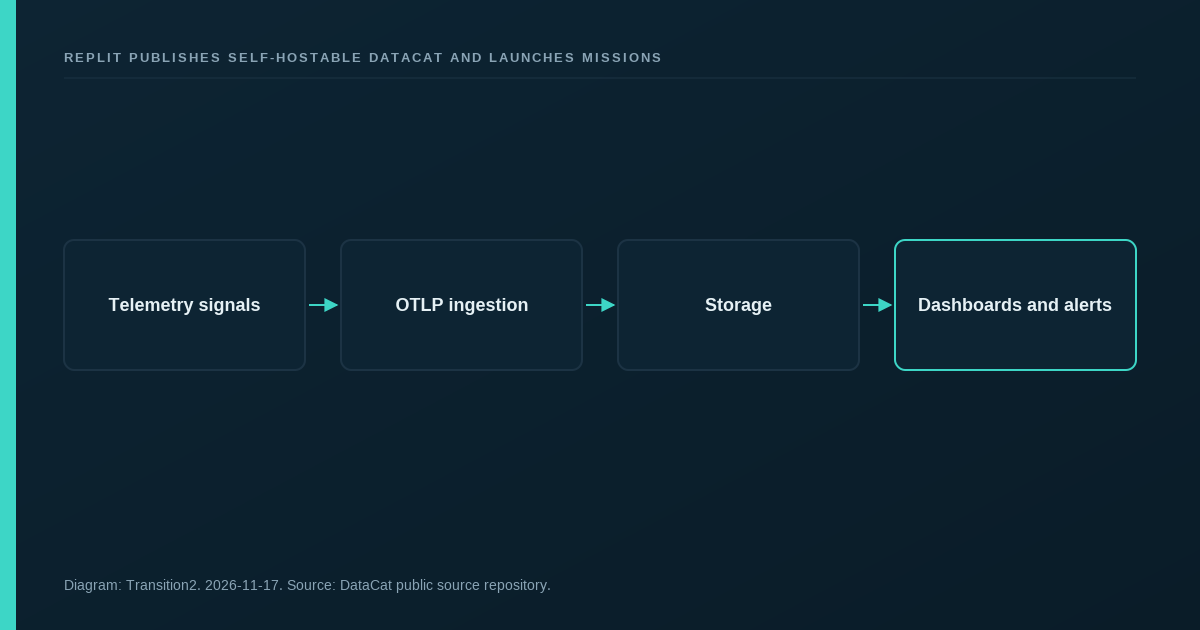
Replit published DataCat, a self-hostable observability project, on November 17, 2026. Its public repository documents dashboards, logs, traces and alerts, along with PostgreSQL and ClickHouse storage options. Replit also launched Missions and says it used the service to build DataCat in two days within a $3,000 capped budget. DataCat repository Replit announcement
What happened
The DataCat repository is the direct source for the software and its documented interfaces. It describes OTLP/HTTP endpoints for traces, metrics and logs. A developer can inspect that documentation alongside the storage options and the project features before deciding what would need to be verified in a self-hosted deployment. DataCat repository
Replit describes Missions as a service that assigns longer projects to groups of cloud agents working against agreed success criteria and a budget. The company presents DataCat as an example of that process. The elapsed time and capped budget come from Replit's account of the build. The repository provides evidence about the published artifact, including what it documents for operators and integrators. Replit announcement DataCat repository
Replit reports 51 of 51 data-correctness and alert-reliability checks and 51 of 56 API compatibility checks. The figures refer to distinct suites. The first concerns correctness and alert behavior as measured by Replit. The second concerns the company's API compatibility comparison. Each result belongs with the name of its own suite when describing what Replit measured. Replit announcement
Why it matters
DataCat gives readers an artifact they can examine in addition to the vendor's account of how it was built. The published code and documentation can inform questions about what telemetry it accepts and which storage options are available. The Missions announcement supplies the terms on which Replit describes the work, including the budget and agreed success criteria. The operational assessment of DataCat depends on the artifact and the requirements of the intended deployment. DataCat repository Replit announcement
The reported checks illustrate why acceptance criteria need to name the behavior being measured. An operator might care about whether an alert fires under a specified condition, while an integrator might care about whether an existing client can continue to send or retrieve the data it expects. Both questions can matter in an observability deployment, and each needs evidence about its particular behavior. Replit's separate suite results give readers a way to keep those dimensions distinct. Replit announcement DataCat repository
What the Transition2 desk tested
The desk ran an offline wire-format simulation for an OTLP ExportTraceServiceRequest using one span. A handwritten codec encoded the length-delimited fields and decoded them into a fresh Python structure. The truncation control exercised the experiment's own DecodeError. The requested pins were CPython 3.12.8, opentelemetry-proto==1.39.0 and protobuf==6.33.5. The two packages were outside the permitted environment, and the recorded run used CPython 3.9.6 with the standard library.
CHECK wire_bytes: PASS compared with fixed protobuf wire vector
CHECK span_count: PASS observed=1 decode_error=None
CHECK span_round_trip: PASS compared name and raw 16-byte trace ID and 8-byte span ID
CHECK truncated_payload_control: PASS DecodeError detail='truncated length-delimited field'
CHECKS 4/4
What this does not show. The simulation exercised the fields and wire type used by the fixture. It provides no evidence about compatibility with a generated client, acceptance by a DataCat endpoint, ingestion, storage, alert behavior or the results of Replit's own checks.
What it means for businesses
A business assessing DataCat as an observability project can ask whether its telemetry and storage requirements fit what the repository documents. A business assessing Missions can ask whether a project can be specified with acceptance criteria and a capped budget. Replit's account connects the two assessments through an example, but each decision requires its own evidence. For DataCat, that means observing the behaviors the business expects from a deployment. For Missions, it means checking the delivered artifact against the agreed criteria. DataCat repository Replit announcement
What it means for AI users
For someone commissioning longer work through cloud agents, the DataCat example makes the delivered artifact central to review. An acceptance criterion can identify a specific workflow and the evidence that would count as success. An alerting workflow, for example, can be described in terms of a condition and the expected alert. An API workflow can be described in terms of what a client sends and what it receives. Those examples reflect different kinds of checks in Replit's account and make the final review more specific than a single statement about completion. Replit announcement DataCat repository
What it means for developers
The documented OTLP/HTTP endpoints give developers a concrete interface to evaluate for traces, metrics and logs. A deployment assessment can distinguish whether a client encodes a payload, whether the service accepts it and whether the expected record becomes available to an operator. The repository's storage choices add another practical detail to record when describing the results of a deployment test. These stages are directly relevant to AI Reliability & Operations because each answers a different question about where telemetry succeeded or stopped. DataCat repository
A compatibility claim can also be tied to the client and operations actually exercised. Replit's reported API compatibility suite provides one scoped comparison. A developer evaluating a specific integration has a narrower question about whether the operations that integration relies on behave as expected in the intended environment. Matching evidence to that question keeps a published suite result and an integration result interpretable. Replit announcement DataCat repository
Copyright Eric MacDougall.
Sources
- DataCat public source repository (accessed 2026-11-18)
- Introducing Replit Missions (accessed 2026-11-18)