News · AI Reliability & Operations · Enterprise AI Governance
Google finds LLM framework that turns security patches into exploits
Google Threat Intelligence Group says exploit_agent compared web software before and after patches, then drafted and ran exploits with no human in the loop.
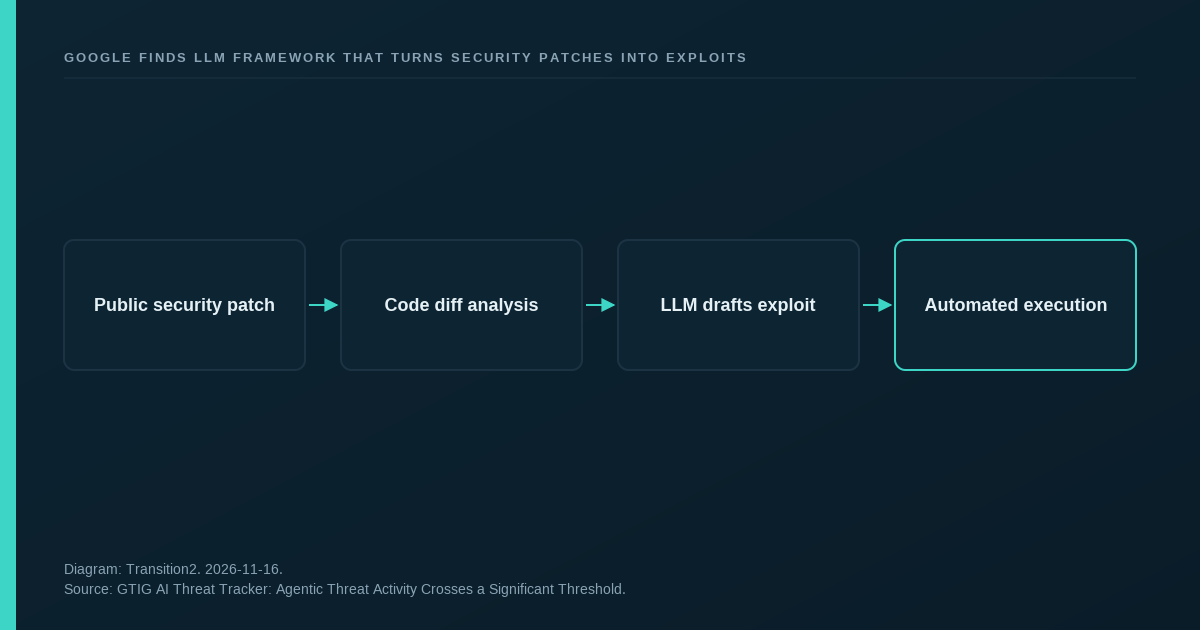
Google Threat Intelligence Group (GTIG) reported on November 16, 2026 that it found an LLM framework called exploit_agent on an exposed staging server, built to compare web application code before and after security patches and then draft and run exploits automatically (GTIG). GTIG says it is the first time it has seen threat actors fully automate discovery and exploitation with no human in the loop. The report's observations include a shrinking patch window, billing spikes from stolen LLM credentials, AI tool configuration files used as a supply-chain vector, and a wave of non-functional LLM proofs of concept that created verification work. Those are observations, not a defender checklist; the report's Mitigations sections describe what Google itself did, including SecOps rulepacks, a Mandiant hardening guide and Big Sleep. The implications below are the desk's reading of those observations.
What happened
GTIG published the finding in a report titled "GTIG AI Threat Tracker: Agentic Threat Activity Crosses a Significant Threshold," with GTIG's Aurora Blum, Kelli Vanderlee, Jess Xia and David Mainor credited on the report (GTIG).
According to the GTIG report, exploit_agent is a multi-agent vulnerability-research and weaponization framework that integrates multiple frontier and local LLMs. It runs continuous differential analysis of popular web application software: it compares code before and after patches, identifies likely vulnerabilities, then drafts and runs exploits without a person approving each step. GTIG describes this as the first time it has seen threat actors fully automate discovery and exploitation with no human in the loop.
The same staging server held post-compromise scripts for internal reconnaissance, brute-forcing, installing webshells and removing other attackers' webshells (GTIG). GTIG says victim telemetry pointed to French media and entertainment websites and to the education sector.
On attribution, GTIG notes that the framework's configuration contained Russian-language comments, but it does not name an actor (GTIG). Language in configuration comments is not the same as an established nationality, and GTIG does not claim one.
The report places exploit_agent alongside other offensive AI frameworks it tracks: ARTEX, CAIRN, CyberStrikeAI, HexStrike AI and PentAGI. GTIG says suspected PRC-nexus actors are experimenting with similar frameworks (GTIG).
GTIG also reports a rise in zero-day activity: from a 2025 average of 8 a month to 11 a month in 2026, with 22 in August 2026 (GTIG). That figure appears only in GTIG's report among the sources reviewed.
The report's example code is a capability check in the WordPress Spectra plugin, also known as Ultimate Addons for Gutenberg, version 2.19.25 (GTIG). The report as reviewed does not say which later release changed that code.
Separately, the FBI issued a FLASH advisory on November 13, 2026, saying ARTEX was used in intrusions, with some progressing from initial targeting to privileged access in under three hours (FBI/IC3). TechCrunch reports the same under-three-hours figure and says the ARTEX developer later made the tool closed-source while older open copies still circulate. The FLASH states that the original repository was removed and that copies remain available. The advisory is treated here as context rather than part of GTIG's findings. GTIG independently lists ARTEX among the frameworks it tracks.
Why it matters
A security patch is public, and the change between versions shows where the code was fixed. exploit_agent, as GTIG describes it, automates the work of reading those changes and turning them into working attacks (GTIG). When that analysis runs continuously across popular web software, the gap between a published fix and a working exploit can narrow. GTIG describes that gap as shrinking; a practical implication, as the desk reads it, is that patch-to-deploy windows matter more.
The report also tempers the picture. GTIG observed that hundreds of non-functional proofs of concept, many likely LLM-generated, created verification work for defenders (GTIG). Automation raises volume and speed; it does not guarantee that each output is valid. Verifying LLM-generated proofs of concept before acting on them is the desk's reading of that observation, not a recommendation stated in the report.
Two of the report's observations concern the AI tooling itself. LLMJacking, as GTIG describes it, produced sharp billing spikes after stolen LLM credentials were abused, and suspected MIDNIGHT NEPTUNE activity modified .claude/settings.json files in repositories as a supply-chain vector (GTIG). Protecting LLM API keys, watching billing, and auditing AI tool configuration files in repositories are the desk's implications from those observations, not items on a GTIG defender checklist. The report's Mitigations sections describe Google's own responses, including SecOps rulepacks, a Mandiant hardening guide and Big Sleep.
The Transition2 desk did not run an experiment for this story: a defensive comparison of two plugin release archives, with no exploitation, was assessed as feasible but is recorded as not run, so no results are reported.
What it means for businesses
The operational change is about time. If patch diffs can be analyzed automatically, the gap between a vendor fix and a working exploit is the window an organization is exposed, and GTIG describes that window as shrinking (GTIG). Shortening patch-to-deploy cycles is the desk's implication from that observation. That matters most for teams running popular web application software and plugins, the category GTIG says exploit_agent analyzes continuously. The zero-day trend GTIG reports, 11 a month in 2026 and 22 in August 2026, adds pressure on the same process. Budget owners for AI services also have a reason to watch LLM billing, a reading of GTIG's account of LLMJacking billing spikes after stolen credentials were abused. Operational practices for this sit under AI Reliability & Operations, and policy questions under Enterprise Governance.
What it means for AI users
People who use AI coding assistants inside shared repositories are now part of the attack surface GTIG describes. Configuration files for AI tools, such as .claude/settings.json, can be committed alongside code, and GTIG reports that a suspected MIDNIGHT NEPTUNE cluster modified such files as a supply-chain vector (GTIG). A cloned repository can carry settings that change how a local AI tool behaves. Users who hold API keys for LLM services should treat them like other credentials, given GTIG's account of stolen keys and billing spikes from LLMJacking. GTIG's observation that many claimed LLM-generated proofs of concept failed is also a reminder that AI-produced security output needs checking before anyone acts on it.
What it means for developers
Three implications from GTIG's observations apply directly to engineering teams (GTIG). First, AI tool configuration files in repositories deserve the same review as build scripts and dependency manifests, since GTIG reports they have been used as a supply-chain vector. Second, LLM API keys used in development and CI should be protected, with billing watched for the kind of misuse GTIG describes in LLMJacking cases. Third, teams that triage vulnerability reports should verify LLM-generated proofs of concept rather than assume they work, given GTIG's account of hundreds of non-functional POCs.
For maintainers of widely deployed web software, including WordPress plugins like the Spectra example GTIG cites, the report is a reminder that every published fix is readable by automated tools as soon as it ships. Clear security advisories and fast upgrade paths for users shorten the window GTIG describes. For defenders tracking the wider tool landscape, GTIG's list of frameworks (ARTEX, CAIRN, CyberStrikeAI, HexStrike AI and PentAGI) and the ARTEX timing reported by TechCrunch show that automated offensive tooling is not limited to one group.
Copyright Eric MacDougall.
Sources
- GTIG AI Threat Tracker: Agentic Threat Activity Crosses a Significant Threshold (accessed 2026-11-17)
- FBI says Artex AI open source hacking tool used to breach networks in \"under three hours\" (accessed 2026-11-17)
- FBI FLASH PDF (accessed 2026-11-17)