News · AI Reliability & Operations · Enterprise AI Governance · Legacy Modernization
A thousand fewer paths to root: autonomous cyber pipelines as hardening
OpenAI's five-stage agent pipeline, with human review at the end, found 948 unique Linux privilege-escalation bugs and drafted a patch for each.
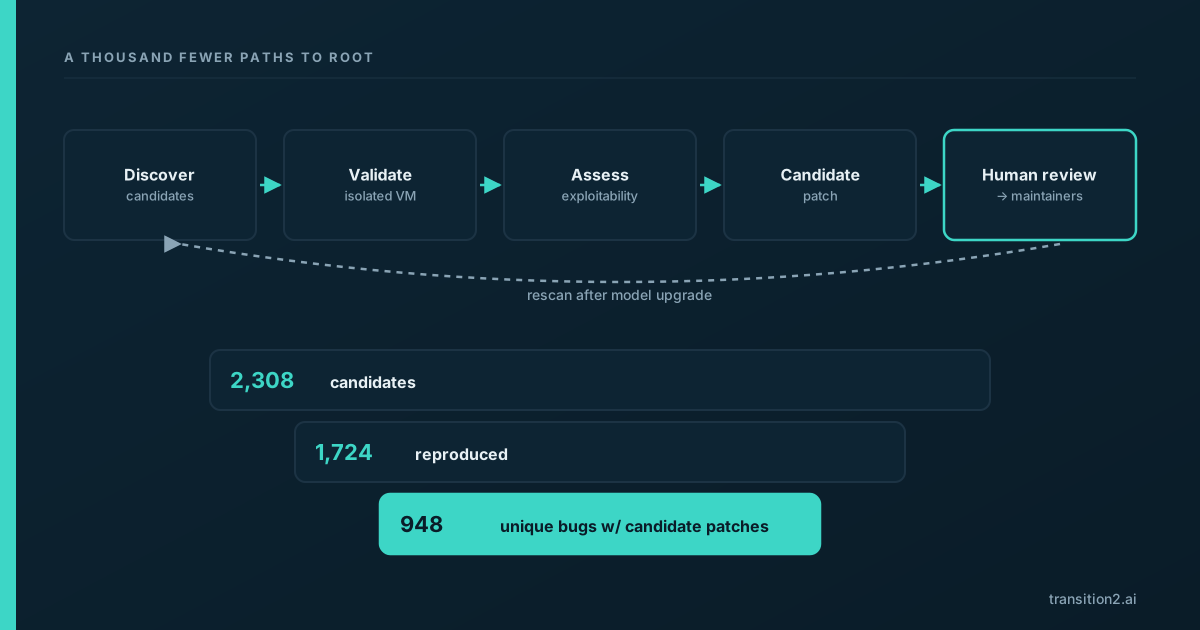
OpenAI published a report on November 4, 2026 describing a five-stage, multi-agent pipeline, powered by an upcoming cyber model, that surfaced 948 unique local privilege-escalation bugs in the Linux kernel and produced a distinct candidate patch for each one (OpenAI). Those patches are going to kernel maintainers for review; they are not merged fixes. For defenders, the story is tempo: when a model can surface flaws at this scale, patch velocity, isolation and rescanning after model upgrades become core parts of a security program.
This article covers the hardening outcome. It does not describe how any of the bugs work or how they could be used. OpenAI itself omitted the full technical details of the new exploitation techniques its agents used, for safety reasons.
What happened
According to OpenAI's report, the pipeline has five stages:
- Vulnerability discovery. Scout agents pick audit targets and Analyst agents scan them.
- Dynamic validation. A triage agent tries to reproduce each candidate inside an isolated virtual machine with the kernel's memory error detector (KASAN) turned on.
- Exploitability assessment. Reproduced candidates are screened for whether they can actually lead to elevated privileges or leaked information.
- Patch generation. The system drafts a fix for each distinct bug.
- Human review. Security researchers review the results before anything is reported to maintainers.
The run took place in mid-October 2026 against the latest kernel master branch. OpenAI reports the following funnel:
| Stage | Count reported by OpenAI | |---|---| | Audit targets chosen by Scout agents | 5,034 (about 2.8 million lines, roughly 7% of the kernel) | | Candidate findings after deduplication (within 12 hours) | 2,308 | | Reproduced in isolated VMs (within 30 hours) | 1,724 | | Distinct candidate patches, counted as unique privilege-escalation bugs | 948 |
OpenAI says the agents produced 1,169 working privilege-escalation exploits and 291 proofs of concept for information leaks. Variant analysis traced the exploits to 948 distinct bugs, each with its own patch. The run cost $1,213,430 in API credits, by OpenAI's account. The target machines ran a stock desktop distribution with standard kernel protections turned on, not a weakened target.
About three in four candidates (74.7%) reproduced. OpenAI says only 3.1% of candidates reflected incorrect analysis by the model; most of the rest either needed elevated privileges to begin with or did not reproduce in the time allowed, for example because of timing-dependent behaviour.
The class of bug is local privilege escalation: a flaw that lets a process already running on a machine gain more privileges than it should, up to full administrative control, which is what "root" in the title refers to.
On reporting, OpenAI says it has already sent out "hundreds of reports and patches for critical vulnerabilities", starting with critical bugs on the Linux kernel community's advice. It is sending the rest gradually with partners in its Patch the Planet initiative, part of a wider commitment it calls Daybreak. When the scan and manual analysis finished after ten days, 61 of the bugs had already been patched upstream, 43 had patches in staging, and 299 were being reported and discussed publicly.
OpenAI also compares this run with one in late July 2026 that used GPT-5.6 Sol and found and exploited 166 unique privilege-escalation bugs, at a cost of $513,690 in API credits. The newer cyber model found more than five times as many novel ones, even though the kernel had absorbed three months of hardening between the two scans. Both the model and the pipeline changed between runs, so the comparison is not a controlled experiment, but OpenAI's own takeaway is to rescan as models improve.
Why it matters
Validation is where the evidence comes from. A pipeline that filed every candidate would flood maintainers with noise. Reproducing each one in an isolated machine with memory checking turned on is what turns a model's guess into something a maintainer can act on. The low share of outright wrong analysis (3.1%) is a measurement worth tracking in any similar system.
Verify the path, not just the result. OpenAI describes an early run in which 20 of 200 reported successful results reached elevated privileges through a different, unassigned bug than the one the agent was supposed to be testing. The pipeline reported success, but for the wrong reason. OpenAI added an independent check. The general lesson applies far beyond kernels: an automated agent that reports "done" should be checked on how it got there.
Maintainer capacity is the bottleneck. The numbers after ten days (61 already patched upstream, 43 in staging, 299 in public discussion) show that discovery now runs faster than the human review and release process downstream. For anyone who runs Linux, protection arrives only when reviewed fixes ship in kernels and distributions and then reach production machines.
Model upgrades reset the baseline. Code that was scanned with one model has not necessarily been scanned with the next. Security teams that rely on automated review should plan to rescan when the models they use, or the models available to others, take a step up.
Stronger models need lighter orchestration. OpenAI reports that with GPT-5.5 Cyber, a library of 103 known techniques raised exploitation success from 76.2% to 88.9% over 63 candidates. With GPT-5.6 Cyber, a lightly orchestrated workflow did better, and adding the library back gained only 1.5 points. Capable discovery pipelines are getting simpler to build, for defenders and for others. The right response is speed: shorten the time between a fix being available and a fix being deployed.
Isolation limits what is not yet patched. OpenAI's advice is that low-privileged access to an unpatched system should be treated as functionally equivalent to root for a well-resourced actor. It recommends defense in depth with sandboxes and isolation, naming Firecracker and gVisor, and keeping software up to date. The pipeline also found and exploited a flaw in the QEMU emulation layer of its own test setup. The flaw had been fixed in upstream QEMU but not in the release build OpenAI was using. That is a reminder that the sandbox is part of the attack surface too. OpenAI says it has since tested its infrastructure and disclosed and patched vulnerabilities in Kata, Moby/Docker, gVisor and other projects.
OpenAI also reports that patch quality improved with iteration and adversarial review, and that the prototype found problems in some human-written patches.
Teams thinking about how this fits with older systems can find related material in the Legacy Modernization hub, and the release and monitoring side is covered in AI Reliability & Operations.
What it means for businesses
Treat patch velocity as a measured security outcome. Track the time from an upstream kernel or distribution fix being published to that fix running on your systems, and set a target for it. Hundreds of candidate patches protect nobody until they are reviewed, released and deployed.
Take OpenAI's framing seriously in risk registers: on an unpatched host, any foothold should be assessed as if it could become full control. Invest in isolation for workloads that run untrusted or third-party code, so that an escalation inside one workload does not become control of the host.
If you adopt autonomous discovery or patching tools, run them as a controlled pipeline: discovery and validation in isolated environments, an independent check that each result came from the intended cause, proposed patches as reviewable changes, and a human gate before anything is reported or merged. Record which model and version produced each finding, and plan a rescan when it changes. The Enterprise AI Governance hub covers how to document that kind of pipeline.
What it means for AI users
For most people, the practical action is the familiar one: install operating system and kernel updates promptly, especially on machines that run software from many sources. As fixes from this effort move through maintainer review and into releases, updates are how they arrive.
Reports like this one describe outcomes. They are not instructions, and OpenAI itself left out the full technical detail of the new techniques its agents used. The safe way to use this research is to read the vendor's hardening summary, confirm that fixes have reached your systems, and move on.
What it means for developers
Design for isolation by default. Run untrusted code, including code produced by agents, inside lightweight virtual machines or sandboxed kernels such as Firecracker or gVisor rather than directly on shared hosts. Keep the test harness patched as well; it is part of the boundary.
If you build discovery or patching pipelines, keep validation inside an isolated environment, require dynamic reproduction before a finding is filed, and add an independent check that the reproduced result came from the finding under test. Route every proposed patch through normal code review. Never paste reproduction details or exploit material into tickets, chat or logs that have wider access than the security team; record the class of issue, the affected component and the fix.
Measure the pipeline honestly, per model version: the share of candidates that reproduce, the share rejected as incorrect analysis, the share that end in an accepted upstream patch, and how long acceptance takes. Those ratios show whether a model upgrade improved results or simply produced more leads, and whether added orchestration is still earning its place.
Sources
- A thousand fewer paths to root (OpenAI, Nov 4, 2026) (accessed 2026-11-06)