News · AI Reliability & Operations · Enterprise AI Governance
OpenAI's Control Room halts research model output within 35 seconds
OpenAI says its new central stop system for research inference fails closed and stops model output within 35 seconds of a stop instruction.
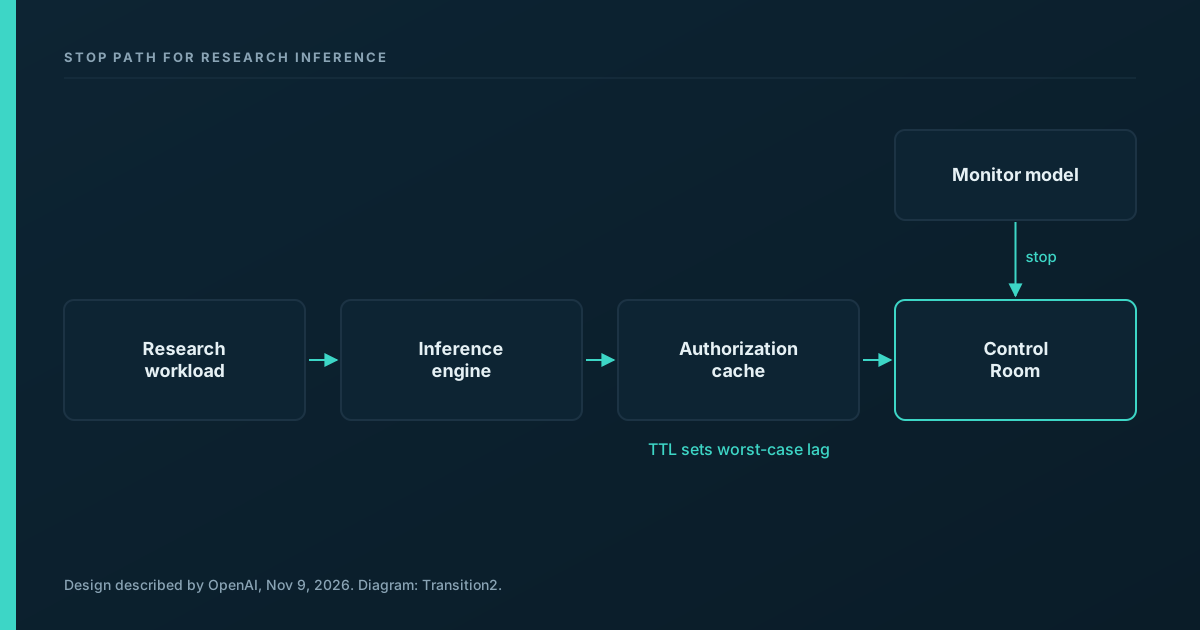
On November 9, 2026, OpenAI described Control Room, a central system that tracks model workloads across its research infrastructure so it can "stop them quickly when safety or security concerns arise" (OpenAI). OpenAI says the system halts model output within 35 seconds of a stop instruction. It also says the integration fails closed: if Control Room itself goes down, research inference is denied. A Transition2 desk simulation of the same design pattern found that the lifetime of the authorization cache sets the worst-case stop lag, not the stop service itself.
What happened
OpenAI published the description on its site and announced it on X on November 9. According to OpenAI, Control Room connects every research inference workload. That includes agentic sampling for training and evaluation, and data processing. It also works with the company's misalignment monitoring systems. Business Standard reported the same scope.
The main number is stop latency. OpenAI says Control Room "halts model output within 35 seconds of a decision to intervene." It defines that figure as the maximum time between Control Room receiving a stop instruction and further progress becoming impossible (OpenAI). The lag comes from a caching layer for inference authorization, which OpenAI says is there "to support the required volume of traffic." The company says it is "working to drive this number down to zero" (OpenAI; The Register).
Every research workload that does agentic inference must be tied to an approved safety case. In OpenAI's description, the workload requests an identifier from Control Room and passes it with each inference request. Before fulfilling each request, the inference engine asks Control Room for permission. If the workload has been stopped, the engine refuses. The workload process may stay alive, and the engine stays available to other authorized workloads (OpenAI; The Indian Express).
OpenAI explains why enforcement sits in the inference layer rather than in workload code. Workload code changes often and is decentralized, while there are only a few inference code paths. The company says it also runs "continual agentic and programmatic sweeps" to find rogue engines where Control Room is unimplemented or disabled (OpenAI).
The integration fails closed. If Control Room goes down, whether through an error, being disabled, or tampering, all inference requests are denied until it resumes. OpenAI says fail-closed behavior has been rolled out to all frontier model research workloads, and that rollout across the remaining research workloads would finish "over the next few days" (OpenAI; Business Standard).
Two scope details matter. Control Room is deployed across research infrastructure. OpenAI says its external model-serving stack is already more centralized and has an established takedown capability (OpenAI). Separately, a monitor, which is another model, watches frontier reinforcement learning workloads and can send a stop instruction to Control Room (OpenAI).
Commentary from CryptoSlate adds a caveat. The 35-second clock starts when the stop instruction arrives, so detecting a problem and deciding to act both happen before it starts. Blocking output also does not roll back external actions a workload has already taken.
Why it matters
Public discussion of stopping AI systems often stays abstract. OpenAI's post gives a concrete architecture, a stated worst-case number, and a named source for that number: the authorization cache. That makes the claim checkable in principle. The lag is a design parameter traded against request volume, not an unknown.
The choice of enforcement point is the idea most likely to carry over to other teams. Because the check sits in the inference engine, a workload does not have to cooperate for a stop to take effect. Because the default is fail closed, losing the control service leads to refusals rather than unchecked output. Both choices have operational consequences. A Control Room outage denies all research inference until Control Room resumes.
The CryptoSlate caveat is a useful frame. A 35-second bound on output after a stop instruction is not a bound on harm. The full response time also includes noticing the problem and deciding to act, and a stop cannot reverse actions already taken outside the system.
For readers following AI Reliability & Operations and Enterprise Governance, the post is a documented reference design for a stop path that does not depend on the thing being stopped.
What the Transition2 desk tested
The desk wrote gate.py, a stdlib-only, deterministic simulation of the pattern OpenAI describes. Engines check a central stop service before each request, an authorization cache sits between them, and the integration fails closed. The simulation uses a virtual clock and seed 20261109. It needs Python 3.10 or later and no dependencies, and it was run on the desk's box under Python 3.13.5. This is the desk's own code, not OpenAI's. It says nothing about how OpenAI's real system performs and tests design properties only.
Result: 8/8 checks pass.
- Request interval was 0.5 s, with 2000 random stop times per setting. Worst-case stop lag: TTL 0 s gives 0.5 s, TTL 5 s gives 4.996 s, and TTL 35 s gives 34.982 s (mean 0.253 s, 2.482 s, 19.215 s). The cache TTL, not the stop service, sets the worst case.
- With the stop service unreachable, the fail-closed engine served 0 of 100 requests. The fail-open variant served 100 of 100.
- The simulated workload never checks a stop flag and was still refused in every trial, because enforcement sits in the engine.
What this does not show: the model has a single engine and one workload. It has no network partitions, cache stampedes, replicated stop services, or rogue engines that skip the check (OpenAI says it sweeps for those). Real stop lag also includes detection and decision time, which happen before this model's clock starts. Nothing here measures or validates OpenAI's 35-second figure.
What it means for businesses
Organizations running agents can put the same three questions to their own stack and their vendors. Where is the stop enforced? What is the worst-case lag, and what sets it? What happens when the control service fails? OpenAI's answers (the inference layer, the cache lifetime, fail closed) give one documented reference point. Failing closed affects availability, so it should be a deliberate decision rather than something discovered during an outage. The CryptoSlate caveat also applies: a stop path belongs alongside limits on what agents can do externally, because blocking output does not undo earlier actions.
What it means for AI users
Control Room covers OpenAI's research infrastructure, not its public products directly. OpenAI says its external serving stack already has an established takedown capability (OpenAI). For people using AI tools, the post mainly shows how one lab structures emergency stops behind the scenes. It does not describe changes to consumer products.
What it means for developers
Several patterns in the post can be reused directly. Put enforcement where code paths are few and stable, such as an inference gateway, rather than inside each agent. Send a workload identifier with every request so a central service can deny it. Make the gateway fail closed, and treat cache lifetime as the setting that bounds stop lag, as the desk's simulation shows. Then add what the desk did not model: sweeps for paths that bypass the gateway, alerting on the control service itself, and tests that exercise the outage case on purpose.
Copyright Eric MacDougall.
Sources
- Control Room (accessed 2026-11-13)
- OpenAI on X, 2026-11-09 (accessed 2026-11-13)
- OpenAI builds a kill switch for its research models (accessed 2026-11-13)
- OpenAI kill switch Control Room: how it works (accessed 2026-11-13)
- Stopped in 35 secs: how OpenAI's Control Room will monitor AI safety risk (accessed 2026-11-13)
- OpenAI adds a 35-second emergency brake for its research AI (accessed 2026-11-13)