News · AI Reliability & Operations · Enterprise AI Governance
FBI warns attackers abuse ARTEX LLM pentest framework
An FBI FLASH alert says attackers are misusing the open-source ARTEX framework, with some observed intrusions reaching privileged access in under three hours.
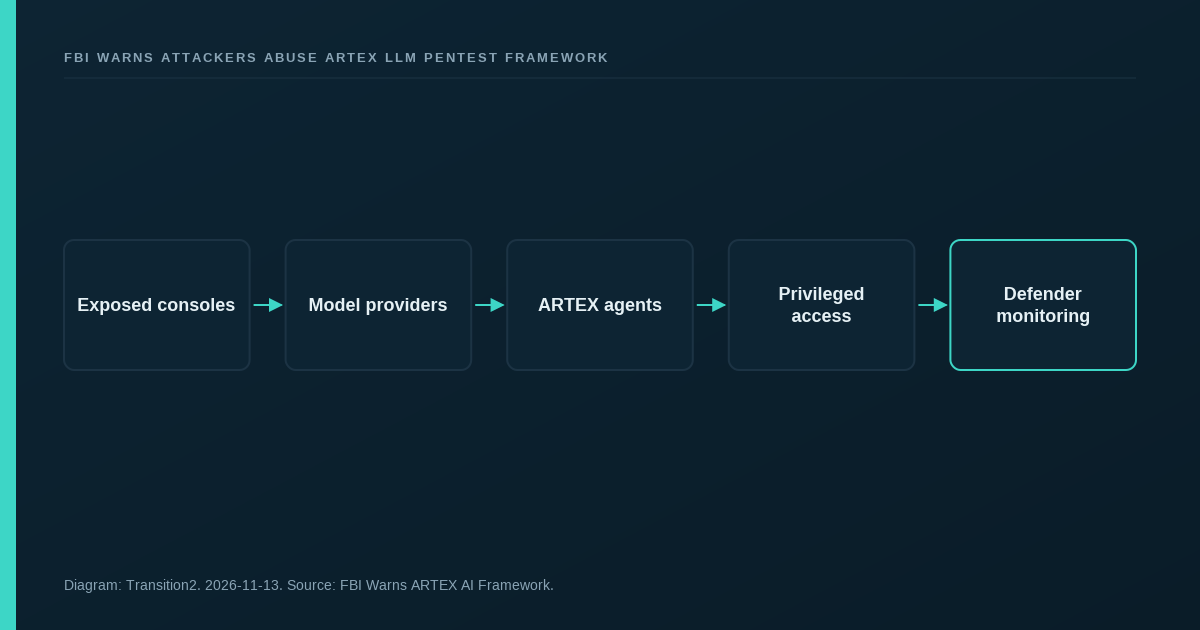
The FBI issued a FLASH alert through its Internet Crime Complaint Center on November 13, 2026 warning that attackers are misusing ARTEX, an open-source framework that drives penetration-testing agents with large language models. The bureau says malicious use has been observed since at least August 2026 across multiple sectors, and that some observed intrusions reached privileged access in under three hours (FBI/IC3). The practical response for defenders is inventory, least privilege and monitoring, not alarm over a single tool.
What happened
According to the FBI FLASH alert, ARTEX is an open-source, multi-agent penetration-testing framework written in Go that ships no model of its own and connects to external LLM providers (FBI/IC3). The bureau says malicious use has appeared since at least August 2026 across sectors including financial services, government and technology, and that some observed intrusions reached privileged access in under three hours (FBI/IC3). That figure describes some observed intrusions, not a guaranteed capability.
The tool was released in July 2026, and the original repository was removed on October 8, 2026, though forks and a commercial "ARTEX PRO" remain available (FBI/IC3). Researchers counted more than 1,600 publicly exposed ARTEX consoles in early November, and the reporting is explicit that exposure alone does not prove malicious use (Cyber Security News). One South Korean financial-sector campaign is linked to data on about 67,000 people, and more than 2,250 ConnectWise Cloud Backup downstream tenants figure in the reporting (FBI/IC3).
The reporting carries several discrepancies worth flagging. On the ConnectWise figure, GBHackers and OODA Loop describe a compromise affecting more than 2,250 downstream tenants, while Cyber Security News frames the same number as attempted access and a measure of targeting rather than confirmed breaches (GBHackers; Cyber Security News). OODA Loop, the only outlet to make this claim, attributes the ConnectWise compromise to a named threat actor and the under-three-hours observation to Microsoft (OODA Loop). The FLASH lists the external model providers ARTEX can use; this piece does not repeat those names.
For detection, the reporting lists indicators including an IP address for an ARTEX host and an LLM API reseller domain, xcai[.]pro, while warning that cloud IP addresses can be reassigned, so analysts should corroborate before blocking (FBI/IC3). The published mitigations are defensive and unremarkable: inventory internet-facing systems, restrict administrative endpoints, apply least privilege to application consent grants, monitor identity-provider credential additions and unexpected outbound LLM API traffic, scan repositories for secrets, preserve evidence, and validate historical indicators against current telemetry (GBHackers). The FBI FLASH alert is the primary source for these facts (FBI/IC3).
Why it matters
The alert marks a shift in how defenders should think about offensive tooling. A framework built for authorized testing, wired to external models and run by multiple agents, lowers the effort of chaining reconnaissance to privileged access, and the FBI's timeline shows that some intrusions moved fast. The useful takeaway is not the speed figure in isolation but the pattern it implies: exposed consoles, over-broad consent grants and unmonitored model egress are the conditions that let an agentic workflow run. More than 1,600 exposed consoles (Cyber Security News) is a measure of attack surface, not of compromise, and the gap between those two numbers is where defensive work lives. Teams responsible for AI Reliability & Operations can treat the mitigations as a checklist that holds regardless of which tool is involved.
The desk ran no experiment here: reproducing an offensive intrusion framework is out of scope and unsafe, and because the original repository has been removed and the indicators are IP addresses and domains, they cannot be meaningfully tested offline without live telemetry.
What it means for businesses
The exposure is concentrated in things most organizations already know they should control: internet-facing administrative endpoints, application consent grants, and credential additions in the identity provider. Start by inventorying what is reachable from the internet and tightening consent to least privilege. Because the published indicators include IP addresses that may be reassigned, corroborate before blocking so you do not disrupt a legitimate tenant that later inherits the address. Treat the ConnectWise figure as contested: the reporting splits on whether more than 2,250 downstream tenants were compromised or targeted.
What it means for AI users
The notable detail for AI users is that ARTEX ships no model and relies on external providers, which means unexpected outbound traffic to model APIs is a monitoring signal. Organizations that allow broad LLM access should watch for anomalous API egress and for reseller domains that proxy model calls. The FLASH lists the external model providers ARTEX can use, so unexpected outbound traffic to model APIs is the monitoring signal, not any single named provider.
What it means for developers
The defensive measures map cleanly onto engineering practice: keep secrets out of repositories and scan for them, restrict management and deployment endpoints, and alert on credential additions in your identity platform. Preserve evidence when something looks wrong, and validate the published historical indicators against your own telemetry rather than blocking them blindly. The framework being open source and forked means signature-based detection alone will age quickly; behavior-based monitoring of privileged access and model egress is the more durable investment.
Copyright Eric MacDougall.
Sources
- FBI Warns ARTEX AI Framework (accessed 2026-11-15)
- FBI Reveals How Hackers Use ARTEX AI Agents to Gain Privileged Access in Under Three Hours (accessed 2026-11-15)
- FBI FLASH on ARTEX: Agentic AI Hacking Frameworks Move From Pen Testing Tool to Mainstream Threat (accessed 2026-11-15)
- FBI FLASH PDF (accessed 2026-11-15)