News · AI Products & Copilots · Models, Tooling & Developer Practice · AI for SaaS & Software Companies
Muse Wonder: Meta's frontier model for personal and professional agents
Meta's Muse Wonder and Muse Wonder Full target long-running agents with a 1M context and features Meta calls Active Memory and Active Focus.
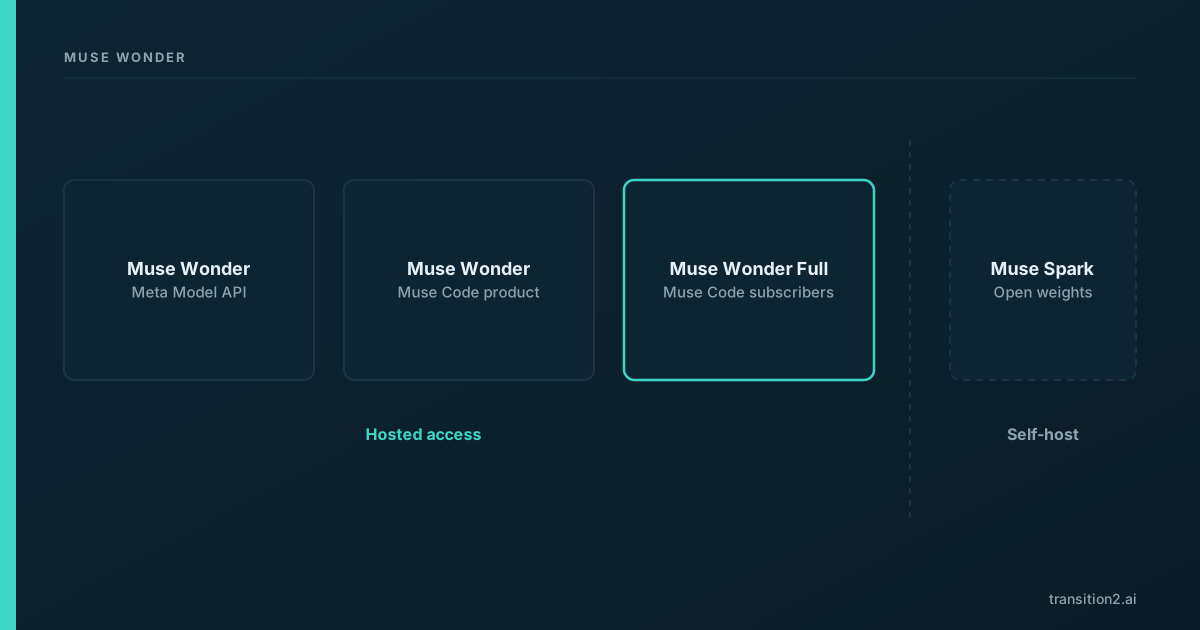
Meta introduced Muse Wonder on October 12, 2026, a model it positions for long-running personal and professional agents, alongside a larger tier called Muse Wonder Full. Muse Wonder is available through the Meta Model API and Meta's Muse Code product, and Muse Wonder Full is available to Muse Code subscribers, according to Meta's announcement. The headline features are a 1M token context window and two capabilities Meta calls Active Memory and Active Focus. For teams choosing an agent model, the useful question is less about rank and more about how these features behave when a task runs for a long time and touches real systems.
What happened
On October 12, 2026, Meta published its Muse Wonder announcement and a matching model page. The release has two parts.
- Muse Wonder is offered through the Meta Model API and inside Muse Code.
- Muse Wonder Full is offered to Muse Code subscribers.
Both have a 1M token context window. The model page identifies the API model as muse-wonder-1.0, priced at $4 per million input tokens, $0.20 per million cached input tokens and $20 per million output tokens. muse-wonder-full-1.0 is available only by subscription in Muse Code, on the Power Usage and Maximum Usage plans.
Meta defines the two headline features in behavioral terms:
- Active Memory is "carrying important context about you across conversations and actively retrieving the details relevant to the task at hand".
- Active Focus is how the model keeps working toward a hard goal: trying alternative approaches, working through blockers and adapting to new information. Meta says it asks for clarification when needed and checks in before taking important actions.
Meta says it evaluates memory with MemoryBench, focus with FocusBench, and sustained execution with SWE-Marathon, which tests work on long-running software projects. Its domain evaluations include Harvey's Legal Agent Benchmark (LAB). The model page describes Muse Wonder as planning long tasks, delegating to sub-agents and recovering from errors.
The announcement does not explain how either feature is implemented, and the scores are Meta's own. The Transition2 desk treats them as claims to be tested, not as established behavior. Meta also says the models were trained at its gigawatt-scale Prometheus data center. It says Muse Wonder has its strongest safeguards to date against chemical, biological, radiological, nuclear and cyber misuse, with a full safety report to follow.
Why it matters
Most agent failures in production are not single bad answers. They are slow drifts: an agent loses track of the goal after many steps, forgets a constraint set early in the session, or hands a sub-task to a helper and never checks the result. Meta is explicitly pitching Muse Wonder at that class of problem, which is why the release is worth attention even before independent results arrive.
Three points stand out.
Long context is not the same as long-task reliability. A 1M token window lets an agent hold a large amount of material at once. It does not, on its own, guarantee that the agent uses the right part of that material at the right step. Meta presents Active Memory and Active Focus as features for long tasks. Whether they close the gap for a given workload is something each team has to test on its own tasks.
Sub-agent delegation moves the risk boundary. When a model can split work and hand pieces to sub-agents, the number of actions taken on behalf of one request grows. Each sub-agent call is another place where permissions, inputs and outputs need checking. Meta's model page lists delegating to sub-agents as a core capability, which makes delegation behavior part of what buyers should evaluate.
Distribution shapes control. The same model family reaches users in two ways: an API that a business wires into its own systems, and a packaged product, Muse Code. Those routes give a business different levels of control over logging, permission scopes and where an agent can act. Because the Full tier is limited to Muse Code subscribers, some capability is reachable only through the packaged product, at least at launch according to the announcement.
For context on how the Transition2 desk thinks about this category, see the AI Products and Copilots hub and the Models, Tooling and Developer Practice hub.
How to evaluate a long-running agent model
Because the key claims are about behavior over time, a short benchmark run is weak evidence. A more useful evaluation for Muse Wonder, or any model making similar claims, looks like this:
- Run tasks that are long by design. Pick real workflows that take many steps, such as a multi-file code change or a research task that pulls from several sources. Measure task completion, not answer quality on a single turn.
- Plant constraints early and check them late. Put an instruction at the start of a session that matters near the end. Record how often it is still respected. This directly tests the Active Memory claim.
- Count interventions. Track how often a human has to step in to correct course. Fewer corrections per completed task is a clearer signal than a leaderboard position.
- Inspect delegation. Log every sub-agent call: what it was asked, what it returned, and whether the parent checked the result. Look for sub-tasks that were accepted without verification.
- Test interruption. Stop the agent mid-task and resume it. Note whether it picks up from a sensible point or repeats or skips work.
- Measure resource use. Record tokens consumed and wall-clock latency per completed task, because long-context, long-running work can consume far more compute than a short exchange.
Run the same harness against the model currently in use. A comparison on identical tasks is the only fair way to see whether the new features change outcomes for a particular team.
What it means for businesses
Compare agent products on how they stop, what they are allowed to touch, and how they are tested, not only on published rankings. Muse Wonder's pitch is long-running work and delegation, so ask for the controls that go with that: how a running task can be paused or cancelled, how permissions are scoped per tool, and what logs are available afterward. Decide early whether the API route or the Muse Code route fits, because they differ in how much of the surrounding system a business controls. Treat Active Memory and Active Focus as claims to verify with a structured evaluation like the one above before relying on them in a workflow that changes records or sends messages.
What it means for AI users
A long-running agent should have clear ownership of what it can change. Before handing a multi-step task to Muse Wonder or a similar model, know which accounts, files and tools it can reach, and whether it can act without asking. Expect to check its work at sensible points rather than only at the end, since the failures that matter in long tasks tend to accumulate quietly. If a product does not make it easy to see what the agent did and to stop it partway through, that is a reason for caution regardless of the model behind it.
What it means for developers
Plan for delegation, error recovery and parallel tool use from the start. If Muse Wonder hands work to sub-agents, build a wrapper that records each delegated call, validates its output, and limits what the sub-agent can access. Design for interruption: persist task state so that a stopped run can resume cleanly. Keep the 1M token window as an upper bound rather than a default, and measure how much context a task actually needs, since larger contexts increase latency and token use. Finally, add the planted-constraint and intervention-count checks to your evaluation suite so that model upgrades are judged on the same long-task behavior Meta is claiming to improve.
Sources
- Muse Wonder blog (accessed 2026-11-06)
- Muse Wonder model page (accessed 2026-11-06)