News · Enterprise AI Governance · Procurement Intake & Approvals
US rule requires licenses for data centers renting AI compute to China
A Commerce interim rule also adds five diversion-risk countries and rescinds the AI Diffusion Rule, with its start tied to Federal Register publication.
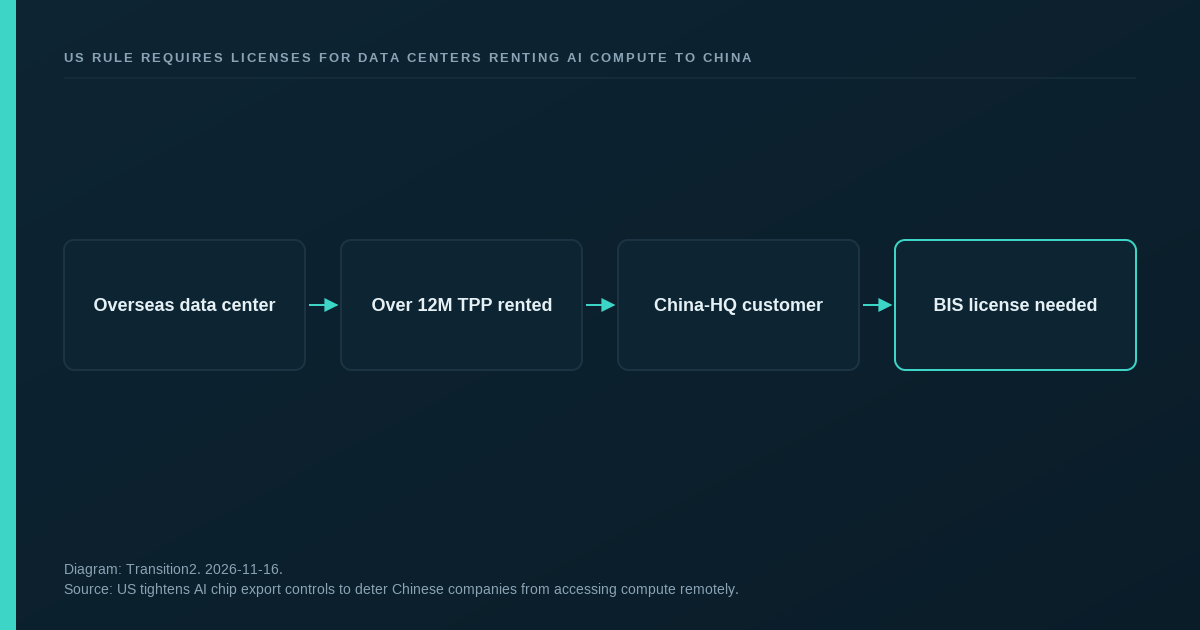
The US Commerce Department's Bureau of Industry and Security (BIS) issued an interim rule on November 16, 2026 that requires a license to export, reexport or transfer chips and servers to a data center, anywhere, that provides more than 12 million aggregate TPP (total processing performance) of compute to companies headquartered in China or Country Group D:5, according to TechCrunch. Nixon Peabody describes the same control as an exporter end-use rule based on knowledge of that use, and includes Macau alongside China and Country Group D:5. Operators that already provide covered compute have 90 days from the effective date to obtain a license if they want to continue, according to Nixon Peabody. The same rule adds license requirements for advanced-chip exports to five countries and formally rescinds the AI Diffusion Rule of January 2025, as summarized by Nixon Peabody. It takes effect on Federal Register publication, so its start date was not fixed on the day it was announced (Nixon Peabody).
What happened
BIS issued the measure as an interim rule on remote access to advanced chips on November 16, as reported by CBS News and the law firm Nixon Peabody. The RIN, 0694-AK50, and the rule's title, "Addressing Remote Access to Advanced Semiconductors," are given only by Nixon Peabody.
The central change is an exporter end-use control. A license is needed to export, reexport or transfer chips and servers to a data center, in any country, that provides more than 12 million aggregate TPP to companies headquartered in China or Country Group D:5, as reported by TechCrunch. Nixon Peabody describes the trigger as the exporter's knowledge that the items are destined to such a data center, and includes Macau with China and Country Group D:5. Data centers already serving covered customers have 90 days from the effective date to obtain a license, according to Nixon Peabody. TechCrunch estimates that 12 million TPP is about the compute of 750 Nvidia H100 or H200 chips; that is the outlet's own estimate, not a BIS figure.
The rule also adds license requirements for advanced-chip exports to Indonesia, Malaysia, Singapore, Thailand and Brazil, which Commerce says "present a higher-than-normal risk of diversion," according to CBS News. Recipients headquartered in the US are exempt from that five-country requirement (TechCrunch). The sources differ on the condition attached: TechCrunch describes the exemption for US-based companies without mentioning reporting, while Nixon Peabody says it depends on the exporter filing monthly reports.
Commercial recommender systems, meaning e-commerce and social-media ranking, are exempt from the new prohibition (Nixon Peabody).
The rule formally rescinds the Biden-era AI Diffusion Rule of January 2025 (TechCrunch). According to Nixon Peabody, the rescission includes the model-weights control under ECCN 4E091, the country tiers and the Data Center VEU program; no other source reviewed gives that breakdown.
On timing, the rule takes effect when it is published in the Federal Register, followed by a 60-day public comment period (Nixon Peabody). Nixon Peabody says BIS expected publication and effect on November 19, 2026. Neither TechCrunch nor CBS News gives an effective date, and CBS describes the rule as an interim rule and as temporary. CBS News also describes existing rules as covering only the most advanced chips and does not mention the 12 million TPP threshold that TechCrunch and Nixon Peabody report.
BIS issued the measure as an interim rule, so it takes effect on publication with public comment taken afterward (Nixon Peabody).
Why it matters
The license trigger for new shipments is an exporter end-use control: a license is required to export, reexport or transfer chips and servers to a data center that provides more than 12 million aggregate TPP to covered companies (TechCrunch). Nixon Peabody adds that the control turns on the exporter's knowledge of that use. The threshold is measured in aggregate TPP and keyed to where the customer is headquartered, and it applies to data centers wherever they are located. Operators themselves need a license for existing arrangements, under the 90-day rule reported by Nixon Peabody.
The 90-day window gives existing operators a defined period to obtain a license, but it runs from the effective date (Nixon Peabody). Until Federal Register publication, that start point rests on an expected date from a single source rather than a published one.
The five-country additions bring Indonesia, Malaysia, Singapore, Thailand and Brazil into the advanced-chip license regime on diversion-risk grounds (CBS News). Whether US-headquartered recipients can rely on the exemption without filings is one of the points where the sources disagree: TechCrunch describes the exemption without mentioning reporting, while only Nixon Peabody ties it to monthly reports.
The rescission removes the AI Diffusion Rule's structure. Per Nixon Peabody, that includes the country tiers, the Data Center VEU program and the model-weights control, so compliance plans built around those mechanisms no longer have the rule they were designed for. The 60-day comment period gives affected companies a formal channel to respond to the new text (Nixon Peabody).
What the Transition2 desk tested
The desk ran an arithmetic check of the TechCrunch estimate that 12 million TPP is about 750 H100 or H200 chips. It used only the Python standard library, simulated no hardware and ran no vendor code. TPP was computed from the ECCN 3A090 definition, TPP = 2 x MacTOPS x bit length of the operation, with MacTOPS taken as TFLOPS divided by 2 and a bit length of 8. Chip throughput came from Nvidia datasheets, which are vendor figures: the H100 SXM and H200 SXM list FP8 at 3,958 TFLOPS with sparsity, and a footnote puts the dense figure at half that, 1,979 TFLOPS. The H100 PCIe dense FP8 figure of 1,513 TFLOPS was included as an informational variant.
Pinned versions: Python 3.9 or newer, standard library only (json, fractions, os, sys), no third-party packages. The pack specification named Python 3.12; the code is 3.9-compatible and also runs on 3.12. The sandbox ran with network access denied, and setup, run and checks all returned exit code 0.
Results: 8/8 checks passed. Per-chip TPP for the H100 SXM was 15832, matching the expected 15832. The H100 SXM count was 757.96 chips, inside the accept range [700,800] and consistent with the "about 750" estimate. The H200 SXM count was also 757.96. The threshold round trip returned chips*TPP=12000000. Both negative controls fell outside the range as required: using the sparsity figure gave 378.98 chips, and omitting bit length gave 6063.67 chips. The H100 PCIe variant, which was not range-checked, gave 991.41 chips, so the estimate holds for SXM parts rather than every H100 model.
What this does not show. The inputs were transcribed from public documents, not fetched at run time, and should be checked against the live datasheets and regulation. The desk did not read the rule text, so the check assumes a simple sum of per-chip TPP and does not verify how the interim rule aggregates TPP across a data center. It does not show how TechCrunch derived its figure, only that the figure is arithmetically consistent with the public definition and vendor specs. Datasheet peak values are not real-world throughput.
What it means for businesses
For companies that buy or operate data-center capacity, the key variables are customer headquarters and aggregate volume. A license is required to export, reexport or transfer covered chips and servers to a data center that provides more than 12 million aggregate TPP to companies headquartered in China, Macau or Country Group D:5, and a data center already serving such customers has 90 days from the effective date to obtain a license if it wants to continue (Nixon Peabody). Businesses with facilities or suppliers in Indonesia, Malaysia, Singapore, Thailand or Brazil face the new advanced-chip export license requirements, and the US-headquartered exemption is described by Nixon Peabody as conditional on monthly exporter reports. Contracts and compliance calendars that reference the rule have no confirmed start date until Federal Register publication. Broader coverage of rules like this sits under Enterprise Governance and Procurement.
What it means for AI users
The obligations described in the sources fall on exporters and data-center operators rather than on people using AI services (TechCrunch). Commercial recommender systems, the ranking behind e-commerce and social-media feeds, are exempt from the new prohibition (Nixon Peabody). Organizations headquartered in China or Country Group D:5 that rent large compute pools abroad are the users most directly affected, because the trigger is keyed to customer headquarters, not to where the hardware sits (TechCrunch). Nixon Peabody includes Macau in that headquarters test.
What it means for developers
The threshold is aggregate TPP across what a data center provides to a covered customer (TechCrunch). The desk's check found the 750-chip estimate consistent with dense FP8 figures for SXM parts, while the PCIe variant gave 991.41 chips, so chip counts are a rough proxy rather than the legal test. Per Nixon Peabody, the rescission also removes the model-weights control under ECCN 4E091. The 60-day comment period after publication is the formal route for technical feedback on the text (Nixon Peabody).
Copyright Eric MacDougall.
Sources
- US tightens AI chip export controls to deter Chinese companies from accessing compute remotely (accessed 2026-11-17)
- Commerce Department limits remote access to AI chips (accessed 2026-11-17)
- BIS targets remote access to advanced chips through overseas data centers (accessed 2026-11-17)