News · Procurement Intake & Approvals · Enterprise AI Governance · Portfolio AI Execution
Procurement intake for models, agents, and MCP connectors
An AI tool is now a model, an agent harness, connectors and data flows at once. Procurement intake has to cover each layer with a named risk owner.
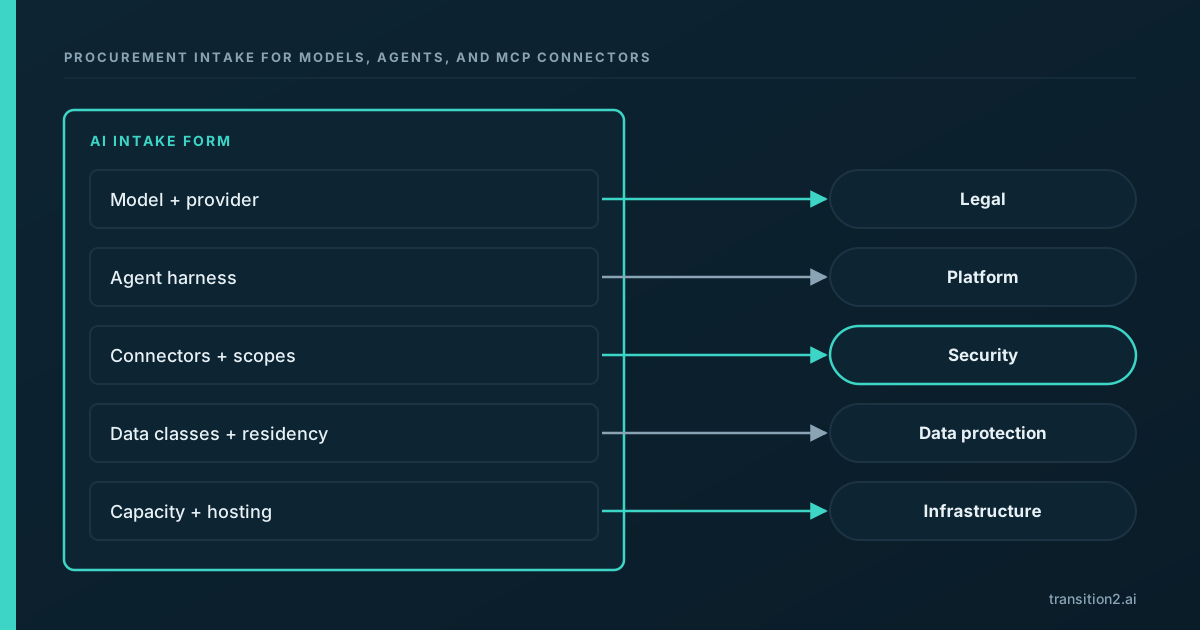
Since August 2, 2026, the European Commission's enforcement powers over obligations for providers of the most advanced general-purpose AI models have been in effect, as set out in the EU AI Act service desk FAQ. In parallel, vendors such as Anthropic now document centrally managed authorization for MCP connectors, and the politics of power for data centers have moved into mainstream coverage. Taken together, they mean an AI tool is no longer one product to approve. Procurement intake needs fields for the model, the agent harness, the connectors and the data, each with an owner.
What happened
Three threads from recent months land on the procurement desk.
Regulation. The EU AI Act service desk FAQ describes the Commission's enforcement powers related to the obligations of providers of the most advanced general-purpose models. Enforcement applies to providers, but the evidence those providers produce is what downstream organisations will want to see. In the desk's reading, that raises the contractual evidence an enterprise should request: what the provider documents about the model, and how it will share that documentation with customers.
Connectors. Anthropic's documentation on centrally managing authorization for MCP connectors means that the systems an assistant can reach are governed through the enterprise's identity provider. Each connector is a grant of access with its own scopes, and each needs review the same way an OAuth application does.
Capacity. Axios reported on October 8, 2026 on the changing regime for power supply to data centers and the politics around it. The desk treats that report as context rather than as a source for specific figures. The desk's explainer on H.R. 9340 and the Senate debate covers the legislation in more detail. The point for procurement is narrower: capacity assumptions behind hosted and self-hosted AI depend on infrastructure that is itself subject to public decisions.
Why it matters
Traditional software intake asks a familiar set of questions: who is the vendor, what data does the tool hold, where is it hosted, who approved it. Those questions still apply, but an AI tool has more layers than a conventional SaaS application, and each layer has a different risk owner.
- The model may come from a different provider than the application, and may change without the application changing. Legal and risk teams care about what the provider documents, especially where the model falls under the obligations the EU FAQ describes.
- The agent harness decides what the model is allowed to do: which steps need approval, what is logged, how failures are handled. Platform and operations teams own that layer.
- The connectors decide what the model can reach. Security owns their scopes, and centrally managed authorization gives it a place to enforce them.
- The data includes what goes in, what is retained, and where it is processed. Data protection teams own residency and retention.
- Capacity and hosting decide whether the tool is available at the throughput and latency the workflow needs. Infrastructure owns that, and the power regime coverage is a reminder that capacity is not a fixed given.
The layers also change on different schedules. An application contract may run for a year while the model underneath it is updated several times, a new connector is added at a user's request, or hosting moves to a different region. Intake that happens once, at signature, records a snapshot that can go stale within weeks. The practical answer is to treat the intake record as a living document: each layer has an owner who is told when that layer changes, and a material change reopens review for that layer only, rather than the whole tool.
An intake form that only captures the vendor name and a data question misses most of that. The result is unmanaged connectors and models nobody reviewed, which is how shadow AI starts.
A measurement angle
Intake quality can be measured:
- Field completeness: the share of approved AI tools whose intake record has every layer filled in, with an owner for each.
- Connector reconciliation: the number of connectors active in the identity provider against the number recorded in intake. Any difference is unmanaged access.
- Model change tracking: whether intake records note the model version, and how many tools changed model since approval without a review.
- Review cycle time: how long intake takes per layer, so that bottlenecks are visible and people are not pushed toward going around the process.
What it means for businesses
Extend procurement intake forms with fields for the model and its provider, the evaluation evidence the vendor can share, the connectors and scopes requested, data residency and retention, and hosting and capacity. Assign each field group to a named risk owner so that no layer is approved by default. For portfolio companies, a shared intake template keeps those reviews consistent across the group; the portfolio execution hub covers shared capability patterns. The procurement hub covers intake and approval design.
Ask providers how they will share the documentation associated with the obligations the EU FAQ describes, and write the answer into the contract record.
What it means for AI users
Shadow AI acquisitions create unmanaged connectors. Signing up for an AI tool on a personal account and connecting it to work systems creates access that nobody reviewed and nobody can revoke centrally. If you need a tool, put it through intake; if intake is too slow, say so, because that is a signal the process needs fixing rather than avoiding.
What it means for developers
Provide a standard architecture questionnaire for vendors, owned by engineering and reused across every AI intake. It should ask which model and version the product uses and how model changes are communicated, which steps require human approval and how that is enforced, which connectors are requested and with what scopes, what is logged and for how long, where data is processed, and how the product behaves when capacity is constrained. Publish the questionnaire internally so that teams proposing a tool can answer it before intake rather than during it.
Where connectors are involved, wire intake to the identity provider: a connector approved in intake should be the only way it appears in centrally managed authorization, and the reconciliation check above should run on a schedule.
Sources
- EU AI Act service desk FAQ: Commission enforcement powers for providers of the most advanced models (accessed 2026-11-06)
- Centrally manage authorization for MCP connectors (accessed 2026-11-06)
- Axios: data center power regime (accessed 2026-11-06)