News · Enterprise AI Governance · Contract Review Workflows · AI Reliability & Operations
EU AI Act: the Commission can now enforce GPAI systemic-risk duties
Since 2 August 2026 the European Commission can enforce Article 55 duties for general-purpose AI models with systemic risk, with fines and market measures.
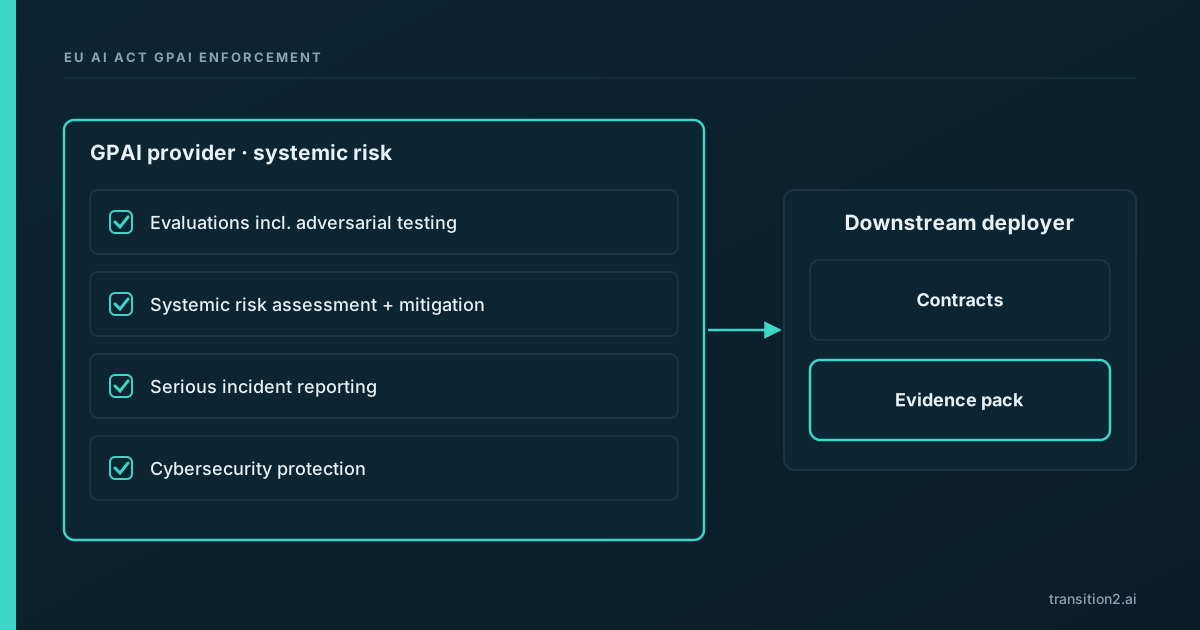
According to the AI Act Service Desk FAQ on the Commission's enforcement powers, the Commission's enforcement powers over obligations for providers of the most advanced AI models have applied since 2 August 2026. The obligations for providers of general-purpose AI (GPAI) models with systemic risk are set out in Article 55 of the AI Act: model evaluation including adversarial testing, systemic risk assessment and mitigation, serious incident reporting, and cybersecurity protection for the model and its physical infrastructure. The duties themselves have applied since 2 August 2025; what changed a year later is that the Commission can now enforce them, with powers that run from information requests to fines. Providers carry the direct duties, but businesses that build on these models need contracts and evidence trails that reflect them.
This article summarises official materials and is not legal advice.
What happened
The AI Act gave providers a one-year period, from 2 August 2025, to comply before the Commission's enforcement powers applied on 2 August 2026, according to the Service Desk FAQ. The Commission's guidelines page adds a third date: providers of GPAI models placed on the market before 2 August 2025 must comply by 2 August 2027. The official sources set out three things.
Who is covered. The obligations in Article 55 apply to providers of general-purpose AI models that are classified as having systemic risk. The Commission's guidelines for GPAI providers explain how the GPAI rules apply to providers.
What providers must do. Article 55(1) of the AI Act requires providers of GPAI models with systemic risk, in addition to the general GPAI obligations, to:
- Evaluate the model using standardised protocols and tools that reflect the state of the art, including conducting and documenting adversarial testing.
- Assess and mitigate possible systemic risks at Union level, including their sources.
- Track, document and report serious incidents and possible corrective measures to the AI Office, and as appropriate to national competent authorities, without undue delay.
- Ensure adequate cybersecurity protection for the model and its physical infrastructure.
Article 55(2) lets providers rely on codes of practice to demonstrate compliance until a harmonised standard is published.
The Service Desk FAQ adds that providers must notify the Commission when they know they are developing one of the most advanced models, and must assess and mitigate systemic risks. It notes that most relevant providers have signed the GPAI Code of Practice.
How the Commission can enforce. The enforcement framework and the FAQ describe a set of powers:
- requests for information, which the enforcement page says can be simple requests from the AI Office or formal requests by Commission decision;
- requests for access to a model so that the AI Office, or independent experts it appoints, can evaluate it;
- requirements to put risk mitigation measures in place;
- requests that a provider restrict the making available of a model on the market, withdraw it or recall it;
- fines. The FAQ says up to 3% of global annual turnover; Article 101 of the Act sets the ceiling at 3% of annual total worldwide turnover in the preceding financial year or EUR 15 million, whichever is higher.
The FAQ also sets expectations about how the powers will be used. The AI Office treats technical compliance dialogues with providers as its "first tool of choice", says that "in one important way, nothing changes in August", and says it may use its enforcement powers where those dialogues are not sufficient.
Why it matters
What changed on 2 August 2026 is that the Commission's powers to act on the most advanced models became available. The Article 55 duties can now be backed by formal requests, measures and fines, even though the AI Office says dialogue remains its first approach.
Three consequences follow from the official materials.
Evaluation becomes evidence. Article 55 makes evaluation, including adversarial testing, an obligation for covered providers. Combined with the Commission's power to request information and model access, that means evaluation work has to be documented well enough to hand over.
Incidents need a reporting path. Serious incident reporting requires a provider to detect, classify and report incidents. That depends on monitoring and on clear internal ownership, not only on policy documents.
Infrastructure is in scope. The cybersecurity duty covers both the model and its infrastructure. Serving systems, weight storage and access controls fall within the obligation, not only the model's behavior.
The strongest powers affect availability. The toolkit includes restriction or withdrawal of a model from the market. Those are the measures with the most direct effect on downstream users, because a business that has built a workflow around one model depends on that model remaining available in the EU. The official materials describe the powers; they do not indicate how often each will be used. A business can still prepare by knowing which of its workflows depend on a single covered model and what its fallback would be.
For downstream businesses, the provider obligations do not transfer automatically, but they shape what a business can reasonably ask its model providers for. If a provider has to produce evaluation results and incident reports for the regulator, a customer can ask what of that information is available under contract.
For more context, see the Transition2 Enterprise AI Governance hub and the Contract Review Workflows hub.
A readiness checklist
Businesses that use or build on general-purpose models can work through a short checklist:
- Classify your role. Determine for each AI system whether your organisation is a provider, a deployer or a distributor under the Act. The obligations differ by role.
- Identify covered models. List the general-purpose models in use and note which providers treat them as having systemic risk.
- Review contracts. Check whether supplier agreements address evaluation evidence, incident notification, cybersecurity commitments and cooperation with regulator requests.
- Build an evidence pack. Keep records of how each model was selected, evaluated and monitored in your own use.
- Test the incident path. Run a tabletop exercise in which a model-related incident has to be detected, escalated and documented.
Each step produces a record that can be checked. That is the practical measure of readiness: whether the evidence exists and can be produced on request.
What it means for businesses
Start by mapping whether you act as a provider, a deployer or a distributor for each AI system. Activities such as modifying or redistributing a model can affect which role applies, so check the official guidance for each case rather than assuming. Update contracts with model providers to cover evaluation evidence, incident notification and security commitments. Keep an evidence pack for each significant AI use so that questions from customers, auditors or regulators can be answered from records rather than reconstructed later.
What it means for AI users
People using AI services in the EU may see more transparency material from providers, such as documentation of evaluations and risk measures. Enforcement powers that include restriction or withdrawal mean that availability of the most capable models in the EU is subject to regulatory review. The official materials do not say how often those powers will be used. Users who rely on a specific model for important work should know which provider supplies it and where its documentation is published.
What it means for developers
Keep evaluation results, including adversarial testing, and incident logs in a form that can be exported and handed over. If a model provider or a regulator asks what testing was done, the answer should come from a reproducible record. Treat the cybersecurity of serving infrastructure as in scope: access controls on weights, secure configuration of inference endpoints and monitoring for misuse all relate to the duties in Article 55. Even where your organisation is not a provider of a systemic-risk model, building these habits makes it easier to meet contractual and audit requests from customers who are subject to the Act.
Sources
- Commission enforcement powers FAQ (AI Act Service Desk) (accessed 2026-11-06)
- Guidelines for providers of GPAI models (accessed 2026-11-06)
- Enforcement framework of the AI Act (accessed 2026-11-06)
- Regulation (EU) 2024/1689, Article 55 (EUR-Lex) (accessed 2026-11-06)