News · Enterprise AI Governance · Enterprise Knowledge Assistants · Procurement Intake & Approvals
Enterprise MCP connector governance after the stateless pivot
MCP connectors now provision through the identity provider. Enterprises need an inventory, scopes and an approval path for every tool a model can call.
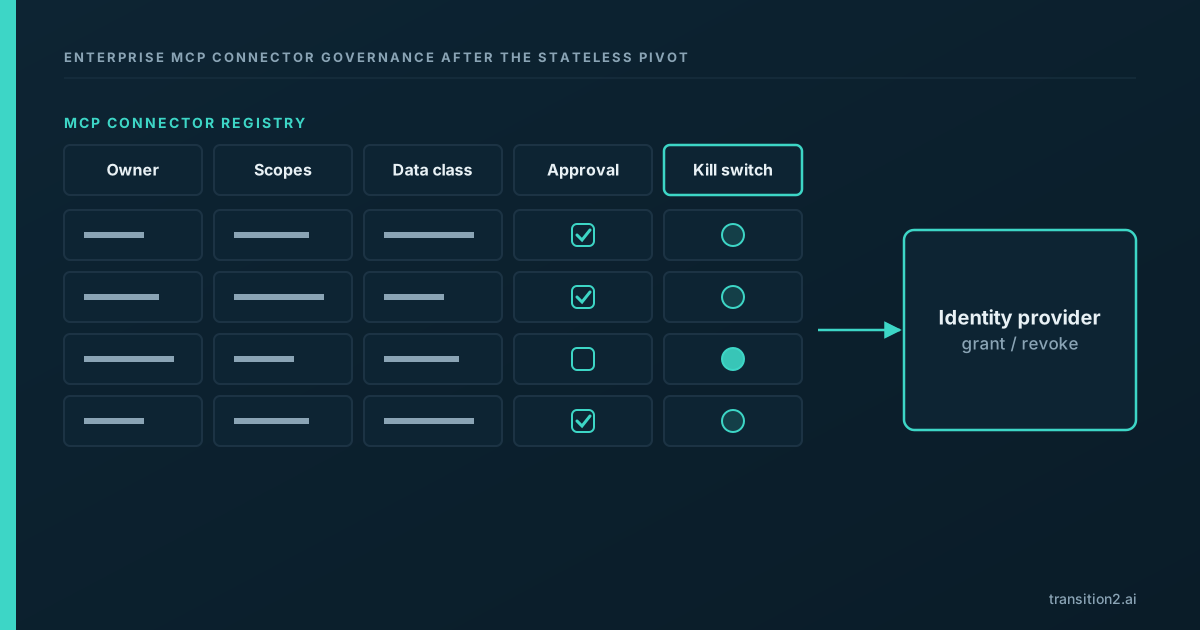
Anthropic's enterprise-managed authorization for MCP connectors, generally available since August 24, 2026, lets admins provision connectors for a whole organisation through the identity provider, starting with Okta, so that access to the tools a model can call is handled by the enterprise rather than by each individual user. Read together with the MCP 2026-07-28 specification work Anthropic describes, the direction is clear: enforcement moves to endpoints and identity systems. For enterprises, that turns MCP connectors into something to inventory, scope and review, the same way they already treat OAuth applications.
What happened
Three developments point the same way.
First, Anthropic's enterprise-managed authorization changes who connects tools. Previously an admin enabled a connector and then every user authorized it individually. Now an admin authorizes a connector once, users inherit access through the IdP groups and roles they already have, and the same access applies across Claude chat, Claude Code and Cowork. Anthropic says admins can shorten access-token lifetimes so a deprovisioned user's connector access expires quickly, and can require that a connector only ever connects through the IdP, which stops people linking a personal account to a work tool. Supported connectors listed include Asana, Atlassian, Canva, Datadog, Figma, Granola, Linear, Notion, Slack and Supabase. The feature is the first implementation of the Enterprise-Managed Authorization extension to MCP, which Okta's Aaron Parecki describes as embedding the Cross App Access protocol into MCP.
Second, the MCP 2026-07-28 revision, which Anthropic covers in its article on bringing that version to Claude, moves MCP from a bidirectional stateful protocol to a request/response model, and aligns authorization with production OAuth 2.0 and OpenID Connect deployments so servers connect to identity systems such as Entra or Okta without workarounds. In the desk's reading, a request/response protocol carries less session context between calls, which shifts the burden of deciding who may do what onto the endpoint that serves each call and the identity system behind it. The protocol is not where an enterprise's access policy lives; the identity provider and the connector endpoint are.
Third, the open-source agent-desktop v1.2.0 release shows how quickly a capability as broad as computer use can be packaged as an MCP server (desk coverage). Meanwhile Anthropic says Claude's connectors directory now lists more than 950 MCP servers. Once a desktop is reachable through the same connector interface as a ticketing system or a document store, the connector list stops being a short list of well-understood integrations.
For the security baseline, the OWASP MCP Security Cheat Sheet is the community reference the Transition2 desk recommends teams read alongside vendor documentation.
Why it matters
Connector sprawl is the new SaaS sprawl. Shadow IT taught many enterprises that the risky part of a new tool is rarely the tool itself. It is the grant: which data it can read, which actions it can take, and who noticed when it was added. MCP connectors are grants in that sense. Each one gives a model a route into a system, with whatever scopes the connection was authorized for.
The stateless pivot raises the stakes of getting that inventory right. If the protocol carries less context, then the identity provider's view of which connectors exist, which scopes they hold and which users or groups may use them becomes the main control plane. An organisation that has not registered its connectors there has no single place to answer basic questions: what can the organisation's assistants reach today, and how quickly can one route be turned off?
The desktop example matters because it collapses a boundary many teams relied on. Application-level controls assume the agent goes through the application. A desktop connector can reach whatever the signed-in user can reach on that machine. The governance answer is not to describe workarounds; it is to treat broad connectors as high-privilege grants that need an owner, a narrow scope where the connector supports one, and an explicit approval.
A measurement angle
Governance that cannot be measured tends to become theatre. Four numbers are worth tracking from the first week:
- Registry coverage: the share of connectors in active use that appear in the central registry with a named owner.
- Scope breadth: the number of connectors holding write or admin scopes, tracked over time, with a target of steady or falling.
- Time to revoke: how long it takes from a decision to disable a connector to the moment it stops answering calls, tested in a drill rather than assumed.
- Review freshness: the share of connectors reviewed in the last quarter.
None of these needs a new tool to start. A spreadsheet with an owner column is better than no registry, and the identity provider's own logs usually answer the time to revoke question once someone runs the drill.
What it means for businesses
Add MCP connectors to procurement intake and periodic access reviews, the same way OAuth applications are handled. The enterprise-managed authorization that Anthropic documents gives the control point, including IdP-only connection and short token lifetimes; the business process still has to use it. Concretely, that means every new connector request names a business owner, states which data classes it touches, and passes through the same approval path as any other system integration. Broad connectors, such as desktop control, belong in the highest review tier by default. The procurement hub and the enterprise governance hub cover the intake and review patterns in more depth.
It also means agreeing who can pull the switch. A kill switch that only one platform engineer knows how to operate is not a control. Write down who may disable a connector, under what conditions, and how users are told.
What it means for AI users
Only enable connectors you would grant a new colleague on their first day: access matched to the work, not access to everything the system offers. When an assistant asks to connect to a new tool, check what it is asking for. A connector that only needs to read a calendar should not be requesting write access to a mailbox. If the organisation runs centrally managed authorization, the connectors offered to you have already passed a review; connecting something outside that list on a personal account undoes the point of the review.
Treat broad capabilities with extra care. A desktop or file-system connector acts with your permissions on your machine. If you would not leave a colleague unattended at your logged-in laptop, think twice before granting the same reach to an agent.
What it means for developers
Maintain a connector registry with five fields at minimum: owner, scopes, data classes, approval record and kill switch. Keep it next to the identity provider configuration, not in a separate document that drifts. Because the 2026-07-28 revision is described as stateless, enforce authorization at the connector endpoint on every call rather than trusting earlier context in the conversation. Request the narrowest scopes the connector needs, log each call with the identity it ran under, and test revocation in staging so the time to revoke number is real.
Use the OWASP MCP Security Cheat Sheet as the review checklist for each connector you build or adopt, and record which items each connector meets. When a connector as broad as the one in the agent-desktop release is proposed, require a written justification and an owner before it reaches the registry. The registry is only useful if adding to it is the easy path and bypassing it is the hard one.
Sources
- Centrally manage authorization for MCP connectors (accessed 2026-11-06)
- MCP 2026-07-28 to Claude (accessed 2026-11-06)
- OWASP MCP Security Cheat Sheet (accessed 2026-11-06)
- agent-desktop MCP release v1.2.0 (accessed 2026-11-06)