News · Enterprise AI Governance · Portfolio AI Execution · Legacy Modernization
NERC CLO/CLOP: AI data centers move toward grid registration
NERC's Project 2026-02 would register AI and data center sites of 50 MW or more as Computational Load Owners and Operators, with three new standards.
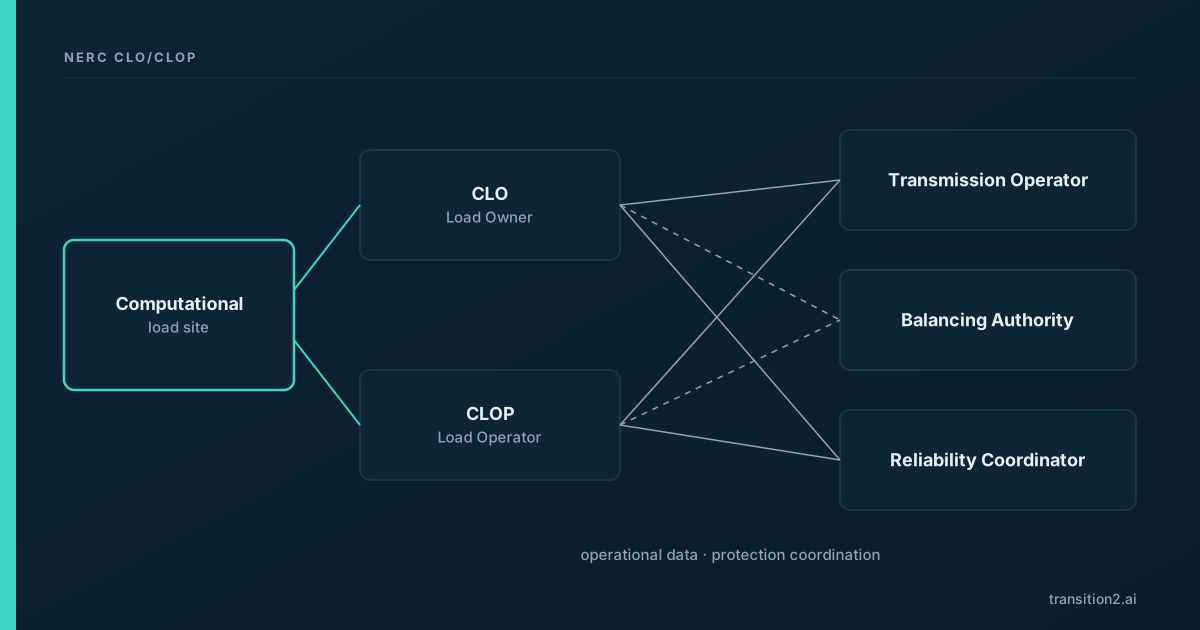
Large AI and data center sites in North America are on a path to becoming registered entities in the grid reliability system. Through Project 2026-02, the North American Electric Reliability Corporation (NERC) has defined two new registered roles, the Computational Load Owner (CLO) and the Computational Load Operator (CLOP), and a first set of reliability standards for them, documented in materials that include an October 2026 project FAQ. The work follows a July 16, 2026 order from the Federal Energy Regulatory Commission (FERC). The standards and the registration criteria both still need FERC approval, and compliance dates will come from the approved implementation plans.
What happened
The sequence, based on NERC's filings and standards documents:
- The FERC order. On July 16, 2026, FERC issued an order in docket RD26-7-000 directing NERC to file reliability updates covering computational loads by December 31, 2026, according to NERC's Project 2026-02 materials, including the project FAQ.
- New definitions. NERC's materials define a Computational Load Site, the Computational Load Owner (CLO) that owns it, and the Computational Load Operator (CLOP) that operates it.
- Foundational standards. The FAQ describes three standards:
- CLO-001-1: interconnection requirements, studies, commissioning, qualified changes and modeling data. - CLO-002-1: operational data, interpersonal communications, Operating Instructions and the response to them, set out in the CLO-002-1 standard. - CLO-003-1: protection coordination and the disturbance monitoring data needed for event analysis.
- Registration threshold. NERC's petition, filed with FERC on October 21, 2026 with a request for expedited treatment, proposes registering the owners and operators of a Computational Load Site "with a total connected Load greater than or equal to 50 MW that is supplied through electrical equipment connected at a voltage level greater than or equal to 100 kV". The FAQ says the standards' applicability aligns with that criterion. It also says the 100 kV test looks at the voltage of the equipment supplying the site, not the point of connection named in an interconnection agreement.
- Status. The petition asks FERC to approve revisions to NERC's Rules of Procedure. The FAQ says the standards were targeted for NERC Board of Trustees approval by the end of 2026. CLO-002-1's version history records Board adoption on October 26, 2026, with FERC approval still to come. NERC says Phase 2 standards development will follow these foundational standards.
The project FAQ, dated October 2026, is the most accessible summary of the project for non-specialists.
Why it matters
Until now, large computing sites have mostly appeared in grid planning as customers. The CLO and CLOP roles change that by giving these sites defined responsibilities inside the reliability framework that already governs generators and transmission operators.
The three standards point to three kinds of obligation.
Planning and interconnection (CLO-001). A site that falls within scope has a defined role in how its connection to the grid is planned and studied. That brings grid reliability requirements into the earliest stages of site development.
Operational data and communications (CLO-002). Grid operators need to know what large loads are doing. The CLO-002-1 standard addresses the data and communications a computational load must provide. Requirement R8 says each Computational Load Operator must comply with each Operating Instruction from its Transmission Operator, Balancing Authority or Reliability Coordinator, unless the action cannot be physically carried out or would violate safety, equipment, regulatory or statutory requirements. For a site operator, that implies telemetry, communication channels and procedures for acting on grid operators' instructions.
Protection and disturbance monitoring (CLO-003). Large loads can affect grid stability during faults and disturbances. CLO-003-1 covers how protection systems are coordinated and what disturbance monitoring data a site provides for event analysis.
In practice, a registered site coordinates with the established grid functions: the Transmission Operator, the Balancing Authority and the Reliability Coordinator. That coordination becomes an operating requirement rather than an informal relationship.
Two details deserve attention before the rules are final. The first is the threshold. The proposed line, at least 50 MW of connected load supplied at 100 kV or above, brings large campuses into scope while leaving smaller facilities below it. Organisations can already check their sites against it, but FERC could still change it. The second is the split between ownership and operation. Because the definitions name the owner and the operator as separate roles, arrangements in which one company owns a building and another runs it need a clear answer about which entity holds which obligations.
For portfolio owners, the timing matters. FERC's order sets a filing deadline of December 31, 2026, and compliance is expected to phase in after approval. Sites in planning today should therefore check the requirements against their own development timelines rather than treat them as a later concern.
For more context, see the Transition2 Enterprise AI Governance hub and the Portfolio AI Execution hub.
What to track
Organisations with large compute footprints can turn this into a short watch list:
- The threshold. Check each existing and planned site against the proposed 50 MW and 100 kV criterion now, and again once FERC acts.
- Role assignment. For each in-scope site, identify which legal entity would be the CLO and which would be the CLOP, especially where colocation or managed operations split ownership from operations.
- Telemetry gap. Compare the data a site can produce today with what CLO-002 requires, and record the gaps.
- Operating Instructions. Confirm the site has a staffed, tested way to receive and act on instructions from its grid operators, as CLO-002-1 requires.
- Protection review. Confirm that protection settings and disturbance monitoring can meet CLO-003 expectations.
- Phase-in dates. Record compliance dates once the approved implementation plan is published.
This article describes the filed materials and is not compliance advice. Final obligations depend on the text FERC approves.
What it means for businesses
Treat CLO and CLOP readiness as a diligence item in site selection and in decisions to finance or acquire AI campuses. A site that will need to register carries reliability obligations for planning, data sharing and protection, and those need owners, systems and processes. Confirm early who would hold each role, particularly in colocation arrangements. Track the FERC decision and the final threshold, since both determine which sites are in scope.
What it means for AI users
Most people using AI services never see the data centers behind them, but those sites are becoming formal participants in grid reliability. Under CLO-002-1, an in-scope site's operator must follow its grid operators' Operating Instructions, within safety and equipment limits. That means a large AI site can be told by the grid to change what it is doing, which matters most during grid emergencies. Whether providers will also sign contractual commitments on load flexibility is not settled in the materials reviewed here. For organisations that depend on a particular hosting region, it is reasonable to ask providers how they are preparing for the new standards.
What it means for developers
Engineers who build facility monitoring and control systems should look at the CLO-002-1 data and communications requirements now. Instrument facility telemetry so it can be exported in the form grid operators need, with reliable timestamps and clear ownership. Keep disturbance and protection event records retained and searchable to support CLO-003. Avoid building compliance logic on assumptions beyond the cited filings, because the approved text may differ from the petition stage.
Sources
- CLO-002-1 Computational Load Operational Data and Communications (accessed 2026-11-06)
- NERC CLO/CLOP registry criteria petition to FERC (accessed 2026-11-06)
- Project 2026-02 FAQ (Oct 2026) (accessed 2026-11-06)