News · Workflow Automation · Contract Review Workflows · Invoice Reconciliation
Approval gates are the product: what managed agents must prove
Mistral's Studio managed agents resume after crashes and pause for human approval. For finance and legal work, score agent platforms on evidence, not demos.
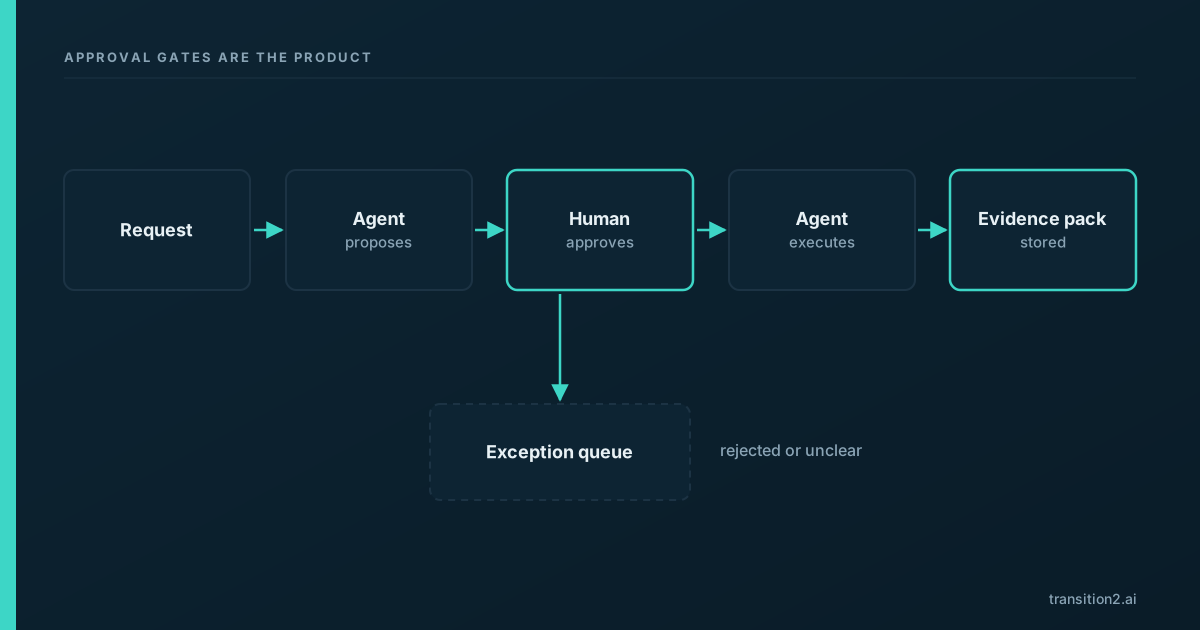
On November 5, 2026, Mistral announced managed agents in its Studio platform, and its release notes describe two properties that matter for enterprise back-office work: a deployed agent resumes from its last finished step after a crash, and a turn can wait for a person's approval and resume later. For finance and legal workflows such as invoice reconciliation and contract review, those two properties matter more than any demo. The approval gate and the evidence trail it leaves behind are the product.
What happened
Mistral's Build with Studio announcement presents managed agents as part of its enterprise platform, deployable in Mistral's cloud, a customer's VPC or on-premises, and says customers "decide which actions require human approval". Its example is Mistral's own incident agent, which follows the team's runbook and asks for approval before taking sensitive actions. The release notes add the mechanics: execution is durable, a task can run for hours or days and resume from its last finished step after a crash, developers choose which tool calls need approval from code or from a person, and a running turn can be steered or interrupted. Managed Agents is labelled a public preview.
Those are vendor claims from launch material. The Transition2 desk has not tested them, and this article does not rank Mistral against other platforms. The reason to cover the launch is that it names, in plain product language, the two properties that decide whether an agent is fit for regulated back-office work.
Why it matters
Agent demos tend to show the happy path: a request comes in, the agent reasons, the task completes. Back-office work in finance and legal is judged on the other paths. What happens when the agent is halfway through matching a batch of supplier documents and the process dies? What happens when it proposes changing a contract clause that sits outside the approved playbook? Who saw the proposal, who approved it, and where is the record?
Crash-resume answers the first question. Without it, an interrupted run either repeats work, which risks duplicate postings or duplicate messages, or leaves the workflow in an unknown state that a person has to untangle by hand. With it, the platform has to know which steps finished and which did not, and that same knowledge is what makes an audit trail possible.
Approval gates answer the second. In workflows where an action is hard to reverse, such as releasing a financial posting, sending a signed document or changing a supplier record, the safe design is for the agent to propose and a person to approve. The agent still does the tedious part, gathering documents, matching lines, drafting the change, but the commitment stays with a human who can see what they are approving.
Together they produce the thing enterprises actually need to retain: an evidence pack for each privileged action. That pack should show the input, the agent's proposal, the sources it relied on, who approved it and when, and what was executed. The invoice reconciliation and contract review hubs cover why retainable evidence is the core requirement in those workflows.
A measurement angle
Platforms that advertise these properties can be tested on them. Useful measures for a pilot:
- Resume correctness: in a deliberate fault drill, kill a run mid-task and check whether it resumes without repeating or skipping a step. Count the drills that pass.
- Approval latency: the time from an agent proposal to a human decision. If it grows, people will be tempted to auto-approve.
- Exception queue age: how long items routed to a human for exceptions wait. A queue nobody drains is a silent failure.
- Evidence completeness: the share of privileged actions whose evidence pack contains every required field.
These are operational measures. They say nothing about whether a platform will produce a particular business outcome, and no vendor launch post can tell you that either.
What it means for businesses
Score agent platforms on interruptibility, audit logs and exception queues, not on how smooth the demo looks. When evaluating Mistral's managed agents or any peer, ask for a fault drill during the pilot rather than taking crash-resume on trust. Ask to see an approval gate in action on a realistic case, including what the approver sees and whether they can edit or reject the proposal. Ask where evidence is stored, how long it is kept, and whether it can be exported into the systems your auditors already use.
Decide in advance which actions always need a human. In finance, that usually includes releasing a financial posting or changing supplier details; in legal, anything that leaves the building. Put that list in the workflow design, not in a policy document the agent never reads. The workflow automation hub covers exception queue design in more depth.
What it means for AI users
Never accept a silent auto-approve on financial postings or contracts. If you are the person approving an agent's proposal, you should see what the agent is about to do, the sources it used and what will change. If the interface only offers a single approve button with no detail, raise it; that is an approval gate in name only.
Watch the pace, too. Approval gates work when the reviewer has time to review. If proposals arrive faster than anyone can read them, the honest response is to slow the agent down or narrow its scope, not to click through.
What it means for developers
Emit a structured evidence pack for every privileged action. At minimum: a stable identifier for the run and step, the inputs, the proposed action, the sources consulted, the approver identity and timestamp, the executed action and its result. Make each step idempotent where possible so that a resumed run cannot apply the same change twice, and record step completion before moving on so that resume logic has something reliable to read.
Treat the approval gate as a hard boundary in code, not a prompt instruction. The agent should be unable to execute a gated action without a recorded approval, whatever it generates. Route anything outside the expected pattern to an exception queue with an owner, and expose that queue's age as a metric. If a platform such as the one Mistral describes provides these properties, verify them with your own fault and approval drills before relying on them in production.
Sources
- Mistral docs: release notes (Managed Agents, Nov 5, 2026) (accessed 2026-11-06)
- Build with Studio (Mistral) (accessed 2026-11-06)