News · AI Products & Copilots · Customer Experience Agents · Models, Tooling & Developer Practice
Google ships A2UI 1.0, a stable open protocol for agent-built UI
A2UI 1.0 lets agents describe interface screens that host apps render with their own registered components, and adds two-way function calls and accessibility support.
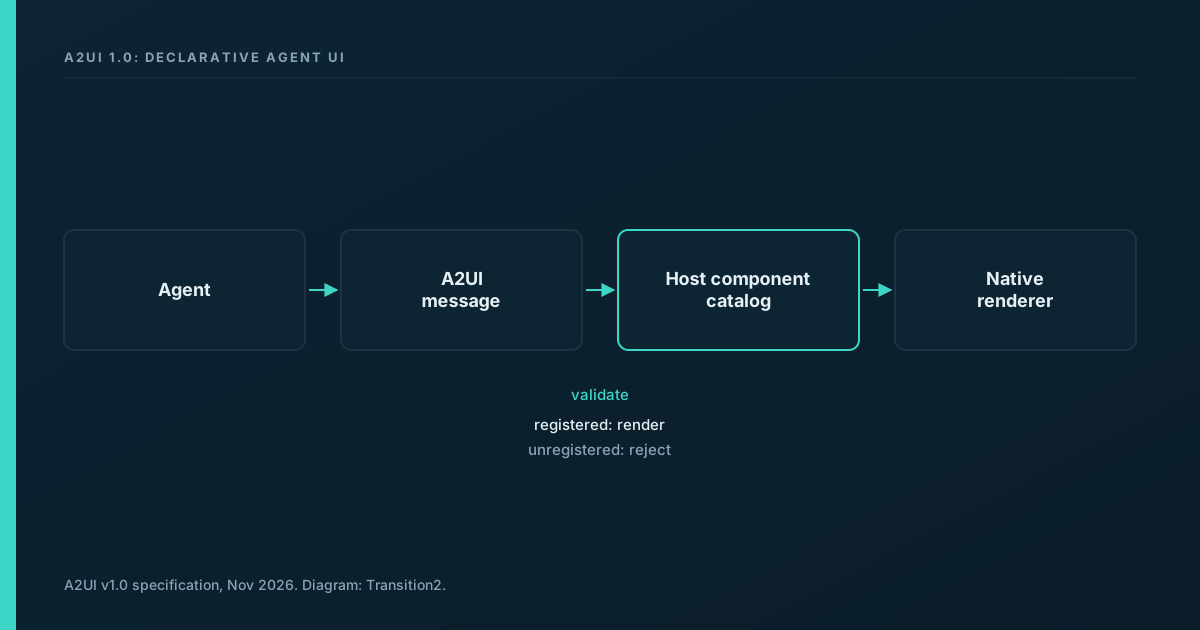
On November 11, 2026, Google released A2UI 1.0, which it calls "the first stable version" of its "open protocol for generative UI" (Google Developers Blog). In A2UI, an agent describes what to show, and the host app renders it with its own native components. Version 1.0 adds two-way function calls, accessibility support and extension metadata. Transition2 desk schema tests found that A2UI 1.0 messages using unregistered components fail validation.
What happened
Google announced the release on its developer blog, and SD Times reported it the same day. The v1.0 specification sets out the model: the agent sends a declarative description of a screen, and the host renders it with components it controls.
The main protocol additions are bidirectional function calls, accessibility support and extension metadata. In the specification these calls are callRendererFunction and callAgentFunction, both with responses (Google Developers Blog; evolution guide; repository).
According to Google, renderers exist for React, Angular and Lit on the web, plus Flutter and SwiftUI. The Jetpack Compose renderer is currently at v0.9.1, with 1.0 "coming soon." Google says the web and Flutter renderers work inside MCP Apps, so A2UI screens can appear in assistants that support MCP Apps, such as Claude and Gemini. Agent SDKs are available for Python, TypeScript and Dart.
Google also makes two control claims. Agents "place and configure only the components you register," and data binding happens on the server so that "sensitive values never reach the model" (Google Developers Blog). These are vendor claims.
The evolution guide from v0.9 to v1.0 lists concrete changes:
- Each component can carry an optional
@catalogId; when it is omitted, the surface's defaultcatalogIdapplies, and catalogs can be mixed on one surface. - If no catalog resolves for a component, the renderer errors and does not render it.
- A function's
allowedCallerslist is verified at runtime. theme/primaryColoris removed.
Google names several early builders: Atlassian, with Jira follow-up cards; Alation; Bloomberg; and ByteDance, whose Lynx renderer supports 0.9 now (Google Developers Blog; SD Times). CopilotKit, a playground partner, says the protocol "enforces your design rules" and that A2UI travels over AG-UI (CopilotKit). That is a partner claim.
Why it matters
Agents that return only text limit what they can do in a product. Letting agents generate arbitrary interface code creates the opposite problem: the host loses control of what appears. A2UI sits between the two. The agent picks from a catalog the host registers, and the host's own components do the rendering (A2UI specification). A stable 1.0 gives renderer and SDK authors a fixed target. The catalog rules in the evolution guide, under which an unresolved catalog means the component does not render, turn "only registered components" into a specified behavior rather than just a convention (evolution guide).
Two-way function calls with runtime-verified allowedCallers make the interface interactive in both directions while keeping a declared list of who may call what. More background on building agent features into products is in AI Products and CX Agents.
What the Transition2 desk tested
The desk checked whether the A2UI 1.0 schema holds an agent to the host's components. It cloned github.com/a2ui-project/a2ui pinned at commit 3ed9601862ecc78027e20ac80ad8b1b98a5d9079, with ajv-cli 5.0.0 and ajv-formats 3.0.1 pinned in package.json, on Node v24.22.1 and Python 3.13.5. It ran the upstream v1.0 schema test suite (specification/v1_0/test/run_tests.py). The only change was in how the runner invokes ajv. The runner calls yarn workspace ... exec ajv, and the desk called the same ajv binary with identical arguments, patched in a throwaway copy and asserted by the run script.
The desk added four cases of its own, validated against agent_to_renderer.json with the basic catalog (catalogs/basic/v1):
- a valid approval card for an agent action
- a component the host never registered (
ShellCommand) - a Button with no action
- a message with version "0.9"
A mutation check flipped each case's expected outcome and confirmed that the flipped version fails.
Results (2026-11-13, desk box):
- Upstream suite plus the desk's cases: 204 passed, 0 failed.
- Desk cases: approval card accepted; ShellCommand rejected; Button without action rejected; wrong version rejected. The mutation check passed for all 4.
The valid card is a Card holding two Text items and two Buttons, with the title "Agent wants to close ticket 4812." Its approve button, verbatim from the test case:
   {
    "id": "approve",
    "component": "Button",
    "child": "approve_lbl",
    "action": {
     "event": {
      "name": "approve"
     }
    }
   },
What this shows, at the schema level only: a message that uses a component outside the host's catalog, or a Button without an action, fails validation. A host that validates incoming messages therefore gets a declared, reviewable surface. The desk did not show that any shipping renderer (React, Angular, Lit, Flutter, SwiftUI, Compose) actually validates before rendering. It did not run a renderer, an agent SDK, a language model or MCP Apps. It did not test bidirectional function calls, or accessibility attributes beyond what the upstream suite covers.
What it means for businesses
For teams putting agents in front of customers or staff, A2UI 1.0 offers a way to show structured screens, such as an approval card for a proposed action, using components the business already controls. Early adopters named by Google include Atlassian, Bloomberg and ByteDance (Google Developers Blog). The guarantees depend on configuration. The registered catalog defines what an agent can show, so reviewing that catalog is a governance task, not just a design task.
What it means for AI users
Google says A2UI screens rendered through MCP Apps can appear in assistants such as Claude and Gemini (Google Developers Blog). In practice, that could mean buttons and cards instead of long text replies, for example a clear Approve or Reject choice before an agent closes a ticket. Version 1.0 also adds accessibility support to the protocol (Google Developers Blog).
What it means for developers
Target 1.0 for new work, and read the evolution guide before migrating from 0.9. The changes include an optional per-component @catalogId, runtime checks on allowedCallers, and removal of theme/primaryColor. Check renderer versions as well: Compose is at v0.9.1, and ByteDance's Lynx renderer supports 0.9 (Google Developers Blog). The desk's results show the schema rejects unregistered components. They do not show that a given renderer enforces this. Validate incoming messages against the v1.0 schema in the host, keep the catalog small, and test the rejection paths directly.
Copyright Eric MacDougall.
Sources
- A2UI 1.0: build delightful, fast, reliable agentic experiences (accessed 2026-11-13)
- A2UI v1.0 specification (accessed 2026-11-13)
- Google releases A2UI 1.0 for generative UI (accessed 2026-11-13)
- A2UI evolution guide v0.9 to v1.0 (accessed 2026-11-13)
- A2UI repository (accessed 2026-11-13)
- Introducing A2UI 1.0 (accessed 2026-11-13)