News · AI Reliability & Operations · Software Factories & AI-Assisted Engineering
NVIDIA details Rust parsers for streaming tool-call output
NVIDIA's Dynamo team published a guide to frontend-crates, Apache-2.0 Rust components that parse streaming reasoning and tool-call output across 18+ model families.
On November 19, 2026, NVIDIA's Dynamo team published a developer post on frontend-crates, the reusable Rust components behind Dynamo's tool-calling parsers (NVIDIA Technical Blog). The Apache-2.0 repository says the parsers cover 18+ model families (GitHub). The parser documentation also makes a point worth carrying into any agent stack: parsing a tool call is not the same as authorizing it.
What happened
The post, by Keiven Chang, Indrajit Maloji Bhosale, Krishnan Prashanth, Zhongdao Ren and Ryan McCormick, explains how the team's parsers handle streamed reasoning and tool-call output (NVIDIA Technical Blog). Its title says the parsers were built "with AI agents." That is NVIDIA's account of its process, and the Transition2 desk did not verify it.
The repository's README describes the project as "Standalone Rust crates for building OpenAI/Anthropic-compatible inference servers," and the code is Apache-2.0 licensed (GitHub). The repository's About field, by contrast, says "No description." The crates are dynamo-protocols, dynamo-tokenizers, dynamo-parsers (v1), dynamo-parsers-v2, dynamo-structural-tag, dynamo-renderer and dynamo-multimodal (GitHub).
According to NVIDIA's post, supported tool-call and reasoning families include gpt_oss (alias harmony), muse_spark, beam and nemotron_v3, alongside DeepSeek V4, Qwen3, Kimi K2/K3, Gemma 4, Hermes and others. The repository puts the total at "18+ model families" (GitHub).
dynamo-parsers-v2 is a 0.x API that can change between minor releases, and the parser README says to pin an exact version. Crate metadata on crates.io shows version 0.10.8 published on November 19 and 0.10.9 on November 20, with 112 versions in total. NVIDIA's blog example pins dynamo-parsers-v2 =0.10.3 and was tested with Rust 1.96.1 (NVIDIA Technical Blog).
The pinned versions disagree across artifacts. The blog uses =0.10.3, the README example uses =0.8.4, and the latest on crates.io is 0.10.9. The repository's GitHub Releases section is empty (GitHub), so crates.io is the version record.
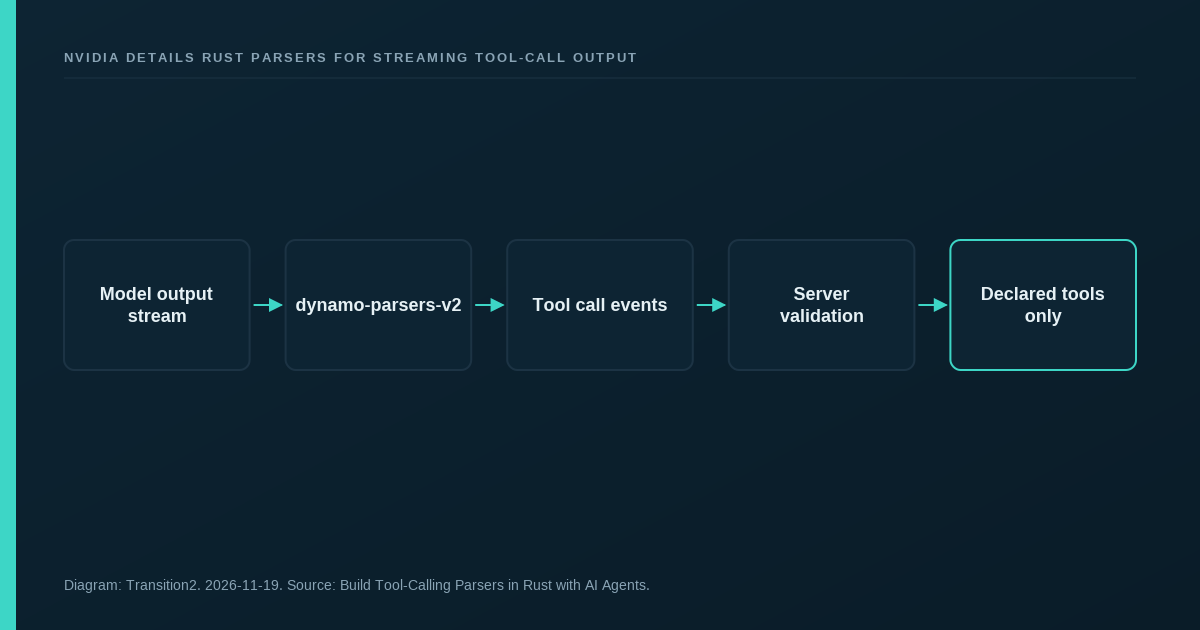
The most important line for security is in the parser README. Parsing is separate from validation: a call to a tool that is not in the request's tool list is still emitted, and the serving layer must reject it. Provisional updates do not authorize execution.
Why it matters
Models that reason and call tools emit structured output inside a token stream, and that stream arrives in arbitrary pieces. A parser has to separate reasoning from user-facing text and reassemble tool calls correctly no matter where a chunk boundary falls. Each model family formats this differently, which is why a shared library covering 18+ families (GitHub) is useful to anyone running their own OpenAI- or Anthropic-compatible server.
The API is still moving. A 0.x crate with 112 published versions (crates.io) and two different pins in NVIDIA's own materials, neither matching the latest release means teams adopting it should expect change and lock versions deliberately.
The security boundary is the lasting lesson. The README states plainly that the parser will emit a call to an undeclared tool (parser README). That is correct behaviour for a parser, whose role is to report what the model produced. It also means any server that executes whatever the parser returns has no authorization check at all.
What the Transition2 desk tested
The pack specified a Rust test against the real crate: Rust 1.96.1 with dynamo-parsers-v2 = "=0.10.3", covering README reproduction, streaming split robustness, the authorization boundary and an optional comparison with 0.10.9. That test was not run. The run environment had no Rust toolchain, no network or crates.io access, and only Python available. No verified commit of the repository was recorded. Running those tests against NVIDIA's crate still requires a machine with Rust 1.96.1 and access to crates.io.
What did run is a simulation: a small, independent Python model of a Hermes-style streaming parser, written for this experiment. It is not NVIDIA's code. It illustrated the general property that parsing is not authorization. The simulation fed reasoning-then-text deltas, and a get_weather tool call split at every byte position and one byte at a time, plus a second input with surrounding text and a multibyte city name. A validating server then had to reject the call when no tools were declared and accept it when get_weather was declared. Negative controls covered a naive per-delta regex parser, a trusting server, malformed JSON and an unterminated tag. A determinism check compared SHA-256 hashes of two full runs.
Versions: Python 3.9+ standard library only (json, re, codecs, hashlib). The sandbox had network access denied.
Results, verbatim:
CHECK t1_sim_reasoning_then_text: PASS segments=2
CHECK t2_ascii_split_robust: PASS 76/76 runs passed
CHECK t2_multibyte_split_robust: PASS 98/98 runs passed
CHECK t3_parser_emits_undeclared_call: PASS emitted=1
CHECK t3_server_rejects_undeclared: PASS accepted=0 rejected=1
CHECK t3_server_accepts_declared: PASS accepted=1
CHECK neg_trusting_server_executes_undeclared: PASS executed=['get_weather'] (hazard the validator prevents)
CHECK neg_naive_parser_breaks_on_splits: PASS ascii_fail=74 multibyte_fail=76
CHECK neg_malformed_json_no_call: PASS {'errors': ['invalid_json'], 'tool_calls': 0}
CHECK neg_unterminated_no_call: PASS {'errors': ['unterminated_tool_call'], 'tool_calls': 0}
CHECK determinism: PASS ee55fc56aa4e0a81
CHECKS 11/11
All 11 checks passed. The simulated parser emitted the undeclared call, the validating server rejected it, and the trusting server executed it. That is the hazard a server-side check exists to prevent.
What this does not show. It shows nothing about the behaviour, correctness or security of NVIDIA's crates, nothing about differences between 0.10.3 and 0.10.9, and nothing about the 18+ model families. It does not confirm NVIDIA's README statement about undeclared tools; that statement stands on the README alone. The simulation only shows why a server-side check is needed in general.
What it means for businesses
Organisations that run their own inference servers, rather than calling a hosted API, can now draw on Apache-2.0 components for a fiddly part of the stack (GitHub). The more important decision sits above the parser: who defines which tools an agent may call, and where that rule is enforced. That belongs in written policy, not just in code. The AI Reliability & Operations and Software Factories hubs cover both sides of that boundary.
What it means for AI users
When an AI assistant "calls a tool," the model is only producing a request in text. Whether anything happens depends on the server that reads that request. NVIDIA's README is explicit that its parser reports calls even to tools the request never offered, and leaves rejection to the server (parser README). For users of agent products, the practical question for any vendor is whether tool calls are checked against an allowed list before they run.
What it means for developers
Pin exactly. The README says dynamo-parsers-v2 is a 0.x API that can change between minor releases (parser README), and the published pins already disagree. Commit Cargo.lock and treat upgrades as reviewed changes.
Validate on the server. Check every emitted tool name against the tools declared for that request, reject anything else, and validate arguments before execution. Do not act on provisional updates, which the README says do not authorize execution.
Test the streaming edges. Split inputs at every byte position, including multibyte characters, and confirm that tool markup never leaks into user-visible text. Malformed or unterminated calls should produce errors, not executions.
Copyright Eric MacDougall.
Sources
- Build Tool-Calling Parsers in Rust with AI Agents (accessed 2026-11-20)
- ai-dynamo/frontend-crates (accessed 2026-11-20)
- parsers/v2/README.md (accessed 2026-11-20)
- dynamo-parsers-v2 crate metadata (accessed 2026-11-20)