News · AI Reliability & Operations · Software Factories & AI-Assisted Engineering
Cursor ties extension breach to exposed Fireworks AI key
Cursor says an access key it issued to Fireworks AI, which Fireworks exposed, was the entry point for a breach that placed backdoored Claude Code builds in its extension marketplace.
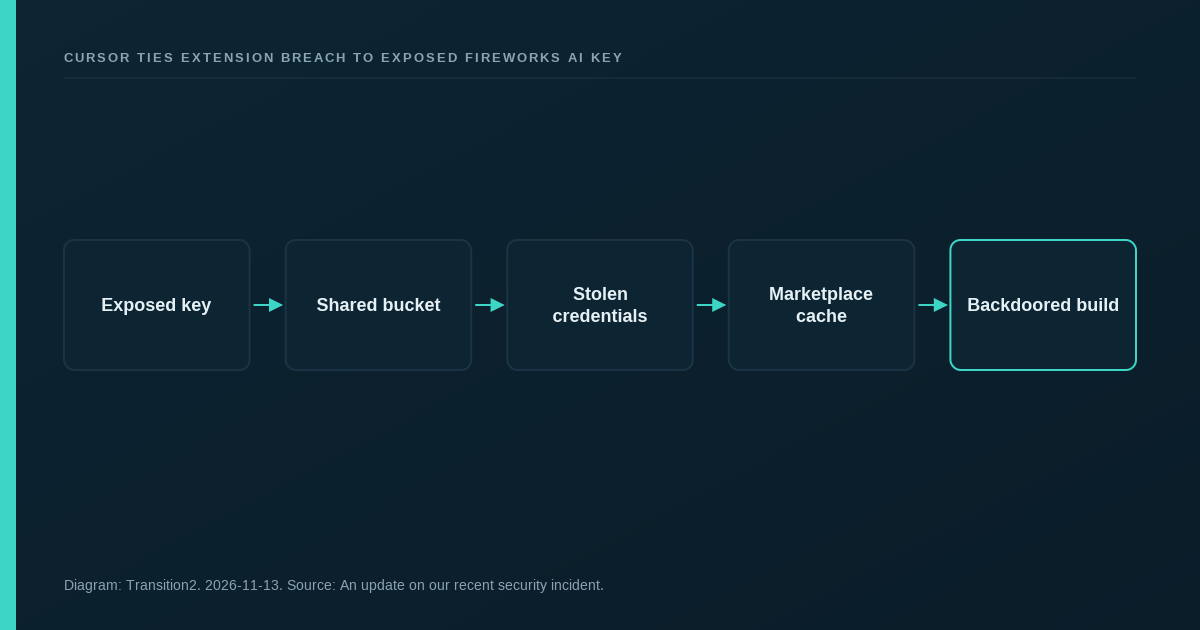
Cursor said on November 13, 2026 that an access key it had issued to Fireworks AI, and that Fireworks exposed, was the way attackers entered the systems behind a breach that briefly placed tampered copies of the Claude Code extension in its marketplace. The company says it believes the incident is contained and that production systems and official updates were not affected (Cursor). For anyone who installed the extension on October 29, the practical response is the same regardless of which vendor claim holds up: check the host, run the published remediation steps, and rotate credentials.
What happened
According to Cursor's incident update, the attacker used an access key that Cursor had issued to Fireworks and that Fireworks had exposed, then used it to copy data from a read-only storage bucket shared with Fireworks (Cursor). That bucket held limited coding-agent traces, mostly from 2025, drawn from sessions that did not use Privacy Mode, and some of those traces contained unredacted credentials (Cursor; Cyber Security News). Cursor says fewer than 0.05% of non-Privacy-Mode users had traces exposed and fewer than 0.01% of customers had API credentials exposed; those are vendor figures.
Using credentials found in the traces, Cursor says the attacker reached connected SaaS tools and accessed several categories of data, including archived non-production repositories, limited support data and emails, usage metrics and contact details, summaries of some agent conversations, and credentials that users had sent to support (Cursor).
On October 29 the attacker used a stolen credential to place malicious copies of Anthropic.claude-code 2.1.312 and 2.1.313 into the cache that serves Cursor's VS Code marketplace, where they were available for about eleven hours (Cursor; BleepingComputer). The exposure window ran roughly 02:27 to 13:35 Pacific that day, and the tampered builds targeted macOS (darwin-arm64) and Windows (win32-x64) (Cursor; StepSecurity). Cursor says at most 5,000 users who requested the cached versions may have received the malicious builds; that number is a ceiling on possible recipients, not a count of infections.
Anthropic did not build or publish the tampered copies. According to StepSecurity, the only source for this claim, Anthropic says version 2.1.313 was never published to Open VSX or the Microsoft Marketplace and that it skipped ahead to 2.1.314 (StepSecurity). Microsoft reports no evidence that the Visual Studio Marketplace or the npm package @anthropic-ai/claude-code were affected (Microsoft Security), and Cursor says Open VSX never carried the malware (Cursor).
For defenders, the published indicators matter more than the narrative. Microsoft and Cursor describe an injected JavaScript loader that runs before the extension's normal code, collects host details, appends an SSH key with the comment "svc-telemetry" to authorized_keys, attempts to enable SSH, opens a reverse SSH tunnel to a remote server listed in the published indicators, persists through a LaunchAgent named com.apple.sysmond on macOS or a scheduled task or Startup-folder script on Windows, and beacons to port 8099 (Microsoft Security). The SHA-256 of the modified extension.js is ecb58cb29078d9646ad1dcdbe51526f2d9cfea06be5fb2ab183e8ecc3ab6bf15, and the planted key fingerprint is SHA256:0Z6R+DF64Do2nwQic8a7kkfDLNNk4IiK+2U2Rci4htk (Cursor). Cursor warns that uninstalling the extension alone may not remove the SSH key or the persistence, and it publishes remediation scripts while advising operators to isolate the host, verify cleanup, consider a rebuild, and rotate credentials.
Cursor says its last observed attacker activity was seen and blocked on November 1 and that the incident is contained. The company deactivated the Fireworks key and moved inference off Fireworks, rotated internal credentials, validated other extensions and rebuilt the marketplace, added secret scanning and network restrictions, redeployed production, and engaged external forensics (Cursor). It says production systems, the Cursor app and official updates were not affected and that no release signing keys were exposed.
Independent coverage records some disagreement. Cursor's security notice says coding errors likely stopped the payload on many Windows and macOS hosts, while StepSecurity describes privilege preconditions such as passwordless sudo on macOS or an elevated session on Windows (Cursor; StepSecurity). BleepingComputer describes credentials as "stolen" from Fireworks, while Cursor's own account says Fireworks exposed a key that Cursor had issued (BleepingComputer; Cursor). In a claim reported only by BleepingComputer, the outlet also places this in a wider wave of credential-theft attacks on AI developer platforms that Wiz calls "Black October", citing one case at about 740,000 US dollars in fraudulent AI charges.
Why it matters
The chain here runs through trust relationships, not a single product flaw. A key issued to one vendor, exposed by that vendor, led to a read-only bucket of traces; credentials inside those traces unlocked connected tooling; and one of those credentials let an attacker poison a marketplace cache that serves extensions to developer machines. Each link is mundane on its own. Together they show why unredacted secrets in logs and broad SaaS reach are an operational risk, not just a theoretical one, and why marketplace caches deserve the same scrutiny as the registries behind them. This is a live concern for AI Reliability & Operations teams that treat extension supply chains as part of their attack surface.
The desk did not run its planned benign indicator checker against synthetic fixtures in this session, so this report carries no experiment results.
What it means for businesses
Treat the October 29 window as the trigger for a review, not reassurance. Inventory which machines pulled the Claude Code extension through Cursor's marketplace that day, and remember that the 5,000 figure is a ceiling on who could have received the build, not a count of compromise. Because uninstalling the extension may leave the SSH key and persistence in place, rely on the published remediation steps and verify cleanup rather than assuming removal. Rotate any credentials that passed through coding-agent traces or were sent to support, since Cursor says both categories were in scope.
What it means for AI users
Sessions run without Privacy Mode are the ones Cursor describes as exposed, and some traces held unredacted credentials. Anyone who pasted a key into an agent session or into a support message should assume it needs rotation. The incident did not involve Anthropic building or publishing anything malicious, so the fix is not to distrust the Claude Code product itself but to verify the extension's integrity against the published hash and to install future updates through channels the vendors confirm were unaffected.
What it means for developers
The published indicators are the actionable part: the extension.js SHA-256, the "svc-telemetry" SSH key comment and fingerprint, the LaunchAgent and scheduled-task persistence names, and the reverse tunnel endpoint. Microsoft's prevention advice is to restrict Cursor extensions to approved publishers and to set an install cooldown for newly published versions, which would blunt a cache-poisoning window like this one (Microsoft Security). Keep secrets out of agent logs, and corroborate the conflicting accounts of how effective the payload was against your own fleet rather than assuming the coding-error story protected every host.
Copyright Eric MacDougall.
Sources
- An update on our recent security incident (accessed 2026-11-15)
- Security notice: malicious version of Anthropic.claude-code identified in the Cursor VS Code Extension Marketplace (accessed 2026-11-15)
- Cursor confirms security breach led to malicious Claude Code extension (accessed 2026-11-15)
- Inside a malicious Claude Code-branded extension and its persistent SSH backdoor (accessed 2026-11-15)
- Trojanized Claude Code Extension Delivered Persistent SSH Backdoor to Developer Machines (accessed 2026-11-15)
- Cursor Reveals How a Leaked Fireworks AI Key Led to a Backdoored Claude Code Extension (accessed 2026-11-15)