News · Enterprise AI Governance · AI Reliability & Operations
Google Project Zero replaces 90+30 with fixed Full X disclosure
Project Zero will disclose vulnerabilities a fixed number of days after reporting them, moving to 60 days in February 2027 and 30 days in January 2028, citing AI-accelerated bug finding.
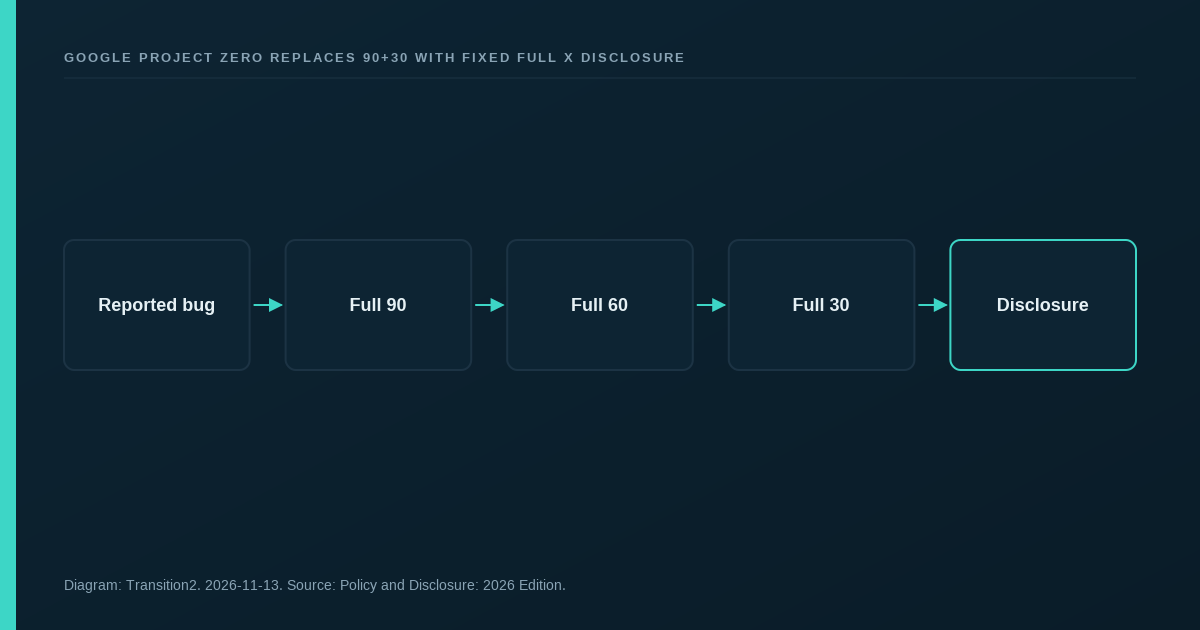
Google Project Zero has retired its longstanding "90+30" disclosure model and replaced it with a fixed "Full X" rule that publishes a vulnerability a set number of days after it is reported to the vendor. The new schedule starts at Full 90 on November 13, 2026, tightens to Full 60 on February 2, 2027, and reaches Full 30 on January 3, 2028. Project Zero attributes the change to AI tools that have sped up both discovery and exploitation (Google Project Zero).
What happened
In its 2026 policy post, Project Zero says it is replacing "90+30", which had given vendors 90 days to fix a flaw plus a 30-day patch soak since 2021, with a single "Full X" window that discloses the vulnerability X days after it is reported (Google Project Zero). The post, authored by Natalie Silvanovich, lays out the step-down: Full 90 from November 13, 2026; Full 60 from February 2, 2027; and Full 30 from January 3, 2028 (Google Project Zero; LavX). Grace periods and the older variant policy are removed, and the remaining exceptions are narrow: bugs exploited in the wild, bugs whose details are already public, and vendor requests to publish (PANews).
Project Zero's stated reasoning is that AI tools have accelerated both discovery and exploitation and raised the odds that several parties find the same flaw independently. Because patches can be reverse-engineered quickly, the team argues the 30-day soak gave a false sense of secrecy, while report volume has grown and negotiating fix status has become unmanageable (Google Project Zero). The team says it now finds "several vulnerabilities a week", compared with a few per year previously (Google Project Zero; LavX). It frames the gradual step-down as a way for vendors to adapt without unfixed bugs becoming available to attackers too early, and LavX reports this responds to vendor feedback.
The post also urges vendors to shrink the patch gap, the time from a fix's release to its installation on user devices, through faster rollout or interim protections (Google Project Zero). The primary post says fix status is still tracked but does not control disclosure timing, and severity does not set timing either (Google Project Zero).
Two ambiguities remain open in the coverage available. Neither the primary post (Google Project Zero) nor LavX (LavX) states whether the windows are counted in calendar days, and nothing says whether a bug reported before February 2, 2027 keeps a 90-day window or moves to 60 days when the clock would expire under the newer rule. Independent coverage so far is thin and mostly aggregator-style, so the primary post should be treated as authoritative.
Why it matters
The change compresses the time between a report and public detail (Google Project Zero), and it removes the negotiation that vendors could lean on to extend a deadline. By the Transition2 desk's analysis, the step-down is the real planning signal: organizations that depend on Project Zero reports as an early warning have until February 2027 before the window drops to 60 days, and until January 2028 before it reaches 30. Patch teams that today budget for a 90-plus-30 cycle will need a materially faster path from a confirmed fix to deployed protection. The stated AI rationale also reframes disclosure timing as a race against parallel discovery rather than a courtesy window, which is a governance shift as much as a technical one. This belongs on the agenda of any AI Reliability & Operations function that owns patch rollout.
The desk did not run its planned disclosure-date calculator in this session, so this report carries no computed dates; the open question of whether a window is fixed at report time or shifts when the clock expires is exactly the ambiguity vendors should raise with Project Zero.
What it means for businesses
The planning horizon is explicit and worth putting on a calendar now. A fix that lands days before a Full 30 deadline in 2028 leaves almost no soak, so the lever that matters is the patch gap between release and installation across your fleet. Organizations that run managed update pipelines, staged rollouts or interim mitigations will absorb the shorter windows more comfortably than those relying on users to update on their own schedule. Treat February 2, 2027 and January 3, 2028 as internal deadlines for having faster deployment in place.
What it means for AI users
The rationale here is a candid statement from a major research team that AI has changed the economics of finding and weaponizing flaws, raising the chance that more than one party finds the same bug. Users of AI-assisted products should expect vendors to face shorter secrecy windows and should prioritize prompt updates, since the gap between a public fix and its installation is now the clearest exposure.
What it means for developers
Build for a world where detail becomes public a fixed number of days after a report, with no grace period to fall back on. That means faster triage, reproducible fix pipelines, and the ability to ship interim protections before a full fix is ready. Because the policy still exempts in-the-wild exploitation and already-public bugs, instrumentation that detects active exploitation early remains valuable. And because the calendar-day question and the transition-boundary question are unresolved in the published text, teams that coordinate with Project Zero should confirm which interpretation applies to any report filed near a step-down date.
Copyright Eric MacDougall.
Sources
- Policy and Disclosure: 2026 Edition (accessed 2026-11-15)
- Project Zero Adopts 90-Day Disclosure Rule, Plans 30-Day Window by 2028 (accessed 2026-11-15)
- Google's Project Zero to Gradually Shorten Vulnerability Disclosure Deadline to 30 Days (accessed 2026-11-15)