News · Portfolio AI Execution · Enterprise AI Governance · AI Reliability & Operations
Who pays for data center grid upgrades: H.R. 9340 and the Senate
The House passed the Ratepayer Protection Act 417 to 3, the Senate vote fell short of the 60 it needed, and a broader Senate bill is now in play.
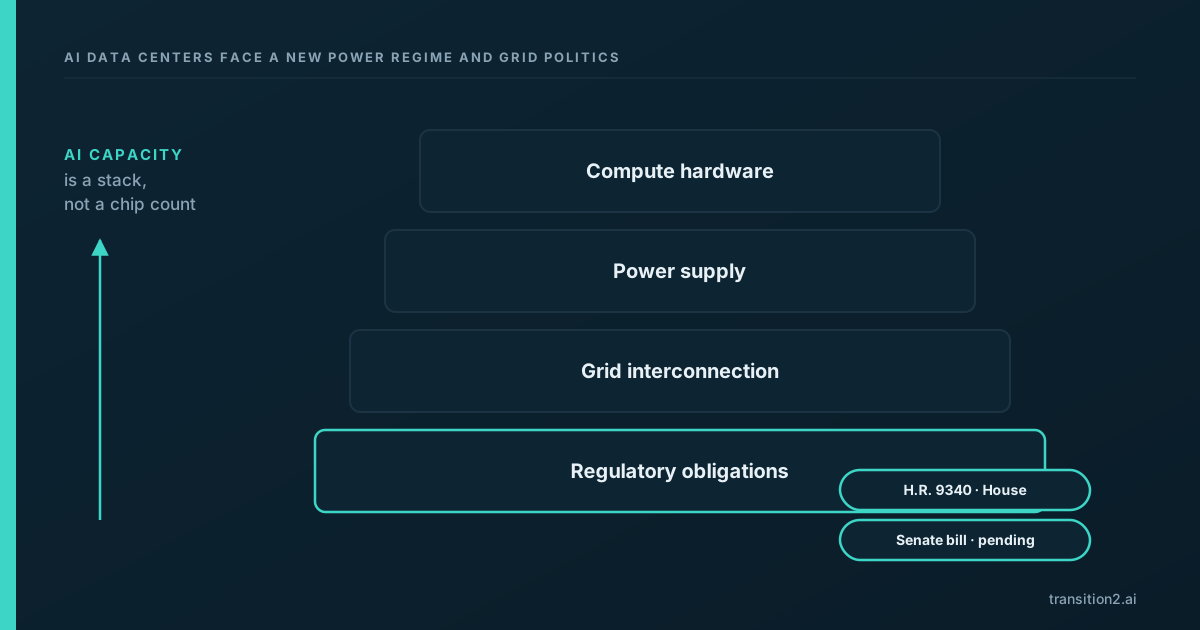
Congress is fighting over who pays for the grid upgrades that large data centers trigger, and nothing is settled. The House passed H.R. 9340, the Ratepayer Protection Act, by 417 to 3 on September 16, 2026. On September 30 the bill got 57 votes in the Senate, short of the 60 it needed, according to news reports. A week later Axios reported a broader bipartisan Senate bill that would put new costs and restrictions on data centers. For anyone planning AI capacity, the terms on which a site gets power now sit next to hardware as a first-order constraint.
What happened
The House vote. The House Clerk's record shows that on September 16, 2026, at 6:53 PM, the House voted on a motion to suspend the rules and pass H.R. 9340, the Ratepayer Protection Act, as amended. Suspension needs a two-thirds majority; the motion passed 417 to 3 (House Clerk, Roll Call 312; vote record).
What the bill does. According to Roll Call, the bill amends the Public Utility Regulatory Policies Act of 1978 to require states to consider adopting federal standards under which data centers and other large-load customers cover the costs of the grid upgrades they need, so those costs are not passed to other customers. It would not require states to adopt any final rules. Roll Call reports the bill was introduced by Rep. Gabe Evans, R-Colo., with Rep. Kathy Castor, D-Fla. It also notes that FERC issued six show-cause orders in June to the regional transmission organizations it oversees, asking them to propose changes for large-load interconnection.
The Senate vote. On September 30 the measure failed in the Senate 57 to 43, Al Jazeera reports; it needed at least 60 votes to get past a filibuster. We could not load the Senate's own roll-call record to confirm the exact motion, so treat the procedural detail as reported rather than verified. CBS News reports that all but four Democrats, Maggie Hassan, Amy Klobuchar, Jon Ossoff and Raphael Warnock, voted against it, arguing that a duty only to consider standards makes the protection optional. "They want it optional, which means zero," Senate Democratic leader Chuck Schumer said, according to CBS. "We want it mandatory."
A broader Senate bill. On October 8, Axios reported that bipartisan legislation unveiled the previous week would force data centers to shoulder new costs and restrictions while speeding up the energy infrastructure needed to power AI, and described it as the most aggressive response yet from Washington. This is a separate measure from H.R. 9340. The detailed provisions sit behind Axios's paywall and were not verified for this article, so they are not summarised here; read the bill text before planning around any specific threshold.
Why it matters
Discussions of AI capacity often focus on chips and servers. These records point to a different constraint: whether a site can get power, how fast, and who pays for the upgrades.
Agreement on the problem, not the remedy. A 417 to 3 House vote shows wide agreement that large loads should not push their grid costs onto other customers. The Senate vote shows the fight is over how binding the answer should be: whether states should only consider standards, or be required to apply them.
The next version may be stricter. Senate Democrats blocked H.R. 9340 because it was too weak, and the broader Senate bill Axios describes adds costs and restrictions. If any version passes, the direction of travel is toward data centers carrying more of their own grid costs, which changes where it makes sense to build and how large a site should be.
States and regulators are moving too. With Congress unsettled, state utility commissions and FERC's large-load proceedings can matter as much as federal law. Where AI services are hosted is shaped by those local conditions.
Reliability rules are arriving at the same time. Separately, NERC is creating registered roles for the owners and operators of large computational loads, which the desk covered in its article on NERC CLO and CLOP standards. Who pays for upgrades and who must register for reliability are separate questions, but they land on the same sites in the same planning cycle.
This article describes the record and the reporting. It does not predict which proposal, if any, will become law.
For more context, see the Portfolio AI Execution hub and the Enterprise AI Governance hub.
What it means for businesses
Model power, interconnection and grid costs as part of every AI capacity decision. Hardware is only one layer of what determines whether capacity is available.
Keep a short register, per site or hosting region, of the federal, state and utility measures that apply, with the source and date of each. Track H.R. 9340 and the broader Senate bill as separate lines, because they would work differently: one asks states to consider standards, the other, as reported, would impose obligations more directly.
If you buy compute, ask providers how exposed they are to large-load cost allocation and how that might affect regional availability or price. If you build or lease sites, add grid-upgrade cost allocation and NERC registration status to the diligence checklist, and mark which planning assumptions depend on legislation that has not passed.
What it means for AI users
State and federal decisions about who pays for grid upgrades are shaping where AI services are hosted. That can show up as differences in which regions a service is offered in, or how quickly a provider adds capacity in a given place. If your data has to stay in a particular region, ask your provider how power constraints there affect its plans.
What it means for developers
Build capacity plans that include curtailment and flexible-load scenarios. Identify which workloads can be paused, slowed or moved when a site's power is constrained, and design schedulers and queues to support that. Batch training and evaluation runs are usually more flexible than interactive inference.
Measure compute and energy use per workload so trade-offs can be made with data, and keep user-facing inference separate from batch work so that flexible workloads absorb constraints first.
Sources
- U.S. House Clerk: Roll Call 312, H.R. 9340 (Sep 16, 2026) (accessed 2026-11-06)
- U.S. House Clerk: Roll Call 312 vote record, XML (Sep 16, 2026) (accessed 2026-11-06)
- Roll Call: data center legislation passes House (Sep 16, 2026) (accessed 2026-11-06)
- CBS News: Senate vote on data center legislation (Sep 30, 2026) (accessed 2026-11-06)
- Al Jazeera: U.S. Senate rejects data centre electricity legislation (Sep 30, 2026) (accessed 2026-11-06)
- Axios: data centers face a sweeping new power regime (Oct 8, 2026) (accessed 2026-11-06)