News · Enterprise AI Governance · Portfolio AI Execution
NVIDIA names Colette Kress interim CEO after Jensen Huang resigns
NVIDIA's board says operations, customer commitments and the product roadmap should continue without interruption while it searches for a permanent chief executive.
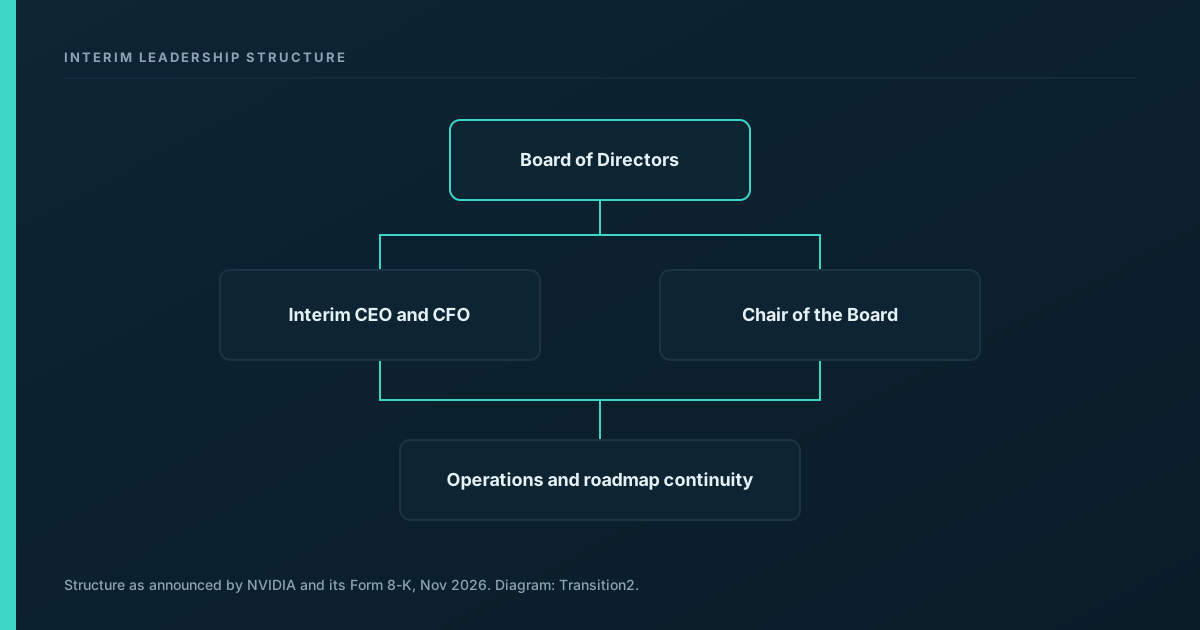
NVIDIA's board announced on November 12, 2026 that Jensen Huang had resigned as President, Chief Executive Officer and a member of the board, effective immediately, according to the company's announcement. Executive Vice President and Chief Financial Officer Colette M. Kress is interim CEO while the board searches for a permanent successor, and longtime director Harvey C. Jones is now Chair of the Board, according to the company's Form 8-K. For organizations whose AI programs run on NVIDIA hardware, the key line is the board's stated expectation for "the company's operations, customer commitments and product roadmap to continue without interruption" (NVIDIA Newsroom).
What happened
The primary record is two company documents published on November 12. The NVIDIA Newsroom release says Huang resigned as President, CEO and director, effective immediately. It credits him with building the company over 33 years and gives no reason for the resignation.
The Form 8-K, with a report date of November 11 and signed November 12, sets out the board's actions in more detail. According to the filing, the board accepted the resignation on November 11 and, following the resignation, appointed Kress, 59, as interim CEO while it searches; it also appointed Jones, 73, as Chair of the Board on November 11. Readers comparing the documents will see two dates: the board acted on November 11, and the company announced the change on November 12.
Both documents describe how the interim structure works. Kress continues as Executive Vice President and CFO while serving as interim CEO, and she joined NVIDIA in September 2013 (NVIDIA Newsroom; Form 8-K). The board says it will consider internal and external candidates for the permanent role (NVIDIA Newsroom). Jones has served on NVIDIA's board since 1993, according to the filing. He is the company's first-ever Chair of the Board and previously served as CEO and Executive Chairman of Synopsys (NVIDIA Newsroom).
The release also covers the near-term calendar. NVIDIA says it will report results for the third quarter of fiscal 2027 on Tuesday, November 17, at about 1:20 p.m. Pacific time, as previously scheduled, with a conference call at 2 p.m. Pacific time (NVIDIA Newsroom).
Inside the company, CNBC reported on emails sent to staff, in which Kress said a company meeting is set for November 18 at 9 a.m. Pacific time.
Why it matters
The record is narrow, and that narrowness is useful. The two company documents establish who now holds which role, when the board acted, and what the company expects for its operations and roadmap (NVIDIA Newsroom; Form 8-K). They do not explain the resignation. For buyers of AI infrastructure, the parts that bear on planning are the continuity statement and the unchanged reporting date, both on the company's own record (NVIDIA Newsroom).
The governance structure has changed in two visible ways. First, NVIDIA has a Chair of the Board for the first time, and the role is held by a long-serving director rather than the chief executive (NVIDIA Newsroom). Second, the interim chief executive also remains chief financial officer, so one person holds both senior roles during the search (NVIDIA Newsroom). On succession, the board has said only that it will weigh internal and external candidates.
For an AI program that depends on a single accelerator vendor, a sudden change at the top is a natural point to check continuity. The vendor's board has said that customer commitments and the product roadmap should continue without interruption (NVIDIA Newsroom). That gives buyers a dated reference point they can record, cite in a risk review and compare against later communications. The Enterprise Governance hub covers how to structure that kind of vendor review.
The next two dates on the record are the November 17 results release and call (NVIDIA Newsroom), and the November 18 company meeting reported by CNBC.
The Transition2 desk did not run an experiment for this story, because it is about corporate governance rather than a model, tool or system that can be tested.
What it means for businesses
Treat the leadership change as a continuity checkpoint, not a reason to change course. The company says operations, customer commitments and the product roadmap continue without interruption (NVIDIA Newsroom), and that statement is the right anchor for internal discussion. A short review can cover three areas.
Roadmap commitments. List every delivery date, hardware generation and software dependency that your AI plans assume from NVIDIA. Note which ones rest on written commitments and which rest only on public roadmap statements. Flag the second group for confirmation through your normal account channel.
Support channels. Confirm that escalation contacts, support agreements and partner relationships are documented and current. Nothing in the release or the filing announces changes to customer arrangements (NVIDIA Newsroom; Form 8-K). The review takes little effort and leaves a dated record.
Second-source plans. If a program has no tested fallback for critical workloads, record that as a known concentration risk, along with what a fallback would require. This is ordinary portfolio hygiene. The Portfolio Execution hub covers how to keep risks like this visible across a set of AI initiatives.
Governance teams should also record the company's new board structure in their vendor risk files: a separate Chair, and an interim CEO who remains CFO (Form 8-K).
What it means for AI users
For people who use AI tools day to day, neither company document announces any change to products or services (NVIDIA Newsroom; Form 8-K). The board expects operations to continue without interruption (NVIDIA Newsroom). If an AI service you rely on runs on NVIDIA hardware, check that service provider's own status pages and announcements for service information.
Coverage of this story will keep moving. The company's release and its regulatory filing are the primary record, and claims that go beyond them should be weighed against those two documents.
What it means for developers
Neither the release nor the filing announces changes to developer software, drivers or programs (NVIDIA Newsroom; Form 8-K), and the board expects the product roadmap to continue without interruption. For engineering teams, the practical response is the same routine discipline that holds up under any vendor event:
- Pin toolchain, driver and library versions in build manifests, so upgrades happen on your schedule.
- Keep an inventory of which parts of your stack depend on vendor-specific libraries and which run on portable layers.
- Where feasible, keep a small tested path on a second backend for critical inference workloads, and run it in continuous integration so it stays current.
- Get roadmap information from official release notes and the company's scheduled communications, not from social media. The November 17 call is the next public event on the company's calendar (NVIDIA Newsroom).
None of this assumes anything will change. It turns a news event into a dated review, grounded in the company's own continuity statement.
Copyright Eric MacDougall.
Sources
- NVIDIA Announces CEO Transition (accessed 2026-11-13)
- NVIDIA Corporation Form 8-K (accessed 2026-11-13)
- CNBC report on NVIDIA employee emails from Kress and Jones (accessed 2026-11-13)