News · Enterprise AI Governance
Italy's Garante fines Meta 805M euros over Facebook gallery access
Italy's data protection authority fined Meta over the Facebook Android app accessing photo galleries without specific consent, in a proceeding that did not examine AI training.
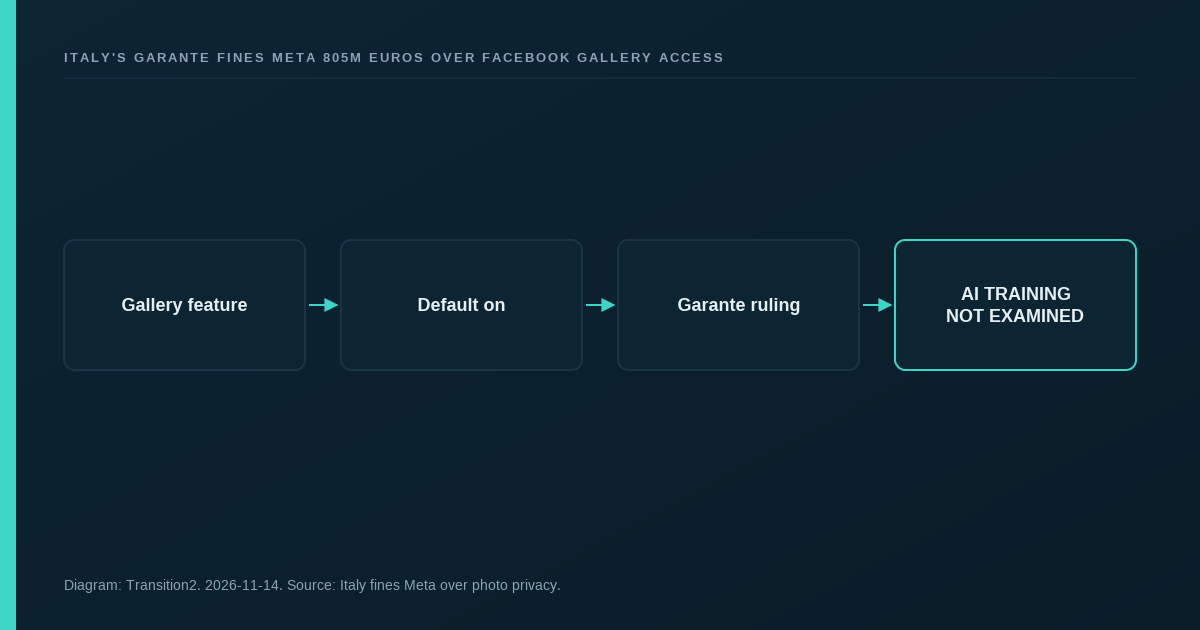
Italy's data protection authority, the Garante, fined Meta 805 million euros on November 14, 2026 over a Facebook Android feature that accessed users' photo galleries without specific consent (Al Jazeera; The Hacker News). The decision did not examine whether gallery content was used to train AI. The Hacker News reports that Meta plans to appeal and calls the fine "disproportionate".
What happened
In its decision, the Garante fined Meta 805 million euros over the Facebook Android app's gallery-suggestions feature, available since 2023, which it says accessed photos, videos and metadata without specific consent or adequate information and was enabled by default (Al Jazeera; The Hacker News). About 20 million Android users in Italy were potentially affected (Al Jazeera; The Hacker News). The legal basis is Article 122 of the Italian Privacy Code, which implements the EU ePrivacy Directive, and the fine is about 0.47% of the group's worldwide turnover (The Hacker News).
The remedies are time-bound. Within 60 days, Meta must present a separate and specific consent request and turn the feature off by default, even for users who already granted the operating-system permission; a report on initiatives is due within 30 days and a report on adopted measures within 90 days; and if the deadline is missed, the feature cannot be enabled without valid consent (The Hacker News). Aggravating factors included a 2019 prior decision against the company and limited cooperation (Al Jazeera).
Crucially for anyone reading this through an AI lens, the proceeding did not examine whether gallery content was used to train AI (Al Jazeera).
According to The Hacker News, the only outlet here reporting Meta's response, Meta plans to appeal, calls the fine "disproportionate", and says the feature works only after a user grants device permission (The Hacker News). Al Jazeera reported that Meta had not commented at the time of its publication (Al Jazeera).
Dollar conversions differ across outlets, so this piece keeps the figure in euros: 805 million euros, as The Hacker News reports it (The Hacker News). Al Jazeera's headline and URL cite one dollar figure while its body cites another (Al Jazeera), and the feature's on-screen label is rendered differently across outlets.
Why it matters
The decision draws a line that matters for AI governance precisely by what it leaves out. The Garante penalized the data access itself, under ePrivacy, and did not examine whether those photos fed model training. In the desk's reading, that separation tells enterprises that device-level consent and training consent are being treated as distinct obligations, and that a clean record on one does not settle the other. For teams tracking Enterprise Governance, the default-on design and the demand for a separate, specific consent are the operational signals to absorb.
The desk ran no experiment here: this is a regulatory decision with no public code or reproducible artifact, and verifying the app's behavior would require an Android device, the app and a user account.
What it means for businesses
The remedy pattern is the lesson. A default-on feature that relies on an operating-system permission was found insufficient, and the regulator is requiring a separate, specific consent and an off-by-default state even for users who already granted the device permission. Businesses that collect media or sensor data through mobile apps should audit whether they are leaning on platform permissions as a stand-in for informed consent. The 60-day remedy deadline and the 30- and 90-day reporting deadlines also show regulators attaching concrete timelines and escalation to these decisions.
What it means for AI users
The headline relief for users is narrow but real: the regulator targeted access to gallery content without specific consent, and did not examine the AI-training question (Al Jazeera). Users should not read the fine as a ruling on whether their photos trained a model, because the Garante says it did not examine that. The required change, a feature that is off by default with its own consent prompt, is the practical outcome to watch for in the app.
What it means for developers
Design consent as a distinct, purpose-specific step rather than inferring it from a granted operating-system permission. The decision faults a default-on feature and an inadequate information flow, so developers building media-access features should surface clear, specific prompts and default to off.
Copyright Eric MacDougall.
Sources
- Italy fines Meta over photo privacy (accessed 2026-11-15)
- Italy Fines Meta 805 Million Over Facebook's Android Gallery Access Without Explicit Consent (accessed 2026-11-15)