News · Enterprise Knowledge Assistants · Contract Review Workflows · AI Reliability & Operations
Office file ingestion can mislead assistants and coding agents
An arXiv paper reports that text extractors can show a model a different Office document than a person sees, and proposes a defense called Prism.
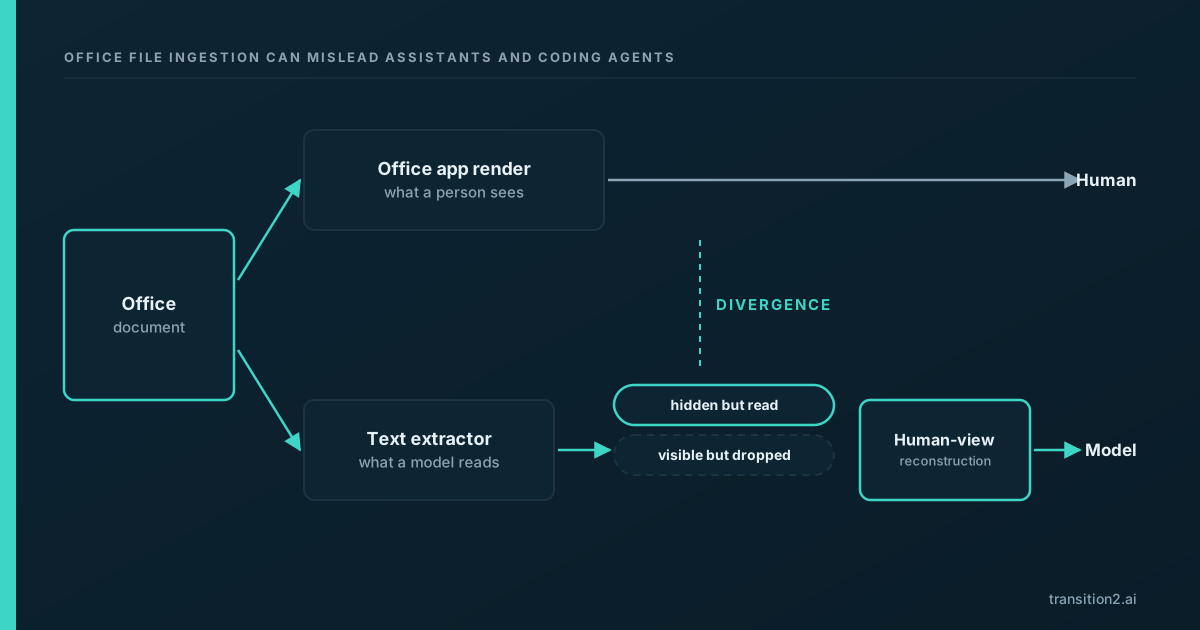
When an Office document is uploaded to a language model, the model usually reads text produced by an extractor, not the page a person sees, and the two can differ in ways an adversary can use. That is the central finding of a paper by Penghui Li first posted to arXiv on November 4, 2026. The paper reports that every assistant and coding agent they tested was misled by at least one of their attacks, and proposes a defense, Prism, that rebuilds the human view before the text reaches the model. The work is a preprint; its results have not been independently replicated.
What the paper reports
Office documents are built on Office Open XML (OOXML) files, a set of structured parts that an Office application assembles into what appears on screen. According to the abstract, extractors used by LLM applications differ in which of those parts they read and how they interpret them, so their output can differ from what Office displays. The abstract gives a simple example: by slightly shifting the positions of text boxes on a slide, an adversary can swap the order in which the model reads them while the slide looks unchanged.
Li combined static analysis of extractor source code with dynamic analysis of how the extractors behave. The paper reports 19 OOXML channels where widely used extractors read content a person cannot see, and 12 where extractors drop content a person can see. It also reports that these extractors ignore display formatting and reading order, so even visible content can reach the model in a different form or sequence.
From those findings Li built five attacks that lead a model to interpret a document differently from a human reviewer, without injecting any instruction into the file. These are not prompt injection: they change what the model is shown, not what it is told to do.
The attacks were tested on four chat assistants (ChatGPT, Claude, Gemini and Microsoft 365 Copilot) and four coding agents (Codex, Claude Code, Antigravity and GitHub Copilot CLI). Each of the eight was misled by at least one attack, according to the paper.
The proposed defense, Prism, reconstructs the human view of the document from the OOXML specification before passing text to the model. The paper describes it as lightweight and reports that it generalizes to attack payloads it was not built around.
The abstract does not say which attacks affected which products, whether any vendor has changed its pipeline since testing, or how Prism performs in numeric terms.
Why it matters
Document agents inherit whatever the ingestion step kept, dropped or reordered. A model can be faithful to the text it was given and still be wrong about the document a reviewer holds, and because the answer quotes text that really was in its input, the error is hard to see.
The paper turns that worry into a measured attack surface with counted channels, across both chat products and coding agents. For contract review, a clause the model never saw cannot be flagged. For an enterprise knowledge assistant, a passage the extractor dropped cannot be retrieved, and hidden content it did read can shape an answer nobody can trace on the visible page.
What it means for businesses
Treat ingestion fidelity as an acceptance gate before enabling a document agent on contracts or other high-consequence files. Pick a representative set of documents, have a person confirm what each says, and compare that with what the pipeline hands the model. Ask vendors and internal teams which extractor their pipeline uses, whether it accounts for hidden content and reading order, and how a reviewer can see the model's view. Keep the final decision with a person.
What it means for AI users
A document that looks clean on screen is not proof that the assistant read the same thing. For anything that matters, ask the assistant to quote the passage it relied on and check that quote against the copy you opened. If the quote is missing from your copy, treat the answer as unverified. Converting to another format before upload may help in some cases, but the abstract does not report testing that, so confirm it rather than assume it.
What it means for developers
Treat model-visible text as a build artifact. Keep a fixture set of Office files with a reviewed canonical text, diff extractor output against it in CI, and fail the build when a parser upgrade changes what the model sees. Log the extractor and version behind each model input. Rebuilding the human view from the specification, as Prism does, is a direction worth evaluating; the AI Reliability & Operations hub covers wiring such checks into a release gate.